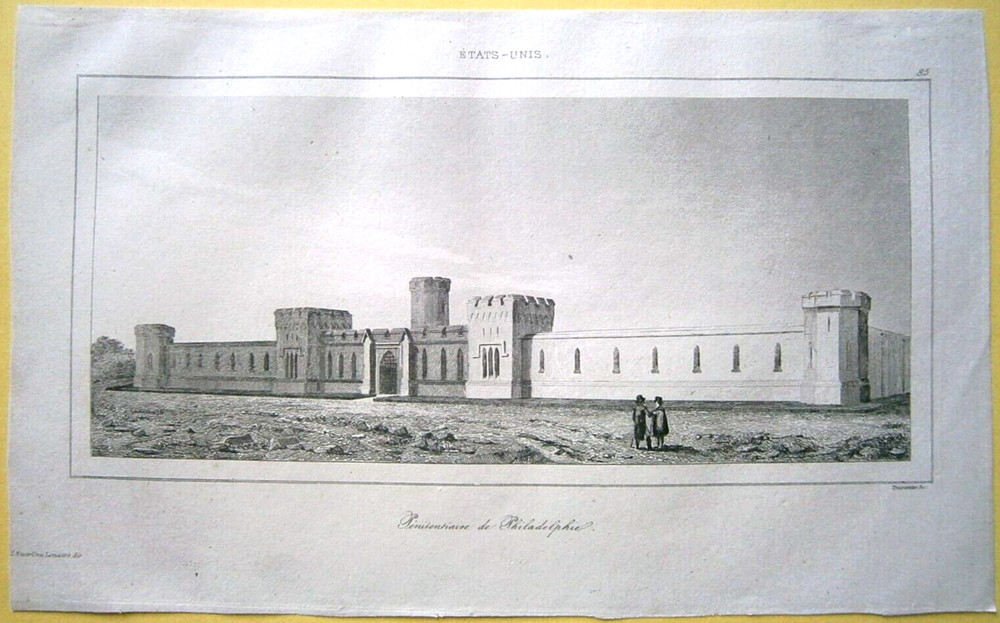
1837 print EASTERN STATE PENITENTIARY, CHERRY HILL, PHILADELPHIA, #85
$ 10.54
Description
1837 print EASTERN STATE PENITENTIARY, CHERRY HILL, PHILADELPHIA, #85. Etats-Unis d'Amérique. Paris: Firmin Didot Freres, [1837], approx. page size 21 x 13 cm, approx. Solitary penitence, however, was soon modified to include the performance of work such as shoemaking or weaving. Roux85 1837 print EASTERN STATE PENITENTIARY, CHERRY HILL, PHILADELPHIA, #85 Print from steel engraving titled Penitentiaire de Philadephie, from 1st edition of Jean B.G. Roux de Rochelle's Etats-Unis d'Amérique. Paris: Firmin Didot Freres, [1837], approx. page size 21 x 13 cm, approx. image size 14 x 9 cm, drawn by Fleury, engraved by Traversier. View represents the Eastern State Penitentiary built in 1829 on Cherry Hill in Philadelphia, where so-called Pennsylvania penal system was applied. From a set of illustrations for Roux de Rochelle's work on the United States. Roux de Rochelle, the French Minister to the U.S., included this volume in a large series entitled L'Univers. The American volume included 96 images of the United States and it was first issued in 1837. Beginning in 1839 the plates were reissued in several French editions, as well as editions in Italian, Spanish and German. Pennsylvania system, penal method based on the principle that solitary confinement fosters penitence and encourages reformation. The idea was advocated by the Philadelphia Society for Alleviating the Miseries of Public Prisons, whose most active members were Quakers. In 1829 the Eastern State Penitentiary, on Cherry Hill in Philadelphia, applied this so-called separate philosophy. Prisoners were kept in solitary confinement in cells 16 feet high, nearly 12 feet long, and 7.5 feet wide (4.9 by 3.7 by 2.3 m). An exercise yard, completely enclosed to prevent contact among prisoners, was attached to each cell. Prisoners saw no one except institution officers and an occasional visitor. Solitary penitence, however, was soon modified to include the performance of work such as shoemaking or weaving. The Pennsylvania system spread until it predominated in European prisons. Critics in the United States argued that it was too costly and had deleterious effects on the minds of the prisoners. The Pennsylvania system was superseded in the United States by the Auburn system.