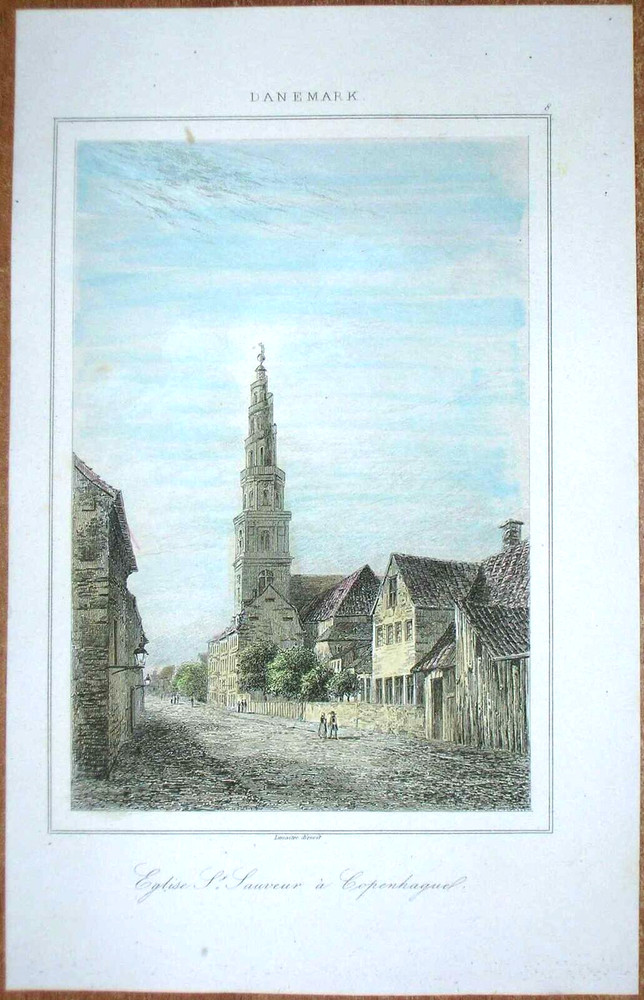
1846 print CHURCH OF OUR SAVIOUR, COPENHAGEN, DENMARK, #8
$ 11.62
Description
1846 print CHURCH OF OUR SAVIOUR, COPENHAGEN, DENMARK, #8. The church is built in a Dutch baroque style and its basic layout is a Greek cross. The walls rest on a granite foundation and are made of red and yellow tiles but in a random pattern unlike what is seen in Christian IV's buildings where they are generally systematically arranged. Danemark08 1846 print CHURCH OF OUR SAVIOUR, COPENHAGEN, DENMARK, #8 Print from steel engraving titled Eglise St. Sauveur a Copenhague, published in a volume of L'Univers, Paris, approx. page size 22 x 13 cm, approx. image size 13.5 x 9 cm. Church of Our Saviour, Copenhagen The Church of Our Saviour (Danish: Vor Frelsers Kirke) is a baroque church in Copenhagen, Denmark, most famous for its corkscrew spire with an external winding staircase that can be climbed to the top, offering extensive views over central Copenhagen. It is also noted for its carillon, which is the largest in northern Europe and plays melodies every hour from 8 am to midnight. History When Christian IV planned Christianshavn in 1617, it was intended as an independent merchant's town on the island of Amager and it therefore needed a church. A temporary church was inaugurated in 1639 but construction of the present Church of Our Saviour, the design of Lambert van Haven, did not start until 1682. The church was inaugurated 14 years later in 1695 but important interior features like the altar had a notoriously temporary character and the tower still had no spire. The church got its permanent altar in 1732 but plans for construction of the spire was not revitalized until 1747 under the reign of Frederik V. The new architect on the project was Lauritz de Thurah. He soon abandoned van Haven´'s original design in favour of his own project that was approved by the King in 1749. Three years later the spire was finished and the King climbed the tower at a ceremony on 28 August 1752. Urban legend There is a long-lived urban legend stating that the architect killed himself by jumping from the top of the spire, when he realised that the spiral turns the wrong way - anticlockwise - around. This is not about Lambert van Haven, since the spire was added to the church almost 50 years after his death, but the designer of the spiral spire, Laurids de Thurah. There is not a grain of truth in the myth though, since Thurah died in his bed seven years after the spire was completed, and there is nothing in the records that indicates that he should have been unhappy with his work in any way. Architecture The church is built in a Dutch baroque style and its basic layout is a Greek cross. The walls rest on a granite foundation and are made of red and yellow tiles but in a random pattern unlike what is seen in Christian IV's buildings where they are generally systematically arranged. The facade is segmented by pilasters in the palladian giant order, that is they continue in the building's entire height. The pilasters are of the Tuscan order with bases and capitals in sandstone. The cornice is also in sandstone but with a frieze in tiles. Between the pilasters are tall round-arched windows with clear glass and iron cames. There are entrances at the gable of the cross arms except for the eastern gable where the sacristy is added. The main entrance is in the western gable below the tower and has a sandstone portal. All entrances are raised four steps from street level. At each side of the tower, there is a gate at street level leading to the two crypts of the church. The roof is vaulted and covered in black-glazed tiles.