
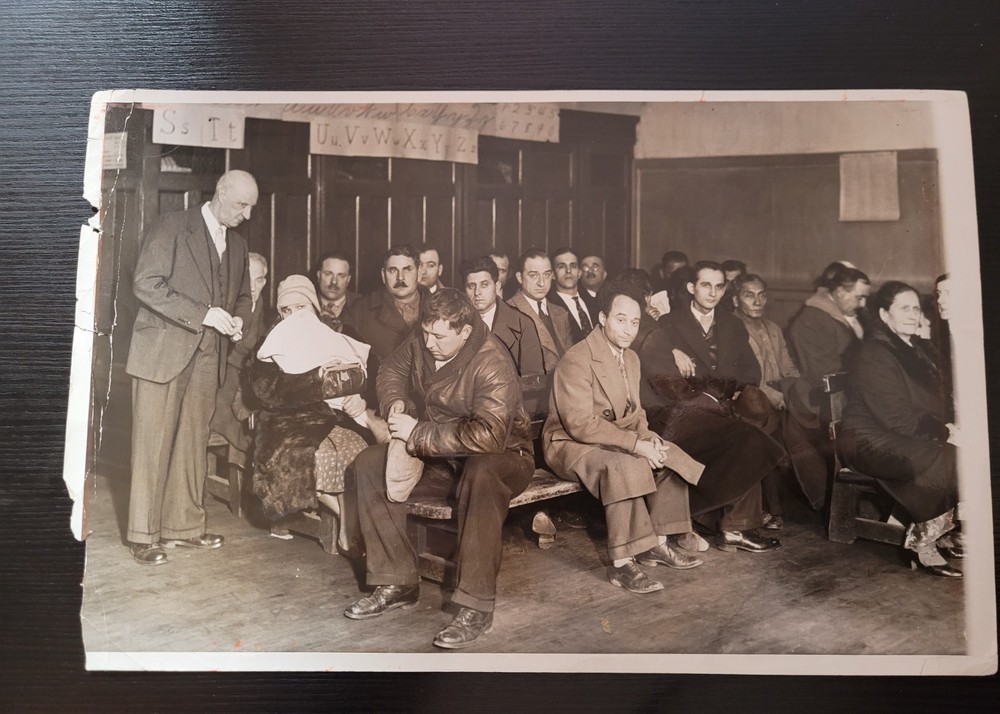
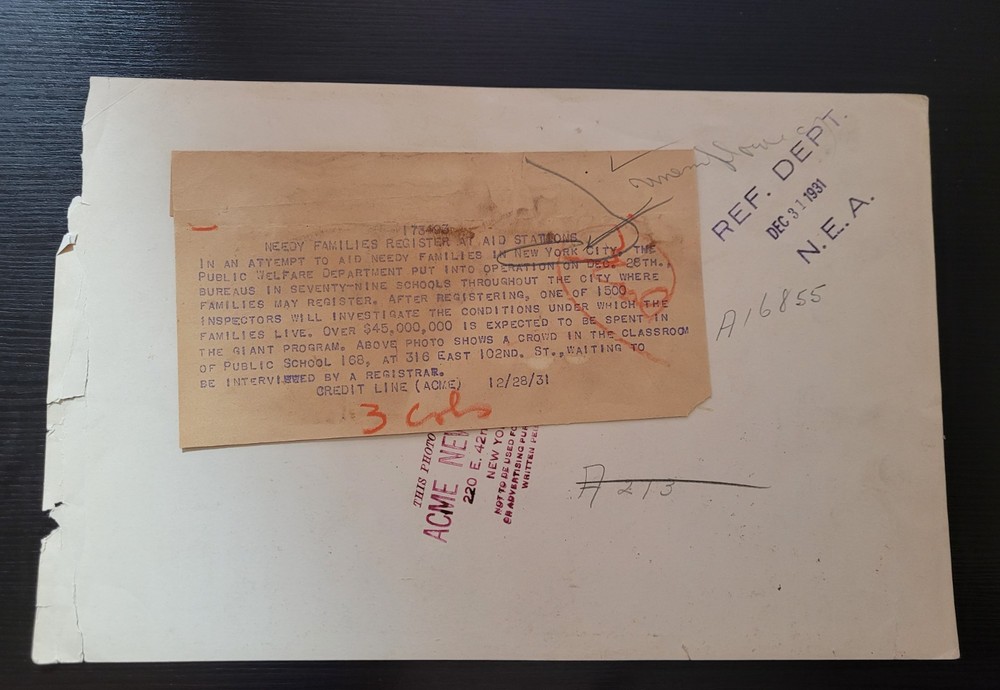
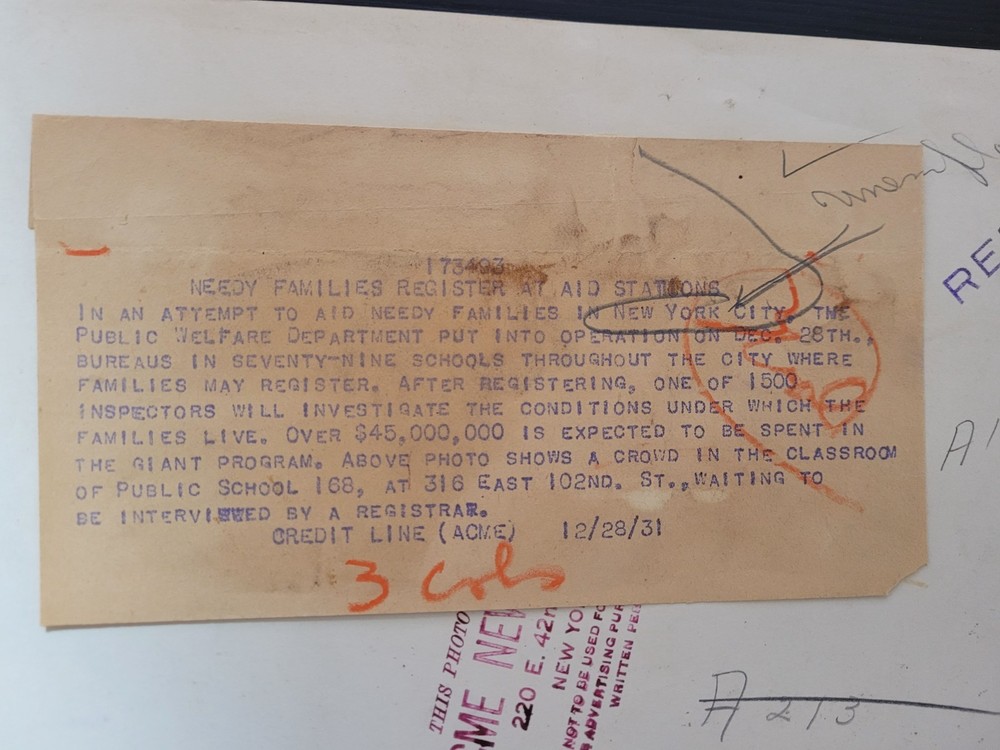
1931 NYC Great Depression Photo Needy Families Register Relief Public School 168
$ 105.08
Description
Authentic 1931 Press Photo: Relief Registration During the Great Depression This original 7x11-inch silver gelatin press photo captures a somber and historic moment in New York City history. Taken on December 28, 1931, it depicts "needy families" gathered in a classroom at Public School 168 in East Harlem, waiting to register for emergency aid through the Public Welfare Department. The image is a poignant look at the human face of the Great Depression, showing men and women in their winter coats, seated on school benches, awaiting interviews that would determine their eligibility for a share of a $45,000,000 relief fund. Full Transcription of Text Front of Photo: Visuals: Classroom setting with alphabet charts (S, T, U, V, W, X, Y, Z) and numerical charts visible on the back wall. Back of Photo (Attached Caption & Stamps): Typed Caption: "NEEDY FAMILIES REGISTER AT AID STATIONS. In an attempt to aid needy families in New York City, the Public Welfare Department put into operation on Dec. 28th, bureaus in seventy-nine schools throughout the city where families may register. After registering, one of 1500 inspectors will investigate the conditions under which the families live. Over $45,000,000 is expected to be spent in the giant program. Above photo shows a crowd in the classroom of Public School 168, at 316 East 102nd St., waiting to be interviewed by a registrar." Credit Line: ACME NEWSPICTURES Date: 12/28/31 Stamps: "REF. DEPT. DEC 31 1931 N.E.A." (Newspaper Enterprise Association) Handwritten Notes: "Unemployed", "3 cols" (referring to a 3-column newspaper layout), "A16855", "#213". Address Stamp: ACME NEWSPICTURES, 220 E. 42nd St., New York City. Historical Context & Significance The Location: Public School 168 was located at 316 East 102nd Street. This area of East Harlem was one of the hardest-hit neighborhoods during the 1930s. The Program: By late 1931, the economic collapse had reached a breaking point. This specific program was part of New York City’s desperate attempt to provide a "Home Relief" safety net before federal New Deal programs (like the WPA) were fully established. The "Inspectors": The mention of 1,500 inspectors highlights the strict "means-testing" of the era, where social workers would visit homes to ensure families were truly destitute before granting aid. The Agency: Acme Newspictures was one of the premier photo agencies of the 20th century, later merging to become part of UPI (United Press International). Condition Notes & Keywords Condition: Good vintage condition. Minor edge wear and creasing consistent with age and newsroom use. Includes original paper caption (slug) attached to the reverse. Keywords: Social Realism, Bread Lines, Poverty, American History, 1930s, Photojournalism, Ephemera, New York City History, Genealogy, East Harlem, Public Schools, Humanitarian Aid. _________________ Harlem is a neighborhood in Upper Manhattan, New York City. It is bounded roughly by the Hudson River on the west; the Harlem River and 155th Street on the north; Fifth Avenue on the east; and 110th Street on the south. The greater Harlem area encompasses several other neighborhoods and extends west and north to 155th Street, east to the East River, and south to Martin Luther King Jr. Boulevard, Central Park, and East 96th Street. Originally a Dutch village, formally organized in 1658,[5] it is named after the city of Haarlem in the Netherlands. Harlem's history has been defined by a series of economic boom-and-bust cycles, with significant population shifts accompanying each cycle.[6] Harlem was predominantly occupied by Jewish and Italian Americans in the late 19th century, while African-American residents began to arrive in large numbers during the Great Migration in the early 20th century. In the 1920s and 1930s, Central and West Harlem were the center of the Harlem Renaissance, a major African-American cultural movement. With job losses during the Great Depression of the 1930s and the deindustrialization of New York City after World War II, rates of crime and poverty increased significantly.[7] In the 21st century, crime rates decreased significantly, and Harlem started to gentrify. The area is served by the New York City Subway and local bus routes. It contains several public elementary, middle, and high schools, and is close to several colleges, including Columbia University, Manhattan School of Music, and the City College of New York. Central Harlem is part of Manhattan Community District 10.[1] It is patrolled by the 28th and 32nd Precincts of the New York City Police Department. The greater Harlem area also includes Manhattan Community Districts 9 and 11 and several police precincts, while fire services are provided by four New York City Fire Department companies. Geography A map of Upper Manhattan, with Greater Harlem highlighted. Harlem proper is the neighborhood in the center. Harlem is located in Upper Manhattan. The three neighborhoods comprising the greater Harlem area—West, Central, and East Harlem—stretch from the Harlem River and East River to the east, to the Hudson River to the west; and between 155th Street in the north, where it meets Washington Heights, and an uneven boundary along the south that runs along 96th Street east of Fifth Avenue, 110th Street between Fifth Avenue to Morningside Park, and 125th Street west of Morningside Park to the Hudson River.[8][9][10] Encyclopædia Britannica references these boundaries,[11] though the Encyclopedia of New York City takes a much more conservative view of Harlem's boundaries, regarding only central Harlem as part of Harlem proper.[12]: 573 Central Harlem is the name of Harlem proper; it falls under Manhattan Community District 10.[8] This section is bounded by Central Park North 110th street on the south; 155th street on the north; Fifth avenue on the east; and Morningside Park, St. Nicholas Avenue, and Edgecombe Avenue on the west.[8] A chain of large linear parks includes Morningside Park, St. Nicholas Park, Jackie Robinson Park, Rucker Park, and Marcus Garvey Park (also known as Mount Morris Park) which separates this area from East Harlem to the east.[8] Central Harlem includes the Mount Morris Park Historic District. West Harlem (Manhattanville, Hamilton Heights, and Sugar Hill) comprises Manhattan Community district 9. The three neighborhoods' area is bounded by Cathedral Parkway/110th Street on the south; 155th Street on the north; Manhattan/Morningside Ave/St. Nicholas/Bradhurst/Edgecombe Avenues on the east; and Riverside Park/the Hudson River on the west. Manhattanville begins at roughly 123rd Street and extends northward to 135th Street. The northernmost section of West Harlem is Hamilton Heights.[9] A chain of large linear parks includes West Harlem Piers, Riverbank State Park, St. Nicholas Park, and Jackie Robinson Park. East Harlem, also called Spanish Harlem or El Barrio, is located within Manhattan Community District 11, which is bounded by East 96th Street on the south, East 138th Street on the north, Fifth Avenue on the west, and the Harlem River on the east.[10] A chain of parks includes Thomas Jefferson Park and Marcus Garvey Park. SoHa controversy In the 2010s some real estate professionals started rebranding south Harlem as "SoHa" (a name standing for "South Harlem" in the style of SoHo or NoHo) in an attempt to accelerate gentrification of the neighborhoods. "SoHa", applied to the area between West 110th and 125th Streets, has become a controversial name.[13][14][15] Residents and other critics seeking to prevent this renaming of the area have labelled the SoHa brand as "insulting and another sign of gentrification run amok"[16] and have said that "the rebranding not only places their neighborhood's rich history under erasure but also appears to be intent on attracting new tenants, including students from nearby Columbia University".[17] Multiple New York City politicians have initiated legislative efforts to curtail this practice of neighborhood rebranding, which when successfully introduced in other New York City neighborhoods, have led to increases in rents and real estate values, as well as "shifting demographics".[17] In 2011, U.S. Representative Hakeem Jeffries attempted but failed to implement legislation "that would punish real estate agents for inventing false neighborhoods and redrawing neighborhood boundaries without city approval."[17] By 2017, New York State Senator Brian Benjamin also worked to render the practice of rebranding historically recognized neighborhoods illegal.[17] Political representation Politically, central Harlem is in New York's 13th congressional district.[18][19] It is in the New York State Senate's 30th district,[20][21] the New York State Assembly's 68th and 70th districts,[22][23] and the New York City Council's 7th, 8th, and 9th districts.[24] History Harlem, from the old fort in the Central Park, New York Public Library Three Harlem Women, ca. 1930 Main article: History of Harlem Before the arrival of European settlers, the area that would become Harlem (originally Haarlem) was inhabited by a Native American band, the Wecquaesgeek, dubbed Manhattans or Manhattoe by Dutch settlers, who along with other Native Americans, most likely Lenape,[25] occupied the area on a semi-nomadic basis. As many as several hundred farmed the Harlem flatlands.[26] Between 1637 and 1639, a few colonial settlements were established.[27][28] The settlement of Harlem was formally incorporated in 1660[2] under the leadership of Peter Stuyvesant.[29] During the American Revolution, the British burned Harlem to the ground.[30] It took a long time to rebuild, as Harlem grew more slowly than the rest of Manhattan during the late 18th century.[31] After the American Civil War, Harlem experienced an economic boom starting in 1868. The neighborhood continued to serve as a refuge for New Yorkers, but increasingly those coming north were poor and Jewish or Italian.[32] The New York and Harlem Railroad,[33] as well as the Interborough Rapid Transit and elevated railway lines,[34] helped Harlem's economic growth, as they connected Harlem to lower and midtown Manhattan. Apartment building in Central Harlem A condemned building in Harlem after the 1970s The Jewish and Italian demographic decreased, while the black and Puerto Rican population increased in this time.[35] The early-20th century Great Migration of black people to northern industrial cities was fueled by their desire to leave behind the Jim Crow South, seek better jobs and education for their children, and escape a culture of lynching violence; during World War I, expanding industries recruited black laborers to fill new jobs, thinly staffed after the draft began to take young men.[36] In 1910, Central Harlem population was about 10% black people. By 1930, it had reached 70%.[37] Starting around the time of the end of World War I, Harlem became associated with the New Negro movement, and then the artistic outpouring known as the Harlem Renaissance, which extended to poetry, novels, theater, and the visual arts. So many black people came that it "threaten[ed] the very existence of some of the leading industries of Georgia, Florida, Tennessee and Alabama."[38] Many settled in Harlem. By 1920, central Harlem was 32.43% black. The 1930 census revealed that 70.18% of central Harlem's residents were black and lived as far south as Central Park, at 110th Street.[39] However, by the 1930s, the neighborhood was hit hard by job losses in the Great Depression. In the early 1930s, 25% of Harlemites were out of work, and employment prospects for Harlemites stayed poor for decades. Employment among black New Yorkers fell as some traditionally black businesses, including domestic service and some types of manual labor, were taken over by other ethnic groups. Major industries left New York City altogether, especially after 1950. Several riots happened in this period, including in 1935 and 1943. There were major changes following World War II. In the late 1950s and early 1960s, Harlem was the scene of a series of rent strikes by neighborhood tenants, led by local activist Jesse Gray, together with the Congress of Racial Equality, Harlem Youth Opportunities Unlimited (HARYOU), and other groups. These groups wanted the city to force landlords to improve the quality of housing by bringing them up to code, to take action against rats and roaches, to provide heat during the winter, and to keep prices in line with existing rent control regulations.[40] The largest public works projects in Harlem in these years were public housing, with the largest concentration built in East Harlem.[41] Typically, existing structures were torn down and replaced with city-designed and managed properties that would, in theory, present a safer and more pleasant environment than those available from private landlords. Ultimately, community objections halted the construction of new projects.[42] From the mid-20th century, the low quality of education in Harlem has been a source of distress. In the 1960s, about 75% of Harlem students tested under grade levels in reading skills, and 80% tested under grade level in math.[43] In 1964, residents of Harlem staged two school boycotts to call attention to the problem. In central Harlem, 92% of students stayed home.[44] In the post-World War II era, Harlem ceased to be home to a majority of the city's black people,[45] but it remained the cultural and political capital of black New York, and possibly black America.[46][47] By the 1970s, many of those Harlemites who were able to escape from poverty left the neighborhood in search of better schools and homes, and safer streets. Those who remained were the poorest and least skilled, with the fewest opportunities for success. Though the federal government's Model Cities Program spent $100 million on job training, health care, education, public safety, sanitation, housing, and other projects over a ten-year period, Harlem showed no improvement.[48] The city began auctioning its enormous portfolio of Harlem properties to the public in 1985. This was intended to improve the community by placing property in the hands of people who would live in them and maintain them. In many cases, the city would even pay to completely renovate a property before selling it (by lottery) below market value.[49] After the 1990s, Harlem began to grow again. Between 1990 and 2006 the neighborhood's population grew by 16.9%, with the percentage of black people decreasing from 87.6% to 69.3%,[39] then dropping to 54.4% by 2010,[50] and the percentage of whites increasing from 1.5% to 6.6% by 2006,[39] and to "almost 10%" by 2010.[50] A renovation of 125th Street and new properties along the thoroughfare[51][52] also helped to revitalize Harlem.[53] Culture See also: Harlem Renaissance A 1933 map of nightclubs in Harlem, showing Savoy Ballroom, Cotton Club, Smalls Paradise and others.[54] In the 1920s and 1930s, Central and West Harlem was the focus of the "Harlem Renaissance", an outpouring of artistic work without precedent in the American Black community. Though Harlem musicians and writers are particularly well remembered, the community has also hosted numerous actors and theater companies, including the New Heritage Repertory Theater,[29] National Black Theater, Lafayette Players, Harlem Suitcase Theater, The Negro Playwrights, American Negro Theater, and the Rose McClendon Players.[55] The Apollo Theater on 125th Street in November 2006 The Apollo Theater opened on 125th Street on January 26, 1934, in a former burlesque house. The Savoy Ballroom, on Lenox Avenue, was a renowned venue for swing dancing, and was immortalized in a popular song of the era, "Stompin' at the Savoy". In the 1920s and 1930s, between Lenox and Seventh Avenues in central Harlem, over 125 entertainment venues were in operation, including speakeasies, cellars, lounges, cafes, taverns, supper clubs, rib joints, theaters, dance halls, and bars and grills.[56] 133rd Street, known as "Swing Street", became known for its cabarets, speakeasies and jazz scene during the Prohibition era, and was dubbed "Jungle Alley" because of "inter-racial mingling" on the street.[57][58] Some jazz venues, including the Cotton Club, where Duke Ellington played, and Connie's Inn, were restricted to whites only. Others were integrated, including the Renaissance Ballroom and the Savoy Ballroom. In 1936, Orson Welles produced his black Macbeth at the Lafayette Theater in Harlem.[59] Grand theaters from the late 19th and early 20th centuries were torn down or converted to churches. Harlem lacked any permanent performance space until the creation of the Gatehouse Theater in an old Croton aqueduct building on 135th Street in 2006.[60] Spiritual African drummer on 135th Street between Adam Clayton Powell Jr. Boulevard and Frederick Douglass Boulevard From 1965 until 2007, the community was home to the Harlem Boys Choir, a touring choir and education program for young boys, most of whom are black.[61] The Girls Choir of Harlem was founded in 1989, and closed with the Boys Choir.[62] From 1967 to 1969, the Harlem Cultural Festival took place in Mount Morris Park. Another name for this festival is "Black Woodstock". Artists like Stevie Wonder, The 5th Dimension, and Gladys Knight performed here.[63][64] Harlem is also home to the largest African American Day Parade, which celebrates the culture of African diaspora in America. The parade was started up in the spring of 1969 with Congressman Adam Clayton Powell Jr. as the Grand Marshal of the first celebration.[65] Arthur Mitchell, a former dancer with the New York City Ballet, established Dance Theatre of Harlem as a school and company of classical ballet and theater training in the late 1960s. The company has toured nationally and internationally. Generations of theater artists have gotten a start at the school. By the 2010s, new dining hotspots were opening in Harlem around Frederick Douglass Boulevard.[66] At the same time, some residents fought back against the powerful waves of gentrification the neighborhood is experiencing. In 2013, residents staged a sidewalk sit-in to protest a five-days-a-week farmers market that would shut down Macombs Place at 150th Street.[67] Uptown Night Market was founded in 2021 to celebrate cuisine, community, and culture.[68] It is one of the largest night markets in Manhattan. The main attractions include musical performances, arts and crafts shows, and food.[69] Music Black Ivory in Harlem 2017 Many R&B/Soul groups and artists formed in Harlem. The Main Ingredient, Frankie Lymon & The Teenagers, Black Ivory, Cameo, Keith Sweat, Freddie Jackson, Alyson Williams, Johnny Kemp, Teddy Riley, Dave Wooley, and others got their start in Harlem. Manhattan's contributions to hip-hop stems largely from artists with Harlem roots such as Doug E. Fresh, Big L, Kurtis Blow, The Diplomats, ASAP Ferg, Mase or Immortal Technique. Harlem is also the birthplace of popular hip-hop dances such as the Harlem shake, toe wop, and Chicken Noodle Soup. Harlem's classical music birthed organizations and chamber ensembles such as Roberta Guaspari's Opus 118,[70] Harlem Chamber Players,[71] Omnipresent Music Festival BIPOC Musicians Festival,[72] Harlem Quartet, and musicians such as violinist Edward W. Hardy.[73] In the 1920s, African-American pianists who lived in Harlem invented their own style of jazz piano, called stride, which was heavily influenced by ragtime. This style played a very important role in early jazz piano[74][75] Language In 1938, jazz bandleader and singer Cab Calloway published the first dictionary by an African-American, Cab Calloway's Cat-ologue: A "Hepster's" Dictionary, which became the official jive language reference book of the New York Public Library.[76][77] In 1939, Calloway published an accompanying book titled Professor Cab Calloway's Swingformation Bureau, which instructed readers how to apply the words and phrases from the dictionary. He released several editions until 1944, the last being The New Cab Calloway's Hepsters Dictionary: Language of Jive.[78] Poet Lemn Sissay observed that "Cab Calloway was taking ownership of language for a people who, just a few generations before, had their own languages taken away."[79] Religious life St. Andrew's Episcopal Church Religious life has historically had a strong presence in Black Harlem. The area is home to over 400 churches,[80] some of which are official city or national landmarks.[81][82] Major Christian denominations include Baptists, Pentecostals, Methodists (generally African Methodist Episcopal Zionist, or "AMEZ" and African Methodist Episcopalian, or "AME"), Episcopalians, and Roman Catholic. The Abyssinian Baptist Church has long been influential because of its large congregation. The Church of Jesus Christ of Latter-day Saints built a chapel on 128th Street in 2005. Many of the area's churches are "storefront churches", which operate in an empty store, or a basement, or a converted brownstone townhouse. These congregations may have fewer than 30–50 members each, but there are hundreds of them.[83] Others are old, large, and designated landmarks. Especially in the years before World War II, Harlem produced popular Christian charismatic "cult" leaders, including George Wilson Becton and Father Divine.[84] Mosques in Harlem include the Masjid Malcolm Shabazz (formerly Mosque No. 7 Nation of Islam, and the location of the 1972 Harlem mosque incident), the Mosque of Islamic Brotherhood and Masjid Aqsa. Judaism, too, maintains a presence in Harlem through the Old Broadway Synagogue. A non-mainstream synagogue of Black Hebrews, known as Commandment Keepers, was based in a synagogue at 1 West 123rd Street until 2008. Landmarks Abyssinian Baptist Church, Harlem St Martin's Episcopal Church, at Lenox Avenue and 122nd Street Hotel Theresa building at the corner of Adam Clayton Powell Jr. Boulevard and 125th Street Adam Clayton Powell Jr. State Office Building, at the same intersection as the Hotel Theresa Officially designated landmarks Many places in Harlem are official city landmarks labeled by the New York City Landmarks Preservation Commission or are listed on the National Register of Historic Places: 12 West 129th Street, a New York City landmark[85] 17 East 128th Street, a New York City landmark[86] 369th Regiment Armory, a New York City landmark and NRHP-listed site[87][82] Abyssinian Baptist Church, a New York City landmark[88] Apollo Theater, a New York City landmark and NRHP-listed site[89][82] Astor Row, a set of New York City landmark houses[81]: 207 Blockhouse No. 1, Fort Clinton, and Nutter's Battery, part of Central Park, a New York City scenic landmark and NRHP-listed site[90][82] Central Harlem West–130–132nd Streets Historic District, a New York City landmark[91] Dunbar Apartments, a New York City landmark[92] Graham Court Apartments, a New York City landmark[93] Hamilton Grange, a New York City landmark and NRHP-listed site[94] Harlem River Houses, a New York City landmark[95] Harlem YMCA, a New York City landmark[96] Hotel Theresa, a New York City landmark[97] Jackie Robinson YMCA Youth Center, a New York City landmark[98] Langston Hughes House, a New York City landmark and NRHP-listed site[99][82] Macombs Dam Bridge and 155th Street Viaduct, a New York City landmark[100] Manhattan Avenue-West 120th-123rd Streets Historic District, a NRHP historic district[82] Metropolitan Baptist Church, a New York City landmark and NRHP-listed site[101][82] Minton's Playhouse, a NRHP-listed site[82] Morningside Park, a New York City scenic landmark[102] Mother African Methodist Episcopal Zion Church, a New York City landmark[103] Mount Morris Park Historic District, a New York City landmark district[104] Mount Olive Fire Baptized Holiness Church, a New York City landmark[105] New York Public Library 115th Street Branch, a New York City landmark and NRHP-listed site[106][82] Regent Theatre, a New York City landmark[107] Schomburg Collection for Research in Black Culture, a New York City landmark and NRHP-listed site[108][82] St. Aloysius Roman Catholic Church, a New York City landmark[109] St. Andrew's Church, a New York City landmark and NRHP-listed site[110][82] St. Philip's Protestant Episcopal Church, a New York City landmark[111] St. Martin's Episcopal Church (formerly Trinity Church), a New York City landmark[112] St. Nicholas Historic District, a New York City landmark district[113] St. Paul's German Evangelical Lutheran Church, a New York City landmark[114] Wadleigh High School for Girls, a New York City landmark[115] Washington Apartments, a New York City landmark[116] Other points of interest Other prominent points of interest include: Adam Clayton Powell Jr. State Office Building All Saints Church ATLAH World Missionary Church Bushman Steps, stairway that led baseball fans from the subway to The Polo Grounds ticket booth.[117] Cotton Club Duke Ellington Circle Frederick Douglass Circle Harbor Conservatory for the Performing Arts Harlem Children's Zone Harlem Hospital Center The Harlem School of the Arts Lenox Lounge Marcus Garvey Park Harlem Fire Watchtower, a New York City landmark and NRHP-listed site[118][82] Morningside Park National Black Theatre New York College of Podiatric Medicine Red Rooster Rucker Park Savoy Ballroom St. Nicholas Houses Studio Museum in Harlem Sylvia's Soul Food Touro College of Osteopathic Medicine New York Amsterdam News Demographics The demographics of Harlem's communities have changed throughout its history. In 1910, black residents formed 10% of Harlem's population, but by 1930, they had become a 70% majority.[7] The period between 1910 and 1930 was marked by the Great Migration of African Americans from the South to northern cities, including New York. Within the city, this era also witnessed an influx of black residents from downtown Manhattan neighborhoods, where black people were feeling less welcome, to the Harlem area.[7] The black population in Harlem peaked in 1950, with a 98% share of the population of 233,000. As of 2000, central Harlem's black residents comprised 77% of the total population of that area; however, the black population has recently declined as many African Americans move out and more immigrants move in.[119] As of 2021, central Harlem's Black residents numbered 56,668, comprising 44% of the total population.[120] In that regard, there are an estimated 27% (34,773) Hispanics, 18% (23,182) White, 4% (5,151) Asian, 6% (7,727) of two or more races and 2% (2,575) Other. Harlem suffers from unemployment rates generally more than twice the citywide average, as well as high poverty rates,[121] and the numbers for men have been consistently worse than the numbers for women. Private and governmental initiatives to ameliorate unemployment and poverty have not been successful. During the Great Depression, unemployment in Harlem went past 20% and people were being evicted from their homes.[122] At the same time, the federal government developed and instituted the redlining policy. This policy rated neighborhoods, such as Central Harlem, as unappealing based on the race, ethnicity, and national origins of the residents.[3] Central Harlem was deemed 'hazardous' and residents living in Central Harlem were refused home loans or other investments.[3] Comparably, wealthy and white residents in New York City neighborhoods were approved more often for housing loans and investment applications.[3] Overall, they were given preferential treatment by city and state institutions. In the 1960s, uneducated black people could find jobs more easily than educated ones could, confounding efforts to improve the lives of people who lived in the neighborhood through education.[3] Land owners took advantage of the neighborhood and offered apartments to the lower-class families for cheaper rent but in lower-class conditions.[123] By 1999 there were 179,000 housing units available in Harlem.[124] Housing activists in Harlem state that, even after residents were given vouchers for the Section 8 housing that was being placed, many were not able to live there and had to find homes elsewhere or become homeless.[124] These policies are examples of societal racism, also known as structural racism. As public health leaders have named structural racism as a key social determinant of health disparities between racial and ethnic minorities,[125] these 20th century policies have contributed to the current population health disparities between Central Harlem and other New York City neighborhoods.[3] Central Harlem For census purposes, the New York City government classifies Central Harlem into two neighborhood tabulation areas: Central Harlem North and Central Harlem South, divided by 126th street.[126] Based on data from the 2010 United States census, the population of Central Harlem was 118,665, a change of 9,574 (8.1%) from the 109,091 counted in 2000. Covering an area of 926.05 acres (374.76 ha), the neighborhood had a population density of 128.1 inhabitants per acre (82,000/sq mi; 31,700/km2).[127] The racial makeup of the neighborhood was 9.5% (11,322) White, 63% (74,735) African American, 0.3% (367) Native American, 2.4% (2,839) Asian, 0% (46) Pacific Islander, 0.3% (372) from other races, and 2.2% (2,651) from two or more races. Hispanic or Latino of any race were 22.2% (26,333) of the population. Harlem's Black population was more concentrated in Central Harlem North, and its White population more concentrated in Central Harlem South, while the Hispanic / Latino population was evenly split.[128] The most significant shifts in the racial composition of Central Harlem between 2000 and 2010 were the White population's increase by 402% (9,067), the Hispanic / Latino population's increase by 43% (7,982), and the Black population's decrease by 11% (9,544). While the growth of the Hispanic / Latino was predominantly in Central Harlem North, the decrease in the Black population was slightly greater in Central Harlem South, and the drastic increase in the White population was split evenly across the two census tabulation areas. Meanwhile, the Asian population grew by 211% (1,927) but remained a small minority, and the small population of all other races increased by 4% (142).[129] The entirety of Community District 10, which comprises Central Harlem, had 116,345 inhabitants as of NYC Health's 2018 Community Health Profile, with an average life expectancy of 76.2 years.[3]: 2, 20 This is lower than the median life expectancy of 81.2 for all New York City neighborhoods.[130]: 53 (PDF p. 84) Most inhabitants are children and middle-aged adults: 21% are between the ages of 0–17, while 35% are between 25 and 44, and 24% between 45 and 64. The ratio of college-aged and elderly residents was lower, at 10% and 11% respectively.[3]: 2 As of 2017, the median household income in Community District 10 was $49,059.[4] In 2018, an estimated 21% of Community District 10 residents lived in poverty, compared to 14% in all of Manhattan and 20% in all of New York City. Around 12% of residents were unemployed, compared to 7% in Manhattan and 9% in New York City. Rent burden, or the percentage of residents who have difficulty paying their rent, is 48% in Community District 10, compared to the boroughwide and citywide rates of 45% and 51% respectively. Based on this calculation, as of 2018, Community District 10 is considered to be gentrifying: according to the Community Health Profile, the district was low-income in 1990 and has seen above-median rent growth up to 2010.[3]: 7 Other sections In 2010, the population of West Harlem was 110,193.[131] West Harlem, consisting of Manhattanville and Hamilton Heights, is predominately Hispanic / Latino, while African Americans make up about a quarter of the West Harlem population.[9] In 2010, the population of East Harlem was 120,000.[132] East Harlem originally formed as a predominantly Italian American neighborhood.[133] The area began its transition from Italian Harlem to Spanish Harlem when Puerto Rican migration began after World War II,[134] though in recent decades, many Dominican, Mexican and Salvadoran immigrants have also settled in East Harlem.[135] East Harlem is now predominantly Hispanic / Latino, with a significant African-American presence.[134] 2020 Census In the 2020 census, Harlem's demographics were broken up into North Harlem, South Harlem, Hamilton Heights, and West Harlem. North Harlem had 40,000+ Black residents being the largest concentration of the black population of the Harlem area, 20,000 to 29,999 Hispanic residents, 5,000 to 9,999 White residents, and less than 5000 Asian residents. South Harlem had 20,000 to 29,999 Black residents, 5,000 to 9,999 Hispanic residents, 10,000 to 19,999 White residents, and fewer than 5,000 Asian residents. Hamilton Heights had 10,000 to 19,999 Black residents, 20,000 to 29,999 Hispanic residents being the largest population group in this section, 5,000 to 9,999 White residents, and fewer than 5,000 Asian residents. West Harlem had an equal number of Black and Hispanic residents with each of their population at 5,000 to 9,999 residents and each the White and Asian population were fewer than 5,000 residents.[136] Police and crime NYPD Police Service Area 6, which serves NYCHA developments in greater Harlem Central Harlem is patrolled by two precincts of the New York City Police Department (NYPD).[137] Central Harlem North is covered by the 32nd Precinct, located at 250 West 135th Street,[138] while Central Harlem South is patrolled by the 28th Precinct, located at 2271–2289 Eighth Avenue.[139] The 28th Precinct has a lower crime rate than it did in the 1990s, with crimes across all categories having decreased by 72.2% between 1990 and 2021. The precinct reported 2 murders, 9 rapes, 172 robberies, 245 felony assaults, 153 burglaries, 384 grand larcenies, and 52 grand larcenies auto in 2021.[140] Of the five major violent felonies (murder, rape, felony assault, robbery, and burglary), the 28th Precinct had a rate of 1,125 crimes per 100,000 residents in 2019, compared to the boroughwide average of 632 crimes per 100,000 and the citywide average of 572 crimes per 100,000.[141][142][143] The crime rate in the 32nd Precinct has also decreased since the 1990s, with crimes across all categories having decreased by 71.4% between 1990 and 2021. The precinct reported 16 murders, 18 rapes, 183 robberies, 519 felony assaults, 168 burglaries, 320 grand larcenies, and 54 grand larcenies auto in 2021.[144] Of the five major violent felonies (murder, rape, felony assault, robbery, and burglary), the 32nd Precinct had a rate of 1,042 crimes per 100,000 residents in 2019, compared to the boroughwide average of 632 crimes per 100,000 and the citywide average of 572 crimes per 100,000.[141][142][143] As of 2018, Community District 10 has a non-fatal assault hospitalization rate of 116 per 100,000 people, compared to the boroughwide rate of 49 per 100,000 and the citywide rate of 59 per 100,000. Its incarceration rate is 1,347 per 100,000 people, the second-highest in the city, compared to the boroughwide rate of 407 per 100,000 and the citywide rate of 425 per 100,000.[3]: 8 Crime trends Main article: Crime in Harlem Police hit a man on the ground with batons during the Harlem riot of 1964 In the early 20th century, Harlem was a stronghold of the Sicilian Mafia, other Italian organized crime groups, and later the Italian-American Mafia. As the ethnic composition of the neighborhood changed, black criminals began to organize themselves similarly. However, rather than compete with the established mobs, gangs concentrated on the "policy racket", also called the numbers game, or bolita in East Harlem. This was a gambling scheme similar to a lottery that could be played, illegally, from countless locations around Harlem. According to Francis Ianni, "By 1925 there were thirty black policy banks in Harlem, several of them large enough to collect bets in an area of twenty city blocks and across three or four avenues."[145] By the early 1950s, the total money at play amounted to billions of dollars, and the police force had been thoroughly corrupted by bribes from numbers bosses.[146] These bosses became financial powerhouses, providing capital for loans for those who could not qualify for them from traditional financial institutions, and investing in legitimate businesses and real estate. One of the powerful early numbers bosses was a woman, Madame Stephanie St. Clair, who fought gun battles with mobster Dutch Schultz over control of the lucrative trade.[147] The popularity of playing the numbers waned with the introduction of the state lottery, which is legal but has lower payouts and has taxes collected on winnings.[148] The practice continues on a smaller scale among those who prefer the numbers tradition or who prefer to trust their local numbers bank to the state. Statistics from 1940 show about 100 murders per year in Harlem, "but rape is very rare".[149] By 1950, many whites had left Harlem and by 1960, much of the black middle class had departed. At the same time, control of organized crime shifted from Italian syndicates to local black, Puerto Rican, and Cuban groups that were somewhat less formally organized.[145] At the time of the 1964 riots, the drug addiction rate in Harlem was ten times higher than the New York City average, and twelve times higher than the United States as a whole. Of the 30,000 drug addicts then estimated to live in New York City, 15,000 to 20,000 lived in Harlem. Property crime was pervasive, and the murder rate was six times higher than New York's average. Half of the children in Harlem grew up with one parent, or none, and lack of supervision contributed to juvenile delinquency; between 1953 and 1962, the crime rate among young people increased throughout New York City, but was consistently 50% higher in Harlem than in New York City as a whole.[43] Injecting heroin grew in popularity in Harlem through the 1950s and 1960s, though the use of this drug then leveled off. In the 1980s, use of crack cocaine became widespread, which produced collateral crime as addicts stole to finance their purchasing of additional drugs, and as dealers fought for the right to sell in particular regions, or over deals gone bad.[150] With the end of the "crack wars" in the mid-1990s, and with the initiation of aggressive policing under mayors David Dinkins and his successor Rudy Giuliani, crime in Harlem plummeted. Compared to in 1981, when 6,500 robberies were reported in Harlem, reports of robberies dropped to 4,800 in 1990; to 1,700 in 2000; and to 1,100 in 2010.[151] Within the 28th and 32nd precincts, there have been similar changes in all categories of crimes tracked by the NYPD.[138][139] Despite reductions versus historic highs, Harlem continues to have a high rate of violent crime and one of the highest rates of violent crime in New York City.[141] This crime is largely correlated with high concentrations of poverty. Illicit activities such as theft, robbery, drug trafficking, prostitution are prevalent. Criminal organizations like street gangs are responsible for many of the murders and shootings in the neighborhood. Gangs There are many gangs in Harlem, often based in housing projects; when one gang member is killed by another gang, revenge violence erupts which can last for years.[152] In addition, the East Harlem Purple Gang of the 1970s, which operated in East Harlem and surroundings, was an Italian American group of hitmen and heroin dealers.[153] Harlem and its gangsters have a strong link to hip hop, rap and R&B culture in the United States, and many successful rappers in the music industry came from gangs in Harlem.[154] Gangster rap, which has its origins in the late 1980s, often has lyrics that are "misogynistic or that glamorize violence", glamorizing guns, drugs and easy women in Harlem and New York City.[155][154] Fire safety The Quarters of FDNY Engine Company 59/Ladder Company 30 Central Harlem is served by four New York City Fire Department (FDNY) fire stations:[156] Engine Company 37/Ladder Company 40 – 415 West 125th Street[157] Engine Company 58/Ladder Company 26 – 1367 5th Avenue[158] Engine Company 59/Ladder Company 30 – 111 West 133rd Street[159] Engine Company 69/Ladder Company 28/Battalion 16 – 248 West 143rd Street[160] Five additional firehouses are located in West and East Harlem. West Harlem contains Engine Company 47 and Engine Company 80/Ladder Company 23, while East Harlem contains Engine Company 35/Ladder Company 14/Battalion 12, Engine Company 53/Ladder Company 43, and Engine Company 91.[156] Health As of 2018, preterm births and births to teenage mothers are more common in Central Harlem than in other places citywide. In Central Harlem, there were 103 preterm births per 1,000 live births (compared to 87 per 1,000 citywide), and 23 births to teenage mothers per 1,000 live births (compared to 19.3 per 1,000 citywide), though the teenage birth rate is based on a small sample size.[3]: 11 Central Harlem has a low population of residents who are uninsured. In 2018, this population of uninsured residents was estimated to be 8%, less than the citywide rate of 12%.[3]: 14 The concentration of fine particulate matter, the deadliest type of air pollutant, in Central Harlem is 0.0079 milligrams per cubic metre (7.9×10⁻⁹ oz/ft3), slightly more than the city average.[3]: 9 Ten percent of Central Harlem residents are smokers, which is less than the city average of 14% of residents being smokers.[3]: 13 In Central Harlem, 34% of residents are obese, 12% are diabetic, and 35% have high blood pressure, the highest rates in the city—compared to the citywide averages of 24%, 11%, and 28% respectively.[3]: 16 In addition, 21% of children are obese, compared to the citywide average of 20%.[3]: 12 84% of residents eat some fruits and vegetables every day, which is less than the city's average of 87%. In 2018, 79% of residents described their health as "good", "very good", or "excellent", more than the city's average of 78%.[3]: 13 For every supermarket in Central Harlem, there are 11 bodegas.[3]: 10 The nearest major hospital is NYC Health + Hospitals/Harlem in north-central Harlem.[161][162] Social factors The population health of Central Harlem is closely linked to influential social factors on health, also known as social determinants of health, and the impact of structural racism on the neighborhood. The impact of discriminatory policies such as redlining have contributed to residents' bearing worse health outcomes in comparison to the average New York city resident. This applies to life expectancy, poverty rates, environmental neighborhood health, housing quality, and childhood and adult asthma rates. Additionally, the health of Central Harlem residents are linked to their experience of racism.[163][164] Public health and scientific research studies have found evidence that experiencing racism creates and exacerbates chronic stress that can contribute to major causes of death, particularly for African-American and Hispanic populations in the United States, like cardiovascular diseases.[164][165][166][167] Certain health disparities between Central Harlem and the rest of New York City can be attributed to 'avoidable causes' such as substandard housing quality, poverty, and law enforcement violence – all of which are issues identified by the American Public Health Association as key social determinants of health. These deaths that can be attributed to avoidable causes are known as "avertable deaths" of "excess mortality'"in public health.[168] Health problems Health and housing conditions Access to affordable housing and employment opportunities with fair wages and benefits are closely associated with wellbeing.[169] Public health leaders have shown that inadequate housing qualities is linked to poor health.[170] As Central Harlem also bears the effects of racial segregation, public health researchers claim that racial segregation is also linked to substandard housing and exposure to pollutants and toxins. These associations have been documented to increase individual risk of chronic diseases and adverse birth outcomes.[125] Historical income segregation via redlining also positions residents to be more exposed to risks that contribute to adverse mental health status, inadequate access to healthy foods, asthma triggers, and lead exposure.[170][169] Drew Hamilton Houses, a large low-income NYCHA housing project in Central Harlem Asthma Asthma is more common in children and adults in Central Harlem, compared to other New York City neighborhoods.[171] The factors that can increase risk of childhood and adult asthma are associated with substandard housing conditions.[172] Substandard housing conditions are water leaks, cracks and holes, inadequate heating, presence of mice or rats, peeling paint and can include the presence of mold, moisture, dust mites.[173] In 2014, Central Harlem tracked worse in regards to home maintenance conditions, compared to the average rates Manhattan and New York City. Twenty percent of homes had cracks or holes; 21% had leaks and 19% had three or more maintenance deficiencies.[171] Adequate housing is defined as housing that is free from heating breakdowns, cracks, holes, peeling paint and other defects. Housing conditions in Central Harlem reveal that only 37% of its renter-occupied homes were adequately maintained by landlords in 2014. Meanwhile, 25% of Central Harlem households and 27% of adults reported seeing cockroaches (a potential trigger for asthma), a rate higher than the city average. Neighborhood conditions are also indicators of population: in 2014, Central Harlem had 32 per 100,000 people hospitalized due to pedestrian injuries, higher than Manhattan's and the city's average.[171] The environment also factors into the health of the people of Central Harlem with the neighborhood being found to have levels of fine particulate matter (PM2.5) at 7.9 micrograms per cubic meter compared to all of NYC at 7.5 micrograms per cubic meter. Poorer neighborhoods have some of the highest levels of air pollution in the city. Adults with asthma emergencies experiencing high rates of poverty visit the emergency department at rates nearly 5 times higher than those neighborhoods with lower levels of poverty. Nearly 3 in 4 deaths related to PM2.5 occurs in adults 65 years or older. The attribution of premature adult mortality rate to exposure of PM2.5 experiencing 77.4–117.7 deaths per 100,000 people.[174] Additionally, poverty levels can indicate one's risk of vulnerability to asthma. In 2016, Central Harlem saw 565 children aged 5–17 years old per 10,000 residents visiting emergency departments for Asthma emergencies, over twice both Manhattan's and the citywide rates. The rate of childhood asthma hospitalization in 2016 was more than twice that of Manhattan and New York City, with 62 hospitalizations per 10,000 residents.[171] Rates of adult hospitalization due to asthma in Central Harlem trends higher in comparison to other neighborhoods. In 2016, 270 adults per 10,000 residents visited the emergency department due to asthma, close to three times the average rates of both Manhattan and New York City.[171] Other health problems Health outcomes for men have generally been worse than those of women. Infant mortality was 124 per thousand in 1928, meaning that 12.4% of infants would die.[175] By 1940, infant mortality in Harlem was 5%, and the death rate from disease generally was twice that of the rest of New York. Tuberculosis was the main killer, and four times as prevalent among Harlem citizens than among the rest of New York's population.[175] A 1990 study of life expectancy of teenagers in Harlem reported that 15-year-old girls in Harlem had a 65% chance of surviving to the age of 65, about the same as women in Pakistan. Fifteen-year-old men in Harlem, on the other hand, had a 37% chance of surviving to 65, about the same as men in Angola; for men, the survival rate beyond the age of 40 was lower in Harlem than Bangladesh.[176] Infectious diseases and diseases of the circulatory system were to blame, with a variety of contributing factors, including consumption of the deep-fried foods traditional to the South, which may contribute to heart disease. Post offices and ZIP Codes Harlem is located within five primary ZIP Codes. From south to north they are 10026 (from 110th to 120th Streets), 10027 (from 120th to 133rd Streets), 10037 (east of Lenox Avenue and north of 130th Street), 10030 (west of Lenox Avenue from 133rd to 145th Streets) and 10039 (from 145th to 155th Streets). Harlem also includes parts of ZIP Codes 10031, 10032, and 10035.[177] The United States Postal Service operates five post offices in Harlem: Morningside Station – 232 West 116th Street[178] Manhattanville Station and Morningside Annex – 365 West 125th Street[179] College Station – 217 West 140th Street[180] Colonial Park Station – 99 Macombs Place[181] Lincoln Station – 2266 5th Avenue[182] Education Main article: Education in Harlem Central Harlem generally has a similar rate of college-educated residents to the rest of the city as of 2018. While 42% of residents age 25 and older have a college education or higher, 19% have less than a high school education and 39% are high school graduates or have some college education. By contrast, 64% of Manhattan residents and 43% of city residents have a college education or higher.[3]: 6 The percentage of Central Harlem students excelling in math rose from 21% in 2000 to 48% in 2011, and reading achievement increased from 29% to 37% during the same time period.[183] Central Harlem's rate of elementary school student absenteeism is higher than the rest of New York City. In Central Harlem, 25% of elementary school students missed twenty or more days per school year, more than the citywide average of 20%.[130]: 24 (PDF p. 55) [3]: 6 Additionally, 64% of high school students in Central Harlem graduate on time, less than the citywide average of 75%.[3]: 6 Schools The New York City Department of Education operates the following public elementary schools in Central Harlem:[184] PS 76 A Phillip Randolph (grades PK-8)[185] PS 92 Mary Mcleod Bethune (grades PK-5)[186] PS 123 Mahalia Jackson (grades PK-8)[187] PS 149 Sojourner Truth (grades PK-8)[188] PS 154 Harriet Tubman (grades PK-5)[189] PS 175 Henry H Garnet (grades PK-5)[190] PS 185 the Early Childhood Discovery and Design Magnet School (grades PK-2)[191] PS 194 Countee Cullen (grades PK-5)[192] PS 197 John B Russwurm (grades PK-5)[193] PS 200 The James Mccune Smith School (grades PK-5)[194] PS 242 The Young Diplomats Magnet School (grades PK-5)[195] Stem Institute of Manhattan (grades K-5)[196] Thurgood Marshall Academy Lower School (grades K-5)[197] The following middle and high schools are located in Central Harlem:[184] Frederick Douglass Academy (grades 6–12)[198] Frederick Douglass Academy II Secondary School (grades 6–12)[199] Mott Hall High School (grades 9–12)[200] Thurgood Marshall Academy For Learning And Social Change (grades 6–12)[201] Wadleigh Secondary School for the Performing and Visual Arts (grades 6–12)[202] Harlem has a high rate of charter school enrollment: a fifth of students were enrolled in charter schools in 2010.[203] By 2017, that proportion had increased to 36%, about the same that attended their zoned public schools. Another 20% of Harlem students were enrolled in public schools elsewhere.[204] Higher education The CUNY Graduate School of Public Health and Health Policy, New York College of Podiatric Medicine, City College of New York, and Touro College of Osteopathic Medicine, in addition to a branch of College of New Rochelle, are all located in Harlem. Libraries New York Public Library, Schomburg Center for Research in Black Culture The New York Public Library (NYPL) operates four circulating branches and one research branch in Harlem, as well as several others in adjacent neighborhoods. The Schomburg Center for Research in Black Culture, a research branch, is located at 515 Malcolm X Boulevard. It is housed in a Carnegie library structure that opened in 1905, though the branch itself was established in 1925 based on a collection from its namesake, Arturo Alfonso Schomburg. The Schomburg Center is a National Historic Landmark, as well as a city designated landmark and a National Register of Historic Places (NRHP)-listed site.[205] The Countee Cullen branch is located at 104 West 136th Street. It was originally housed in the building now occupied by the Schomburg Center. The current structure, in 1941, is an annex of the Schomburg building.[206] The Harry Belafonte 115th Street branch is located at 203 West 115th Street. The three-story Carnegie library, built in 1908, is both a city designated landmark and an NRHP-listed site. It was renamed for the entertainer and Harlem resident Harry Belafonte in 2017.[207] The Harlem branch is located at 9 West 124th Street. It is one of the oldest libraries in the NYPL system, having operated in Harlem since 1826. The current three-story Carnegie library building was built in 1909 and renovated in 2004.[208] The Macomb's Bridge branch is located at 2633 Adam Clayton Powell Jr. Boulevard. The branch opened in 1955 at 2650 Adam Clayton Powell Jr. Boulevard, inside the Harlem River Houses, and was the smallest NYPL branch at 685 square feet (63.6 m2). In January 2020, the branch moved across the street to a larger space.[209] Other branches include the 125th Street and Aguilar branches in East Harlem and the George Bruce and Hamilton Grange branches in western Harlem.[210] Transportation Bridges Bridges spanning the Harlem River between Harlem to the left and the Bronx to the right Harlem–125th Street station on the Metro-North Railroad The Harlem River separates the Bronx and Manhattan, necessitating several spans between the two New York City boroughs. Five free bridges connect Harlem and the Bronx: the Willis Avenue Bridge (for northbound traffic only), Third Avenue Bridge (for southbound traffic only), Madison Avenue Bridge, 145th Street Bridge, and Macombs Dam Bridge. In East Harlem, the Wards Island Bridge, also known as the 103rd Street Footbridge, connects Manhattan with Wards Island. The Triborough Bridge is a complex of three separate bridges that offers connections between Queens, East Harlem, and the Bronx.[211] Public transportation Public transportation service is provided by the Metropolitan Transportation Authority. This includes the New York City Subway and MTA Regional Bus Operations. Some Bronx local routes also serve Manhattan, providing customers with access between both boroughs.[212][213] Metro-North Railroad has a commuter rail station at Harlem–125th Street, serving trains to the Lower Hudson Valley and Connecticut.[214] Subway Harlem is served by the following subway lines: IRT Lenox Avenue Line (2 and 3 trains) between 110th Street–Malcolm X Plaza and Harlem–148th Street[215] IND Eighth Avenue Line (A, B, C, and D trains) between Cathedral Parkway–110th Street and 155th Street[215] IND Concourse Line (B and D trains) at 155th Street[215] In addition, several other lines stop nearby: IRT Broadway–Seventh Avenue Line (1 train) between Cathedral Parkway–110th Street and 145th Street, serving western Harlem[215] IRT Lexington Avenue Line (4, 5, 6, and <6> trains) between 96th Street and 125th Street, serving East Harlem[215] Phase 2 of the Second Avenue Subway is also planned to serve East Harlem, with stops at 106th Street, 116th Street, and Harlem–125th Street.[216][217] Bus Harlem is served by numerous local bus routes operated by MTA Regional Bus Operations:[213] Bx6 and Bx6 SBS along 155th Street Bx19 along 145th Street Bx33 along 135th Street M1 along Fifth/Madison Avenues M2 along Seventh Avenue, Central Park North, and Fifth/Madison Avenues M3 along Manhattan Avenue, Central Park North, and Fifth/Madison Avenues M4 along Broadway, Central Park North, and Fifth/Madison Avenues M60 SBS, M100, M101 and M125 along 125th Street M7 and M102 along Lenox Avenue and 116th Street M10 along Frederick Douglass Boulevard M116 along 116th Street Routes that run near Harlem, but do not stop in the neighborhood, include:[213] M5 along Riverside Drive M11 along Amsterdam Avenue north of West 110 Street M15 SBS and M15 along First/Second Avenues M35 via Triborough Bridge M98 and M103 along Third/Lexington Avenues M104 along Broadway See also The Great Depression was a severe global economic downturn from 1929 to 1939. The period was characterized by high rates of unemployment and poverty, drastic reductions in industrial production and international trade, and widespread bank and business failures around the world. The economic contagion began in 1929 in the United States, the largest economy in the world, with the devastating Wall Street crash of 1929 often considered the beginning of the Depression. Among the countries with the most unemployed were the U.S., the United Kingdom, and Germany. The Depression was preceded by a period of industrial growth and social development known as the "Roaring Twenties". Much of the profit generated by the boom was invested in speculation, such as on the stock market, contributing to growing wealth inequality. Banks were subject to minimal regulation, resulting in loose lending and widespread debt. By 1929, declining spending had led to reductions in manufacturing output and rising unemployment. Share values continued to rise until the October 1929 crash, after which the slide continued until July 1932, accompanied by a loss of confidence in the financial system. By 1933, the U.S. unemployment rate had risen to 25%, about one-third of farmers had lost their land, and 9,000 of its 25,000 banks had gone out of business. President Herbert Hoover was unwilling to intervene heavily in the economy, and in 1930 he signed the Smoot–Hawley Tariff Act, which worsened the Depression. In the 1932 presidential election, Hoover was defeated by Franklin D. Roosevelt, who from 1933 pursued a set of expansive New Deal programs in order to provide relief and create jobs. In Germany, which depended heavily on U.S. loans, the crisis caused unemployment to rise to nearly 30% and fueled political extremism, paving the way for Adolf Hitler's Nazi Party to rise to power in 1933. A Lone Driller's Water Break drinking from a battered pan during the Texas Oil Boom in Kilgore, Texas, 1939 — a snapshot of boomtown grit and improvisation. Between 1929 and 1932, worldwide gross domestic product (GDP) fell by an estimated 15%; in the U.S., the Depression resulted in a 30% contraction in GDP.[1] Recovery varied greatly around the world. Some economies, such as the U.S., Germany and Japan started to recover by the mid-1930s; others, like France, did not return to pre-shock growth rates until later in the decade.[2] The Depression had devastating economic effects on both wealthy and poor countries: all experienced drops in personal income, prices (deflation), tax revenues, and profits. International trade fell by more than 50%, and unemployment in some countries rose as high as 33%.[3] Cities around the world, especially those dependent on heavy industry, were heavily affected. Construction virtually halted in many countries, and farming communities and rural areas suffered as crop prices fell by up to 60%.[4][5][6] Faced with plummeting demand and few job alternatives, areas dependent on primary sector industries suffered the most.[7] The outbreak of World War II in 1939 ended the Depression, as it stimulated factory production, providing jobs for women as militaries absorbed large numbers of young, unemployed men. The precise causes for the Great Depression are disputed. One set of historians, for example, focuses on non-monetary economic causes. Among these, some regard the Wall Street crash itself as the main cause; others consider that the crash was a mere symptom of more general economic trends of the time, which had already been underway in the late 1920s.[3][8] A contrasting set of views, which rose to prominence in the later part of the 20th century,[9] ascribes a more prominent role to failures of monetary policy. According to those authors, while general economic trends can explain the emergence of the downturn, they fail to account for its severity and longevity; they argue that these were caused by the lack of an adequate response to the crises of liquidity that followed the initial economic shock of 1929 and the subsequent bank failures accompanied by a general collapse of the financial markets.[1] Overview The unemployment rate in the U.S. during 1910–60, with the years of the Great Depression (1929–39) highlighted The Dow Jones Industrial Average, 1928–1930 The economic picture at the beginning of the crisis After the Wall Street crash of 1929, when the Dow Jones Industrial Average dropped from 381 to 198 over the course of two months, optimism persisted for some time. The stock market rose in early 1930, with the Dow returning to 294 (pre-depression levels) in April 1930, before steadily declining for years, to a low of 41 in 1932.[10] At the beginning, governments and businesses spent more in the first half of 1930 than in the corresponding period of the previous year. On the other hand, consumers, many of whom suffered severe losses in the stock market the previous year, cut expenditures by 10%. In addition, beginning in the mid-1930s, a severe drought ravaged the agricultural heartland of the U.S.[11] Interest rates dropped to low levels by mid-1930, but expected deflation and the continuing reluctance of people to borrow meant that consumer spending and investment remained low.[12] By May 1930, automobile sales declined to below the levels of 1928. Prices, in general, began to decline, although wages held steady in 1930. Then a deflationary spiral started in 1931. Farmers faced a worse outlook; declining crop prices and a Great Plains drought crippled their economic outlook. At its peak, the Great Depression saw nearly 10% of all Great Plains farms change hands despite federal assistance.[13] Beyond the United States At first, the decline in the U.S. economy was the factor that triggered economic downturns in most other countries due to a decline in trade, capital movement, and global business confidence. Then, internal weaknesses or strengths in each country made conditions worse or better. For example, the U.K. economy, which experienced an economic downturn throughout most of the late 1920s, was less severely impacted by the shock of the depression than the U.S. By contrast, the German economy saw a similar decline in industrial output as that observed in the U.S.[14] Some economic historians attribute the differences in the rates of recovery and relative severity of the economic decline to whether particular countries had been able to effectively devaluate their currencies or not. This is supported by the contrast in how the crisis progressed in, e.g., Britain, Argentina and Brazil, all of which devalued their currencies early and returned to normal patterns of growth faster than countries which stuck to the gold standard, such as France or Belgium.[15] Attempts by individual countries to shore up their economies through protectionist policies – such as the 1930 U.S. Smoot–Hawley Tariff Act and retaliatory tariffs in other countries – led to a collapse in global trade, contributing to the depression.[16] By 1933, the economic decline pushed world trade to one third of its level compared to four years earlier.[17] Change in economic indicators 1929–1932[18] United States United Kingdom France Germany Industrial production −46% −23% −24% −41% Wholesale prices −32% −33% −34% −29% Foreign trade −70% −60% −54% −61% Unemployment +607% +129% +214% +232% Course Crowd gathering at the intersection of Wall Street and Broad Street after the 1929 crash Origins While the precise causes for the occurrence of the Great Depression are disputed and can be traced to both global and national phenomena, its immediate origins are most conveniently examined in the context of the U.S. economy, from which the initial crisis spread to the rest of the world.[19] In the aftermath of World War I, the Roaring Twenties brought considerable wealth to the United States and Western Europe.[20] Initially, the year 1929 dawned with good economic prospects: despite a minor crash on 25 March 1929, the market seemed to gradually improve through September. Stock prices began to slump in September, and were volatile at the end of the month.[21] A large sell-off of stocks began in mid-October. Finally, on 24 October, Black Thursday, the American stock market crashed 11% at the opening bell. Actions to stabilize the market failed, and on 28 October, Black Monday, the market crashed another 12%. The panic peaked the next day on Black Tuesday, when the market saw another 11% drop.[22][23] Thousands of investors were ruined, and billions of dollars had been lost; many stocks could not be sold at any price.[23] The market recovered 12% on Wednesday but by then significant damage had been done. Though the market entered a period of recovery from 14 November until 17 April 1930, the general situation had been a prolonged slump. From September 1929 to 8 July 1932, the market lost 85% of its value.[24] Despite the crash, the worst of the crisis did not reverberate around the world until after 1929. The crisis hit panic levels again in December 1930, with a bank run on the Bank of United States, a former privately run bank, bearing no relation to the U.S. government (not to be confused with the Federal Reserve). Unable to pay out to all of its creditors, the bank failed.[25][26] Among the 608 American banks that closed in November and December 1930, the Bank of United States accounted for a third of the total $550 million deposits lost and, with its closure, bank failures reached a critical mass.[27] The Smoot–Hawley Act and the Breakdown of International Trade Main article: Smoot–Hawley Tariff Act Willis C. Hawley (left) and Reed Smoot in April 1929, shortly before the Smoot–Hawley Tariff Act passed the House of Representatives In an initial response to the crisis, the U.S. Congress passed the Smoot–Hawley Tariff Act on 17 June 1930. The Act was ostensibly aimed at protecting the American economy from foreign competition by imposing high tariffs on foreign imports. The consensus view among economists and economic historians (including Keynesians, Monetarists and Austrian economists) is that the passage of the Smoot–Hawley Tariff had, in fact, achieved an opposite effect to what was intended. It exacerbated the Great Depression[28] by preventing economic recovery after domestic production recovered, hampering the volume of trade; still there is disagreement as to the precise extent of the Act's influence. In a 1995 survey of American economic historians, two-thirds agreed that the Smoot–Hawley Tariff Act at least worsened the Great Depression.[29] According to the U.S. Senate website, the Smoot–Hawley Tariff Act is among the most catastrophic acts in congressional history.[30] Many economists have argued that the sharp decline in international trade after 1930 helped to worsen the depression, especially for countries significantly dependent on foreign trade. Most historians and economists blame the Act for worsening the depression by seriously reducing international trade and causing retaliatory tariffs in other countries. While foreign trade was a small part of overall economic activity in the U.S. and was concentrated in a few businesses like farming, it was a much larger factor in many other countries.[31] The average ad valorem (value based) rate of duties on dutiable imports for 1921–1925 was 25.9% but under the new tariff it jumped to 50% during 1931–1935. In dollar terms, American exports declined over the next four years from about $5.2 billion in 1929 to $1.7 billion in 1933. Hardest hit were farm commodities such as wheat, cotton, tobacco, and lumber.[32] Crowds outside the Bank of United States in New York after its failure in 1931 Governments around the world took various steps into spending less money on foreign goods such as: "imposing tariffs, import quotas, and exchange controls". These restrictions triggered much tension among countries that had large amounts of bilateral trade, causing major export-import reductions during the depression. Not all governments enforced the same measures of protectionism. Some countries raised tariffs drastically and enforced severe restrictions on foreign exchange transactions, while other countries reduced "trade and exchange restrictions only marginally":[33] "Countries that remained on the gold standard, keeping currencies fixed, were more likely to restrict foreign trade." These countries "resorted to protectionist policies to strengthen the balance of payments and limit gold losses." They hoped that these restrictions and depletions would hold the economic decline.[33] Countries that abandoned the gold standard allowed their currencies to depreciate which caused their balance of payments to strengthen. It also freed up monetary policy so that central banks could lower interest rates and act as lenders of last resort. They possessed the best policy instruments to fight the Depression and did not need protectionism.[33] "The length and depth of a country's economic downturn and the timing and vigor of its recovery are related to how long it remained on the gold standard. Countries abandoning the gold standard relatively early experienced relatively mild recessions and early recoveries. In contrast, countries remaining on the gold standard experienced prolonged slumps."[33] The gold standard and the spreading of global depression The gold standard was the primary transmission mechanism of the Great Depression. Even countries that did not face bank failures and a monetary contraction first-hand were forced to join the deflationary policy since higher interest rates in countries that performed a deflationary policy led to a gold outflow in countries with lower interest rates. Under the gold standard's price–specie flow mechanism, countries that lost gold but nevertheless wanted to maintain the gold standard had to permit their money supply to decrease and the domestic price level to decline (deflation).[34][35] Gold standard The Depression in international perspective[36] Some economic studies have indicated that the rigidities of the gold standard not only spread the downturn worldwide, but also suspended gold convertibility (devaluing the currency in gold terms) that did the most to make recovery possible.[37] Every major currency left the gold standard during the Great Depression. The UK was the first to do so. Facing speculative attacks on the pound and depleting gold reserves, in September 1931 the Bank of England ceased exchanging pound notes for gold and the pound was floated on foreign exchange markets. Japan and the Scandinavian countries followed in 1931. Other countries, such as Italy and the United States, remained on the gold standard into 1932 or 1933, while a few countries in the so-called "gold bloc", led by France and including Poland, Belgium and Switzerland, stayed on the standard until 1935–36.[citation needed] According to later analysis, the earliness with which a country left the gold standard reliably predicted its economic recovery. For example, The UK and Scandinavia, which left the gold standard in 1931, recovered much earlier than France and Belgium, which remained on gold much longer. Countries such as China, which had a silver standard, almost avoided the depression entirely. The connection between leaving the gold standard as a strong predictor of that country's severity of its depression and the length of time of its recovery has been shown to be consistent for dozens of countries, including developing countries. This partly explains why the experience and length of the depression differed between regions and states around the world.[38] German banking crisis of 1931 and British crisis The financial crisis escalated out of control in mid-1931, starting with the collapse of the Credit Anstalt in Vienna in May.[39][40] This put heavy pressure on Germany, which was already in political turmoil. With the rise in violence of National Socialist ('Nazi') and Communist movements, as well as investor nervousness at harsh government financial policies,[41] investors withdrew their short-term money from Germany as confidence spiraled downward. The Reichsbank lost 150 million marks in the first week of June, 540 million in the second, and 150 million in two days, 19–20 June. Collapse was at hand. U.S. President Herbert Hoover called for a moratorium on payment of war reparations. This angered Paris, which depended on a steady flow of German payments, but it slowed the crisis down, and the moratorium was agreed to in July 1931. An International conference in London later in July produced no agreements but on 19 August a standstill agreement froze Germany's foreign liabilities for six months. Germany received emergency funding from private banks in New York as well as the Bank of International Settlements and the Bank of England. The funding only slowed the process. Industrial failures began in Germany, a major bank closed in July and a two-day holiday for all German banks was declared. Business failures were more frequent in July, and spread to Romania and Hungary. The crisis continued to get worse in Germany, bringing political upheaval that finally led to the coming to power of Hitler's Nazi regime in January 1933.[42] The world financial crisis now began to overwhelm Britain; investors around the world started withdrawing their gold from London at the rate of £2.5 million per day.[43] Credits of £25 million each from the Bank of France and the Federal Reserve Bank of New York and an issue of £15 million fiduciary note slowed, but did not reverse, the British crisis. The financial crisis now caused a major political crisis in Britain in August 1931. With deficits mounting, the bankers demanded a balanced budget; the divided cabinet of Prime Minister Ramsay MacDonald's Labour government agreed; it proposed to raise taxes, cut spending, and most controversially, to cut unemployment benefits 20%. The attack on welfare was unacceptable to the Labour movement. MacDonald wanted to resign, but King George V insisted he remain and form an all-party coalition "National Government". The Conservative and Liberals parties signed on, along with a small cadre of Labour, but the vast majority of Labour leaders denounced MacDonald as a traitor for leading the new government. Britain went off the gold standard, and suffered relatively less than other major countries in the Great Depression. In the 1931 British election, the Labour Party was virtually destroyed, leaving MacDonald as prime minister for a largely Conservative coalition.[44][45] Turning point and recovery The overall course of the Depression in the United States, as reflected in per-capita GDP (average income per person) shown in constant year 2000 dollars, plus some of the key events of the period. Dotted red line = long-term trend 1920–1970.[46] In most countries of the world, recovery from the Great Depression began in 1933.[8] In the U.S., recovery began in early 1933,[8] but the U.S. did not return to 1929 GNP for over a decade and still had an unemployment rate of about 15% in 1940, albeit down from the high of 25% in 1933. There is no consensus among economists regarding the motive force for the U.S. economic expansion that continued through most of the Roosevelt years (and the 1937 recession that interrupted it). The common view among most economists is that Roosevelt's New Deal policies either caused or accelerated the recovery, although his policies were never aggressive enough to bring the economy completely out of recession. Some economists have also called attention to the positive effects from expectations of reflation and rising nominal interest rates that Roosevelt's words and actions portended.[47][48] It was the rollback of those same reflationary policies that led to the interruption of a recession beginning in late 1937.[49][50] One contributing policy that reversed reflation was the Banking Act of 1935, which effectively raised reserve requirements, causing a monetary contraction that helped to thwart the recovery.[51] GDP returned to its upward trend in 1938.[46] A revisionist view among some economists holds that the New Deal prolonged the Great Depression, as they argue that National Industrial Recovery Act of 1933 and National Labor Relations Act of 1935 restricted competition and established price fixing.[52] John Maynard Keynes did not think that the New Deal under Roosevelt single-handedly ended the Great Depression: "It is, it seems, politically impossible for a capitalistic democracy to organize expenditure on the scale necessary to make the grand experiments which would prove my case—except in war conditions."[53] According to Christina Romer, the money supply growth caused by huge international gold inflows was a crucial source of the recovery of the United States economy, and that the economy showed little sign of self-correction. The gold inflows were partly due to devaluation of the U.S. dollar and partly due to deterioration of the political situation in Europe.[54] In their book, A Monetary History of the United States, Milton Friedman and Anna J. Schwartz also attributed the recovery to monetary factors, and contended that it was much slowed by poor management of money by the Federal Reserve System. Chairman of the Federal Reserve (2006–2014) Ben Bernanke agreed that monetary factors played important roles both in the worldwide economic decline and eventual recovery.[55] Bernanke also saw a strong role for institutional factors, particularly the rebuilding and restructuring of the financial system,[56] and pointed out that the Depression should be examined in an international perspective.[57] Role of women and household economics Women's primary role was as housewives; without a steady flow of family income, their work became much harder in dealing with food and clothing and medical care. Birthrates fell everywhere, as children were postponed until families could financially support them. The average birthrate for 14 major countries fell 12% from 19.3 births per thousand population in 1930, to 17.0 in 1935.[58] In Canada, half of Roman Catholic women defied Church teachings and used contraception to postpone births.[59] Among the few women in the labor force, layoffs were less common in the white-collar jobs and they were typically found in light manufacturing work. However, there was a widespread demand to limit families to one paid job, so that wives might lose employment if their husband was employed.[60][61][62] Across Britain, there was a tendency for married women to join the labor force, competing for part-time jobs especially.[63][64] In France, very slow population growth, especially in comparison to Germany continued to be a serious issue in the 1930s. Support for increasing welfare programs during the depression included a focus on women in the family. The Conseil Supérieur de la Natalité campaigned for provisions enacted in the Code de la Famille (1939) that increased state assistance to families with children and required employers to protect the jobs of fathers, even if they were immigrants.[65] In rural and small-town areas, women expanded their operation of vegetable gardens to include as much food production as possible. In the United States, agricultural organizations sponsored programs to teach housewives how to optimize their gardens and to raise poultry for meat and eggs.[66] Rural women made feed sack dresses and other items for themselves and their families and homes from feed sacks.[67] In American cities, African American women quiltmakers enlarged their activities, promoted collaboration, and trained neophytes. Quilts were created for practical use from various inexpensive materials and increased social interaction for women and promoted camaraderie and personal fulfillment.[68] Oral history provides evidence for how housewives in a modern industrial city handled shortages of money and resources. Often they updated strategies their mothers used when they were growing up in poor families. Cheap foods were used, such as soups, beans and noodles. They purchased the cheapest cuts of meat—sometimes even horse meat—and recycled the Sunday roast into sandwiches and soups. They sewed and patched clothing, traded with their neighbors for outgrown items, and made do with colder homes. New furniture and appliances were postponed until better days. Many women also worked outside the home, or took boarders, did laundry for trade or cash, and did sewing for neighbors in exchange for something they could offer. Extended families used mutual aid—extra food, spare rooms, repair-work, cash loans—to help cousins and in-laws.[69] In Japan, official government policy was deflationary and the opposite of Keynesian spending. Consequently, the government launched a campaign across the country to induce households to reduce their consumption, focusing attention on spending by housewives.[70] In Germany, the government tried to reshape private household consumption under the Four-Year Plan of 1936 to achieve German economic self-sufficiency. The Nazi women's organizations, other propaganda agencies and the authorities all attempted to shape such consumption as economic self-sufficiency was needed to prepare for and to sustain the coming war. The organizations, propaganda agencies and authorities employed slogans that called up traditional values of thrift and healthy living. However, these efforts were only partly successful in changing the behavior of housewives.[71] World War II and recovery A female factory worker in 1942, Fort Worth, Texas. Women entered the workforce as men were drafted into the armed forces. The common view among economic historians is that the Great Depression ended with the advent of World War II. Many economists believe that government spending on the war caused or at least accelerated recovery from the Great Depression, though some consider that it did not play a very large role in the recovery, though it did help in reducing unemployment.[8][72][73][74] The rearmament policies leading up to World War II helped stimulate the economies of Europe in 1937–1939. By 1937, unemployment in Britain had fallen to 1.5 million. The mobilization of manpower following the outbreak of war in 1939 ended unemployment.[75] The American mobilization for World War II at the end of 1941 moved approximately 10 million people out of the civilian labor force and into the war.[76] This finally eliminated the last effects from the Great Depression and brought the U.S. unemployment rate down below 10%.[77] World War II had a dramatic effect on many parts of the American economy.[78] Government-financed capital spending accounted for only 5% of the annual U.S. investment in industrial capital in 1940; by 1943, the government accounted for 67% of U.S. capital investment.[78] The massive war spending doubled economic growth rates, either masking the effects of the Depression or essentially ending the Depression. Businessmen ignored the mounting national debt and heavy new taxes, redoubling their efforts for greater output to take advantage of generous government contracts.[79] Causes Main article: Causes of the Great Depression Attempts to return to the Gold Standard See also: Financial crisis of 1914 During World War I, many countries suspended their gold standard in varying ways. There was high inflation from WWI, and in the 1920s in the Weimar Republic, Austria, and throughout Europe. In the late 1920s there was a scramble to deflate prices to get the gold standard's conversation rates back on track to pre-WWI levels, by causing deflation and high unemployment through monetary policy. In 1933 FDR signed Executive Order 6102 and in 1934 signed the Gold Reserve Act.[80] Gold Standard Policies by Country[81] Country Return to Gold Suspension of Gold Standard Foreign Exchange Control Devaluation Australia April 1925 December 1929 — March 1930 Austria April 1925 April 1933 October 1931 September 1931 Belgium October 1926 — — March 1935 Canada July 1926 October 1931 — September 1931 Czechoslovakia April 1926 — September 1931 February 1934 Denmark January 1927 September 1931 November 1931 September 1931 Estonia January 1928 June 1933 November 1931 June 1933 Finland January 1926 October 1931 — October 1931 France August 1926 – June 1928 — — October 1936 Germany September 1924 — July 1931 — Greece May 1928 April 1932 September 1931 April 1932 Hungary April 1925 — July 1931 — Italy December 1927 — May 1934 October 1936 Japan December 1930 December 1931 July 1932 December 1931 Latvia August 1922 — October 1931 — Netherlands April 1925 — — October 1936 Norway May 1928 September 1931 — September 1931 New Zealand April 1925 September 1931 — April 1930 Poland October 1927 — April 1936 October 1936 Romania March 1927 – February 1929 — May 1932 — Sweden April 1924 September 1931 — September 1931 Spain — — May 1931 — United Kingdom May 1925 September 1931 — September 1931 United States June 1919 March 1933 March 1933 April 1933 Keynesian vs Monetarist view Money supply decreased considerably between Black Tuesday and the Bank Holiday in March 1933, when there were massive bank runs across the United States. CPI 1914–2022 Inflation Deflation M2 money supply increases Year/Year The two classic competing economic theories of the Great Depression are the Keynesian (demand-driven) and the Monetarist explanation.[82] There are also various heterodox theories that downplay or reject the explanations of the Keynesians and monetarists. The consensus among demand-driven theories is that a large-scale loss of confidence led to a sudden reduction in consumption and investment spending. Once panic and deflation set in, many people believed they could avoid further losses by keeping clear of the markets. Holding money became profitable as prices dropped lower and a given amount of money bought ever more goods, exacerbating the drop in demand.[83] Monetarists believe that the Great Depression started as an ordinary recession, but the shrinking of the money supply greatly exacerbated the economic situation, causing a recession to descend into the Great Depression.[84] Economists and economic historians are almost evenly split as to whether the traditional monetary explanation that monetary forces were the primary cause of the Great Depression is right, or the traditional Keynesian explanation that a fall in autonomous spending, particularly investment, is the primary explanation for the onset of the Great Depression.[85] Today there is also significant academic support for the debt deflation theory and the expectations hypothesis that – building on the monetary explanation of Milton Friedman and Anna Schwartz – add non-monetary explanations.[86][87] There is a consensus that the Federal Reserve System should have cut short the process of monetary deflation and banking collapse, by expanding the money supply and acting as lender of last resort. If they had done this, the economic downturn would have been far less severe and much shorter.[88] Mainstream explanations U.S. industrial production, 1928–1939 Modern mainstream economists see the reasons in A money supply reduction (Monetarists) and therefore a banking crisis, reduction of credit, and bankruptcies. Insufficient demand from the private sector and insufficient fiscal spending (Keynesians). Passage of the Smoot–Hawley Tariff Act exacerbated what otherwise might have been a more "standard" recession (both Monetarists and Keynesians).[29] Insufficient spending, the money supply reduction, and debt on margin led to falling prices and further bankruptcies (Irving Fisher's debt deflation). Monetarist view Total money supply contracted -10.28% in October 1929 and continued to contract for the next few years during Herbert Hoover's presidency The Great Depression in the U.S. from a monetary view. Real gross domestic product in 1996-Dollar (blue), price index (red), money supply M2 (green) and number of banks (grey). All data adjusted to 1929 = 100%. Crowd at New York's American Union Bank during a bank run early in the Great Depression The monetarist explanation was given by American economists Milton Friedman and Anna J. Schwartz.[89] They argued that the Great Depression was caused by the banking crisis that caused one-third of all banks to vanish, a reduction of bank shareholder wealth and more importantly monetary contraction of 35%, which they called "The Great Contraction". This caused a price drop of 33% (deflation).[90] By not lowering interest rates, by not increasing the monetary base and by not injecting liquidity into the banking system to prevent it from crumbling, the Federal Reserve passively watched the transformation of a normal recession into the Great Depression. Friedman and Schwartz argued that the downward turn in the economy, starting with the stock market crash, would merely have been an ordinary recession if the Federal Reserve had taken aggressive action.[91][92] This view was endorsed in 2002 by Federal Reserve Governor Ben Bernanke in a speech honoring Friedman and Schwartz with this statement: Let me end my talk by abusing slightly my status as an official representative of the Federal Reserve. I would like to say to Milton and Anna: Regarding the Great Depression, you're right. We did it. We're very sorry. But thanks to you, we won't do it again. — Ben S. Bernanke[93][94] The Federal Reserve allowed some large public bank failures – particularly that of the New York Bank of United States – which produced panic and widespread runs on local banks, and the Federal Reserve sat idly by while banks collapsed. Friedman and Schwartz argued that, if the Fed had provided emergency lending to these key banks, or simply bought government bonds on the open market to provide liquidity and increase the quantity of money after the key banks fell, all the rest of the banks would not have fallen after the large ones did, and the money supply would not have fallen as far and as fast as it did.[95] With significantly less money to go around, businesses could not get new loans and could not even get their old loans renewed, forcing many to stop investing. This interpretation blames the Federal Reserve for inaction, especially the New York branch.[96] One reason why the Federal Reserve did not act to limit the decline of the money supply was the gold standard. At that time, the amount of credit the Federal Reserve could issue was limited by the Federal Reserve Act, which required 40% gold backing of Federal Reserve Notes issued. By the late 1920s, the Federal Reserve had almost hit the limit of allowable credit that could be backed by the gold in its possession. This credit was in the form of Federal Reserve demand notes.[97] A "promise of gold" is not as good as "gold in the hand", particularly when they only had enough gold to cover 40% of the Federal Reserve Notes outstanding. During the bank panics, a portion of those demand notes was redeemed for Federal Reserve gold. Since the Federal Reserve had hit its limit on allowable credit, any reduction in gold in its vaults had to be accompanied by a greater reduction in credit. On 5 April 1933, President Roosevelt signed Executive Order 6102 making the private ownership of gold certificates, coins and bullion illegal, reducing the pressure on Federal Reserve gold.[97] Keynesian view British economist John Maynard Keynes argued in The General Theory of Employment, Interest and Money that lower aggregate expenditures in the economy contributed to a massive decline in income and to employment that was well below the average. In such a situation, the economy reached equilibrium at low levels of economic activity and high unemployment. Keynes's basic idea was simple: to keep people fully employed, governments have to run deficits when the economy is slowing, as the private sector would not invest enough to keep production at the normal level and bring the economy out of recession. Keynesian economists called on governments during times of economic crisis to pick up the slack by increasing government spending or cutting taxes. As the Depression wore on, Franklin D. Roosevelt tried public works, farm subsidies, and other devices to restart the U.S. economy, but never completely gave up trying to balance the budget. According to the Keynesians, this improved the economy, but Roosevelt never spent enough to bring the economy out of recession until the start of World War II.[98] Debt deflation Irving Fisher argued that the predominant factor leading to the Great Depression was a vicious circle of deflation and growing over-indebtedness.[99] He outlined nine factors interacting with one another under conditions of debt and deflation to create the mechanics of boom to bust. The chain of events proceeded as follows: Debt liquidation and distress selling Contraction of the money supply as bank loans are paid off A fall in the level of asset prices A still greater fall in the net worth of businesses, precipitating bankruptcies A fall in profits A reduction in output, in trade and in employment Pessimism and loss of confidence Hoarding of money A fall in nominal interest rates and a rise in deflation adjusted interest rates[99] During the Crash of 1929 preceding the Great Depression, margin requirements were only 10%.[100] Brokerage firms, in other words, would lend $9 for every $1 an investor had deposited. When the market fell, brokers called in these loans, which could not be paid back.[101] Banks began to fail as debtors defaulted on debt and depositors attempted to withdraw their deposits en masse, triggering multiple bank runs. Government guarantees and Federal Reserve banking regulations to prevent such panics were ineffective or not used. Bank failures led to the loss of billions of dollars in assets.[101] Outstanding debts became heavier, because prices and incomes fell by 20–50% but the debts remained at the same dollar amount. After the panic of 1929 and during the first 10 months of 1930, 744 U.S. banks failed. (In all, 9,000 banks failed during the 1930s.) By April 1933, around $7 billion in deposits had been frozen in failed banks or those left unlicensed after the March Bank Holiday.[102] Bank failures snowballed as desperate bankers called in loans that borrowers did not have time or money to repay. With future profits looking poor, capital investment and construction slowed or completely ceased. In the face of bad loans and worsening future prospects, the surviving banks became even more conservative in their lending.[101] Banks built up their capital reserves and made fewer loans, which intensified deflationary pressures. A vicious cycle developed and the downward spiral accelerated. The liquidation of debt could not keep up with the fall of prices that it caused. The mass effect of the stampede to liquidate increased the value of each dollar owed, relative to the value of declining asset holdings. The very effort of individuals to lessen their burden of debt effectively increased it. Paradoxically, the more the debtors paid, the more they owed.[99] This self-aggravating process turned a 1930 recession into a 1933 great depression. Fisher's debt-deflation theory initially lacked mainstream influence because of the counter-argument that debt-deflation represented no more than a redistribution from one group (debtors) to another (creditors). Pure re-distributions should have no significant macroeconomic effects. Building on both the monetary hypothesis of Milton Friedman and Anna Schwartz and the debt deflation hypothesis of Irving Fisher, Ben Bernanke developed an alternative way in which the financial crisis affected output. He builds on Fisher's argument that dramatic declines in the price level and nominal incomes lead to increasing real debt burdens, which in turn leads to debtor insolvency and consequently lowers aggregate demand; a further price level decline would then result in a debt deflationary spiral. According to Bernanke, a small decline in the price level simply reallocates wealth from debtors to creditors without doing damage to the economy. But when the deflation is severe, falling asset prices along with debtor bankruptcies lead to a decline in the nominal value of assets on bank balance sheets. Banks will react by tightening their credit conditions, which in turn leads to a credit crunch that seriously harms the economy. A credit crunch lowers investment and consumption, which results in declining aggregate demand and additionally contributes to the deflationary spiral.[103][104][105] Expectations hypothesis Since economic mainstream turned to the new neoclassical synthesis, expectations are a central element of macroeconomic models. According to Peter Temin, Barry Wigmore, Gauti B. Eggertsson and Christina Romer, the key to recovery and to ending the Great Depression was brought about by a successful management of public expectations. The thesis is based on the observation that after years of deflation and a very severe recession important economic indicators turned positive in March 1933 when Franklin D. Roosevelt took office. Consumer prices turned from deflation to a mild inflation, industrial production bottomed out in March 1933, and investment doubled in 1933 with a turnaround in March 1933. There were no monetary forces to explain that turnaround. Money supply was still falling and short-term interest rates remained close to zero. Before March 1933, people expected further deflation and a recession so that even interest rates at zero did not stimulate investment. But when Roosevelt announced major regime changes, people began to expect inflation and an economic expansion. With these positive expectations, interest rates at zero began to stimulate investment just as they were expected to do. Roosevelt's fiscal and monetary policy regime change helped make his policy objectives credible. The expectation of higher future income and higher future inflation stimulated demand and investment. The analysis suggests that the elimination of the policy dogmas of the gold standard, a balanced budget in times of crisis and small government led endogenously to a large shift in expectation that accounts for about 70–80% of the recovery of output and prices from 1933 to 1937. If the regime change had not happened and the Hoover policy had continued, the economy would have continued its free fall in 1933, and output would have been 30% lower in 1937 than in 1933.[106][107][108] The recession of 1937–1938, which slowed down economic recovery from the Great Depression, is explained by fears of the population that the moderate tightening of the monetary and fiscal policy in 1937 were first steps to a restoration of the pre-1933 policy regime.[109] Common position There is common consensus among economists today that the government and the central bank should work to keep the interconnected macroeconomic aggregates of gross domestic product and money supply on a stable growth path. When threatened by expectations of a depression, central banks should expand liquidity in the banking system and the government should cut taxes and accelerate spending in order to prevent a collapse in money supply and aggregate demand.[110] At the beginning of the Great Depression, most economists believed in Say's law and the equilibrating powers of the market, and failed to understand the severity of the Depression. Outright leave-it-alone liquidationism was a common position, and was universally held by Austrian School economists.[111] The liquidationist position held that a depression worked to liquidate failed businesses and investments that had been made obsolete by technological development – releasing factors of production (capital and labor) to be redeployed in other more productive sectors of the dynamic economy. They argued that even if self-adjustment of the economy caused mass bankruptcies, it was still the best course.[111] Economists like Barry Eichengreen and J. Bradford DeLong note that President Herbert Hoover tried to keep the federal budget balanced until 1932, when he lost confidence in his Secretary of the Treasury Andrew Mellon and replaced him.[111][112][113] An increasingly common view among economic historians is that the adherence of many Federal Reserve policymakers to the liquidationist position led to disastrous consequences.[112] Unlike what liquidationists expected, a large proportion of the capital stock was not redeployed but vanished during the first years of the Great Depression. According to a study by Olivier Blanchard and Lawrence Summers, the recession caused a drop of net capital accumulation to pre-1924 levels by 1933.[114] Milton Friedman called leave-it-alone liquidationism "dangerous nonsense".[110] He wrote: I think the Austrian business-cycle theory has done the world a great deal of harm. If you go back to the 1930s, which is a key point, here you had the Austrians sitting in London, Hayek and Lionel Robbins, and saying you just have to let the bottom drop out of the world. You've just got to let it cure itself. You can't do anything about it. You will only make it worse. ... I think by encouraging that kind of do-nothing policy both in Britain and in the United States, they did harm.[112] Heterodox theories Austrian School Two prominent theorists in the Austrian School on the Great Depression include Austrian economist Friedrich Hayek and American economist Murray Rothbard, who wrote America's Great Depression (1963). In their view, much like the monetarists, the Federal Reserve (created in 1913) shoulders much of the blame; however, unlike the Monetarists, they argue that the key cause of the Depression was the expansion of the money supply in the 1920s which led to an unsustainable credit-driven boom.[115] In the Austrian view, it was this inflation of the money supply that led to an unsustainable boom in both asset prices (stocks and bonds) and capital goods. Therefore, by the time the Federal Reserve tightened in 1928 it was far too late to prevent an economic contraction.[115] In February 1929 Hayek published a paper predicting the Federal Reserve's actions would lead to a crisis starting in the stock and credit markets.[116] According to Rothbard, the government support for failed enterprises and efforts to keep wages above their market values actually prolonged the Depression.[117] Unlike Rothbard, after 1970 Hayek believed that the Federal Reserve had further contributed to the problems of the Depression by permitting the money supply to shrink during the earliest years of the Depression.[118] However, during the Depression (in 1932[119] and in 1934)[119] Hayek had criticized both the Federal Reserve and the Bank of England for not taking a more contractionary stance.[119] Hans Sennholz argued that most boom and busts that plagued the American economy, such as those in 1819–20, 1839–1843, 1857–1860, 1873–1878, 1893–1897, and 1920–21, were generated by government creating a boom through easy money and credit, which was soon followed by the inevitable bust.[120] Ludwig von Mises wrote in the 1930s: "Credit expansion cannot increase the supply of real goods. It merely brings about a rearrangement. It diverts capital investment away from the course prescribed by the state of economic wealth and market conditions. It causes production to pursue paths which it would not follow unless the economy were to acquire an increase in material goods. As a result, the upswing lacks a solid base. It is not real prosperity. It is illusory prosperity. It did not develop from an increase in economic wealth, i.e. the accumulation of savings made available for productive investment. Rather, it arose because the credit expansion created the illusion of such an increase. Sooner or later, it must become apparent that this economic situation is built on sand."[121][122] Marxist Marxists generally argue that the Great Depression was the result of the inherent instability of the capitalist mode of production.[123] According to Forbes, "The idea that capitalism caused the Great Depression was widely held among intellectuals and the general public for many decades."[124] Inequality Power farming displaces tenants from the land in the western dry cotton area. Childress County, Texas, 1938. Two economists of the 1920s, Waddill Catchings and William Trufant Foster, popularized a theory that influenced many policy makers, including Herbert Hoover, Henry A. Wallace, Paul Douglas, and Marriner Eccles. It held the economy produced more than it consumed, because the consumers did not have enough income. Thus the unequal distribution of wealth throughout the 1920s caused the Great Depression.[125][126] According to this view, the root cause of the Great Depression was a global over-investment in heavy industry capacity compared to wages and earnings from independent businesses, such as farms. The proposed solution was for the government to pump money into the consumers' pockets. That is, it must redistribute purchasing power, maintaining the industrial base, and re-inflating prices and wages to force as much of the inflationary increase in purchasing power into consumer spending. The economy was overbuilt, and new factories were not needed. Foster and Catchings recommended[127] federal and state governments to start large construction projects, a program followed by Hoover and Roosevelt. Productivity shock It cannot be emphasized too strongly that the [productivity, output, and employment] trends we are describing are long-time trends and were thoroughly evident before 1929. These trends are in nowise the result of the present depression, nor are they the result of the World War. On the contrary, the present depression is a collapse resulting from these long-term trends. — M. King Hubbert[128] The first three decades of the 20th century saw economic output surge with electrification, mass production, and motorized farm machinery, and because of the rapid growth in productivity there was a lot of excess production capacity and the work week was being reduced. The dramatic rise in productivity of major industries in the U.S. and the effects of productivity on output, wages and the workweek are discussed by Spurgeon Bell in his book Productivity, Wages, and National Income (1940).[129] Effects by country An impoverished American family living in a shanty, 1936 The majority of countries set up relief programs and most underwent some sort of political upheaval, pushing them to the right. Many of the countries in Europe and Latin America, that were democracies, saw their democratic governments overthrown by some form of dictatorship or authoritarian rule, most famously in Germany in 1933. The Dominion of Newfoundland abandoned its autonomy within the British Empire, becoming the only region ever to voluntarily relinquish democracy. There, too, were severe impacts across the Middle East and North Africa, including economic decline which led to social unrest.[130][131] Argentina Decline in foreign trade hit Argentina hard. The British decision to stop importing Argentine beef led to the signing of the Roca–Runciman Treaty, which preserved a quota in exchange for significant concessions to British exports. By 1935, the economy had recovered to 1929 levels, and the same year, the Central Bank of Argentina was formed.[132] However, the Great Depression was the last time when Argentina was one of the richer countries of the world, as it stopped growing in the decades thereafter, and became underdeveloped.[133] Australia Main article: Great Depression in Australia Schoolchildren line up for free issue of soup and a slice of bread in Belmore North Public School, Sydney, 1934 Australia's dependence on agricultural and industrial exports meant it was one of the hardest-hit developed countries.[134] Falling export demand and commodity prices placed massive downward pressures on wages. Unemployment reached a record high of 29% in 1932,[135] with incidents of civil unrest becoming common.[136] After 1932, an increase in wool and meat prices led to a gradual recovery.[137] Canada Main article: Great Depression in Canada Unemployed men march in Toronto, Ontario, Canada. Harshly affected by both the global economic downturn and the Dust Bowl, Canadian industrial production had by 1932 fallen to only 58% of its 1929 figure, the second-lowest level in the world after the United States, and well behind countries such as Britain, which fell to only 83% of the 1929 level. Total national income fell to 56% of the 1929 level, again worse than any country apart from the United States. Unemployment reached 27% at the depth of the Depression in 1933.[138] Chile Main article: Great Depression in Chile The League of Nations labeled Chile the country hardest-hit by the Great Depression, because 80% of government revenue came from exports of copper and nitrates, which were in low demand. Chile initially felt the impact of the Great Depression in 1930, when GDP dropped 14%, mining income declined 27%, and export earnings fell 28%. By 1932, GDP had shrunk to less than half of what it had been in 1929, exacting a terrible toll in unemployment and business failures. Influenced profoundly by the Great Depression, many government leaders promoted the development of local industry in an effort to insulate the economy from future external shocks. After six years of government austerity measures, which succeeded in reestablishing Chile's creditworthiness, Chileans elected to office during the 1938–58 period a succession of center and left-of-center governments interested in promoting economic growth through government intervention. Prompted in part by the devastating 1939 Chillán earthquake, the Popular Front government of Pedro Aguirre Cerda created the Production Development Corporation (Corporación de Fomento de la Producción, CORFO) to encourage with subsidies and direct investments – an ambitious program of import substitution industrialization. Consequently, as in other Latin American countries, protectionism became an entrenched aspect of the Chilean economy. China Main article: Nanjing Decade China was largely unaffected by the Depression, mainly by having stuck to the Silver standard. However, the U.S. silver purchase act of 1934 created an intolerable demand on China's silver coins, and so, in the end, the silver standard was officially abandoned in 1935 in favor of the four Chinese national banks'[which?] "legal note" issues. China and the British colony of Hong Kong, which followed suit in this regard in September 1935, would be the last to abandon the silver standard. In addition, the Nationalist Government also acted energetically to modernize the legal and penal systems, stabilize prices, amortize debts, reform the banking and currency systems, build railroads and highways, improve public health facilities, legislate against traffic in narcotics, and augment industrial and agricultural production. On 3 November 1935, the government instituted the fiat currency (fapi) reform, immediately stabilizing prices and also raising revenues for the government. European African colonies The sharp fall in commodity prices and the steep decline in exports hurt the economies of the European colonies in Africa and Asia.[139][140] The agricultural sector was especially hard-hit. For example, sisal had recently become a major export crop in Kenya and Tanganyika. During the depression, it suffered severely from low prices and marketing problems that affected all colonial commodities in Africa. Sisal producers established centralized controls for the export of their fibre.[141] There was widespread unemployment and hardship among peasants, labourers, colonial auxiliaries, and artisans.[142] The budgets of colonial governments were cut, which forced the reduction in ongoing infrastructure projects, such as the building and upgrading of roads, ports, and communications.[143] The budget cuts delayed the schedule for creating systems of higher education.[144] The depression severely hurt the export-based Belgian Congo economy because of the drop in international demand for raw materials and for agricultural products. For example, the price of peanuts fell from 125 to 25 centimes. In some areas, as in the Katanga mining region, employment declined by 70%. In the country as a whole, the wage labour force decreased by 72,000 people, and many men returned to their villages. In Leopoldville, the population decreased by 33% because of this labour migration.[145] Political protests were not common. However, there was a growing demand, that the paternalistic claims be honored by colonial governments to respond vigorously. The theme was, that economic reforms were more urgently needed than political reforms.[146] French West Africa launched an extensive program of educational reform, in which "rural schools", designed to modernize agriculture, would stem the flow of under-employed farm workers to cities where unemployment was high. Students were trained in traditional arts, crafts, and farming techniques and were then expected to return to their own villages and towns.[147] France Main article: Great Depression in France Soup kitchen for the unemployed in Paris, 1932 The crisis affected France a bit later than other countries, hitting hard around 1931.[148] While the 1920s saw growth at a strong rate of 4.43% per year, during the 1930s rate fell to only 0.63%.[149] The depression was relatively mild: unemployment levels peaked at less than 5%, the fall in production was at most 20% below the 1929 output. France also had no major banking crisis.[150] However, the depression had drastic effects on the local economy, and partly explains the February 6, 1934 riots and even more the formation of the Popular Front, led by SFIO socialist leader Léon Blum, which won the elections in 1936. Ultra-nationalist groups also saw increased popularity, though democracy prevailed into World War II. France's relatively high degree of self-sufficiency meant the damage was considerably less than in neighbouring states like Germany. Germany Main article: Weimar Republic Unemployed men in Hamburg, 1931 The devil operating a screw press against a workman, Nazi propaganda medal The Great Depression hit Germany hard. The impact of the Wall Street crash forced American banks to end the new loans that had been funding the repayments under the Dawes Plan and the Young Plan. The financial crisis escalated out of control in mid-1931, starting with the collapse of the Credit Anstalt in Vienna in May.[40] This put heavy pressure on Germany, which was already in political turmoil with the rise in violence of national socialist and communist movements, as well as with investor nervousness at harsh government financial policies,[41] investors withdrew their short-term money from Germany as confidence spiraled downward. The Reichsbank lost 150 million marks in the first week of June, 540 million in the second, and 150 million in two days, 19–20 June. Collapse was at hand. U.S. President Herbert Hoover called for a moratorium on payment of war reparations. This angered Paris, which depended on a steady flow of German payments, but it slowed the crisis down, and the moratorium was agreed to in July 1931. An international conference in London later in July produced no agreements, but on 19 August, a standstill agreement froze Germany's foreign liabilities for six months. Germany received emergency funding from private banks in New York as well as the Bank of International Settlements and the Bank of England. The funding only slowed the process. Industrial failures began in Germany, a major bank closed in July, and a two-day holiday for all German banks was declared. Business failures became more frequent in July, and spread to Romania and Hungary.[42] In 1932, 90% of German reparation payments were cancelled (in the 1950s, Germany repaid all its missed reparations debts). Widespread unemployment reached 25%, as every sector was hurt. The government did not increase government spending to deal with Germany's growing crisis, as they were afraid that a high-spending policy could lead to a return of the hyperinflation that had affected Germany in 1923. Germany's Weimar Republic was hit hard by the depression, as American loans to help rebuild the German economy now stopped.[151] The unemployment rate reached nearly 30% in 1932.[152] Adolf Hitler speaking in 1935 The German political landscape was dramatically altered, leading to Adolf Hitler's rise to power. The Nazi Party rose from being peripheral to winning 18.3% of the vote in the September 1930 election, and the Communist Party also made gains, while moderate forces, like the Social Democratic Party, the Democratic Party, and the People's Party lost seats. The next two years were marked by increased street violence between Nazis and Communists, while governments under President Paul von Hindenburg increasingly relied on rule by decree, bypassing the Reichstag.[153] Hitler ran for the Presidency in 1932, and while he lost to the incumbent Hindenburg in the election, it marked a point during which both Nazi Party and the Communist parties rose in the years following the crash to altogether possess a Reichstag majority following the general election in July 1932.[152][154] Although the Nazis lost seats in November 1932 election, they remained the largest party, and Hitler was appointed as Chancellor the following January. The government formation deal was designed to give Hitler's conservative coalition partners many checks on his power, but over the next few months, the Nazis manoeuvred to consolidate a single-party dictatorship.[155] Hitler followed an economic policy of autarky, creating a network of client states and economic allies in central Europe and Latin America. By cutting wages and taking control of labor unions, plus public works spending, unemployment fell significantly by 1935. Large-scale military spending played a major role in the recovery.[156] The policies had the effect of driving up the cost of food imports and depleting foreign currency reserves, leading to economic impasse by 1936. Nazi Germany faced a choice of either reversing course or pressing ahead with rearmament and autarky. Hitler chose the latter route, which, according to Ian Kershaw, "could only be partially accomplished without territorial expansion" and therefore war.[157][158] Greece Main article: Economic history of Greece and the Greek world The reverberations of the Great Depression hit Greece in 1932. The Bank of Greece tried to adopt deflationary policies to stave off the crises that were going on in other countries, but these largely failed. For a brief period, the drachma was pegged to the U.S. dollar, but this was unsustainable given the country's large trade deficit and the only long-term effects of this were Greece's foreign exchange reserves being almost totally wiped out in 1932. Remittances from abroad declined sharply, and the value of the drachma began to plummet from 77 drachmas to the dollar in March 1931 to 111 drachmas to the dollar in April 1931. This was especially harmful to Greece, as the country relied on imports from the UK, France, and the Middle East for many necessities. Greece went off the gold standard in April 1932, and declared a moratorium on all interest payments. The country also adopted protectionist policies, such as import quotas, which several European countries also did during the period. Protectionist policies coupled with a weak drachma and the stifling of imports allowed the Greek industry to expand during the Great Depression. In 1939, the Greek industrial output was 179% that of 1928. These industries were for the most part "built on sand", as one report of the Bank of Greece put it, as without massive protection, they would not have been able to survive. Despite the global depression, Greece managed to suffer comparatively little, averaging an average growth rate of 3.5% from 1932 to 1939. The dictatorial regime of Ioannis Metaxas took over the Greek government in 1936, and economic growth was strong in the years leading up to the Second World War. Iceland Main article: Economic history of Iceland Iceland's post-World War I prosperity came to an end with the outbreak of the Great Depression. The Depression hit Iceland hard, as the value of exports plummeted. The total value of Icelandic exports fell from 74 million kronur in 1929 to 48 million in 1932, and was not to rise again to the pre-1930 level until after 1939.[159] Government interference in the economy increased: "Imports were regulated, trade with foreign currency was monopolized by state-owned banks, and loan capital was largely distributed by state-regulated funds".[159] Due to the outbreak of the Spanish Civil War, which cut Iceland's exports of saltfish by half, the Depression lasted in Iceland until the outbreak of World War II (when prices for fish exports soared).[159] India Main article: Great Depression in India How much India was affected by the Great Depression has been debated. Historians have argued that it slowed long-term industrial development.[160] Apart from two sectors – jute and coal – the economy was little-affected. However, there were major negative impacts on the jute industry, as world demand fell and prices plunged.[161] Otherwise, conditions were fairly stable. Local markets in agriculture and small-scale industry showed modest gains.[162] Ireland Main article: Economic history of the Republic of Ireland Frank Barry and Mary E. Daly have argued that: Ireland was a largely agrarian economy, trading almost exclusively with the UK at the time of the Great Depression. Beef and dairy products comprised the bulk of exports, and Ireland fared well relative to many other commodity producers, particularly in the early years of the depression.[163][164][165][166] Italy Main article: Economic history of Italy Unemployed outside a factory in Italy, October 1931 Benito Mussolini giving a speech at the Fiat Lingotto factory in Turin, 1932 The Great Depression hit Italy very hard.[167] As industries came close to failure they were bought out by the banks in a largely illusionary bail-out—the assets used to fund the purchases were largely worthless. This led to a financial crisis peaking in 1932 and major government intervention. The Industrial Reconstruction Institute (IRI) was formed in January 1933 and took control of the bank-owned companies, suddenly giving Italy the largest state-owned industrial sector in Europe (excluding the USSR). IRI did rather well with its new responsibilities—restructuring, modernising and rationalising as much as it could. It was a significant factor in post-1945 development. But it took the Italian economy until 1935 to recover the manufacturing levels of 1930—a position that was only 60% better than that of 1913.[168][169] Japan Main article: Economic history of Japan See also: Shōwa financial crisis The Great Depression did not strongly affect Japan. The Japanese economy shrank by 8% during 1929–31. Japan's Finance Minister Takahashi Korekiyo was the first to implement what have come to be identified as Keynesian economic policies: first, by large fiscal stimulus involving deficit spending; and second, by devaluing the currency. Takahashi used the Bank of Japan to sterilize the deficit spending and minimize resulting inflationary pressures. Econometric studies have identified the fiscal stimulus as especially effective.[170] The devaluation of the currency had an immediate effect. Japanese textiles began to displace British textiles in export markets. The deficit spending proved to be most profound and went into the purchase of munitions for the armed forces. By 1933, Japan was already out of the depression. By 1934, Takahashi realized that the economy was in danger of overheating, and to avoid inflation, moved to reduce the deficit spending that went towards armaments and munitions. This resulted in a strong and swift negative reaction from nationalists, especially those in the army, culminating in his assassination in the course of the February 26 Incident. This had a chilling effect on all civilian bureaucrats in the Japanese government. From 1934, the military's dominance of the government continued to grow. Instead of reducing deficit spending, the government introduced price controls and rationing schemes that reduced, but did not eliminate inflation, which remained a problem until the end of World War II. The deficit spending had a transformative effect on Japan. Japan's industrial production doubled during the 1930s. Further, in 1929 the list of the largest firms in Japan was dominated by light industries, especially textile companies (many of Japan's automakers, such as Toyota, have their roots in the textile industry). By 1940 light industry had been displaced by heavy industry as the largest firms inside the Japanese economy.[171] Latin America Main article: Great Depression in Latin America Because of high levels of U.S. investment in Latin American economies, they were severely damaged by the Depression. Within the region, Chile, Bolivia and Peru were particularly badly affected.[172] Before the 1929 crisis, links between the world economy and Latin American economies had been established through American and British investment in Latin American exports to the world. As a result, Latin Americans export industries felt the depression quickly. World prices for commodities such as wheat, coffee and copper plunged. Exports from all of Latin America to the U.S. fell in value from $1.2 billion in 1929 to $335 million in 1933, rising to $660 million in 1940. But on the other hand, the Depression led the area governments to develop new local industries and expand consumption and production. Following the example of the New Deal, governments in the area approved regulations and created or improved welfare institutions that helped millions of new industrial workers to achieve a better standard of living. Netherlands Main article: Great Depression in the Netherlands A line of unemployed people in Amsterdam, 1933 From roughly 1931 to 1937, the Netherlands suffered a deep and exceptionally long depression. This depression was partly caused by the after-effects of the American stock-market crash of 1929, and partly by internal factors in the Netherlands. Government policy, especially the very late dropping of the Gold Standard, played a role in prolonging the depression. The Great Depression in the Netherlands led to some political instability and riots, and can be linked to the rise of the Dutch fascist political party NSB. The depression in the Netherlands eased off somewhat at the end of 1936, when the government finally dropped the Gold Standard, but real economic stability did not return until after World War II.[173] New Zealand Main article: History of New Zealand § Great Depression New Zealand was especially vulnerable to worldwide depression, as it relied almost entirely on agricultural exports to the United Kingdom for its economy. The drop in exports led to a lack of disposable income from the farmers, who were the mainstay of the local economy. Jobs disappeared and wages plummeted, leaving people desperate and charities unable to cope. Work relief schemes were the only government support available to the unemployed, the rate of which by the early 1930s was officially around 15%, but unofficially nearly twice that level (official figures excluded Māori and women). In 1932, riots occurred among the unemployed in three of the country's main cities (Auckland, Dunedin, and Wellington). Many were arrested or injured through the tough official handling of these riots by police and volunteer "special constables".[174] Persia In Iran, then known as the Imperial State of Persia, the Great Depression had negative impacts on its exports. In 1933 a new concession was signed with the Anglo-Persian Oil Company.[175] Poland Main article: Second Polish Republic § Economy Poland was affected by the Great Depression longer and stronger than other countries due to inadequate economic response of the government and the pre-existing economic circumstances of the country. At that time, Poland was under the authoritarian rule of Sanacja, whose leader, Józef Piłsudski, was opposed to leaving the gold standard until his death in 1935. As a result, Poland was unable to perform a more active monetary and budget policy. Additionally, Poland was a relatively young country that emerged merely 10 years earlier after being partitioned between German, Russian, and the Austro-Hungarian Empires for over a century. Prior to independence, the Russian part exported 91% of its exports to Russia proper, while the German part exported 68% to Germany proper. After independence, these markets were largely lost, as Russia transformed into USSR that was mostly a closed economy, and Germany was in a tariff war with Poland throughout the 1920s.[176] Industrial production fell significantly: in 1932 hard coal production was down 27% compared to 1928, steel production was down 61%, and iron ore production noted an 89% decrease.[177] On the other hand, electrotechnical, leather, and paper industries noted marginal increases in production output. Overall, industrial production decreased by 41%.[178] A distinct feature of the Great Depression in Poland was the de-concentration of industry, as larger conglomerates were less flexible and paid their workers more than smaller ones. Unemployment rate rose significantly (up to 43%) while nominal wages fell by 51% in 1933 and 56% in 1934, relative to 1928. However, real wages fell less due to the government's policy of decreasing cost of living, particularly food expenditures (food prices were down by 65% in 1935 compared to 1928 price levels). Material conditions deprivation led to strikes, some of them violent or violently pacified – like in Sanok (March of the Hungry in Sanok [pl] 6 March 1930), Lesko county (Lesko uprising 21 June – 9 July 1932) and Zawiercie (Bloody Friday (1930) [pl] 18 April 1930). To adapt to the crisis, Polish government employed deflation methods such as high interest rates, credit limits and budget austerity to keep a fixed exchange rate with currencies tied to the gold standard. Only in late 1932 did the government effect a plan to fight the economic crisis.[179] Part of the plan was mass public works scheme, employing up to 100,000 people in 1935.[177] After Piłsudski's death, in 1936 the gold standard regime was relaxed, and launching the development of the Central Industrial Region kicked off the economy, to over 10% annual growth rate in the 1936–1938 period. Portugal Main article: Economic history of Portugal Already under the rule of a dictatorial junta, the Ditadura Nacional, Portugal suffered no turbulent political effects of the Depression, although António de Oliveira Salazar, already appointed Minister of Finance in 1928 greatly expanded his powers and in 1932 rose to Prime Minister of Portugal to found the Estado Novo, an authoritarian corporatist dictatorship. With the budget balanced in 1929, the effects of the depression were relaxed through harsh measures towards budget balance and autarky, causing social discontent but stability and, eventually, an impressive economic growth.[180] Puerto Rico In the years immediately preceding the depression, negative developments in the island and world economies perpetuated an unsustainable cycle of subsistence for many Puerto Rican workers. The 1920s brought a dramatic drop in Puerto Rico's two primary exports, raw sugar and coffee, due to a devastating hurricane in 1928 and the plummeting demand from global markets in the latter half of the decade. 1930 unemployment on the island was roughly 36% and by 1933 Puerto Rico's per capita income dropped 30% (by comparison, unemployment in the United States in 1930 was approximately 8% reaching a height of 25% in 1933).[181][182] To provide relief and economic reform, the United States government and Puerto Rican politicians such as Carlos Chardon and Luis Muñoz Marín created and administered first the Puerto Rico Emergency Relief Administration (PRERA) 1933 and then in 1935, the Puerto Rico Reconstruction Administration (PRRA).[183] Romania Main article: Great Depression in Romania Romania was also affected by the Great Depression.[184][185] South Africa Main article: Great Depression in South Africa As world trade slumped, demand for South African agricultural and mineral exports fell drastically. The Carnegie Commission on Poor Whites had concluded in 1931 that nearly one-third of Afrikaners lived as paupers. The social discomfort caused by the depression was a contributing factor in the 1933 split between the "gesuiwerde" (purified) and "smelter" (fusionist) factions within the National Party and the National Party's subsequent fusion with the South African Party.[186][187] Unemployment programs were begun that focused primarily on the white population.[188] Soviet Union The Soviet Union was the only major socialist state in the world and had very little international trade. Its economy was not tied to the rest of the world and was mostly unaffected by the Great Depression.[189] At the time of the Depression, the Soviet economy was growing steadily, fuelled by intensive investment in heavy industry. The apparent economic success of the Soviet Union at a time when the capitalist world was in crisis led many Western intellectuals to view the Soviet system favorably. Jennifer Burns wrote: As the Great Depression ground on and unemployment soared, intellectuals began unfavorably comparing their faltering capitalist economy to Russian Communism. Karl Marx had predicted that capitalism would fall under the weight of its own contradictions, and now with the economic crisis gripping the West, his predictions seem to be coming true. By contrast Russia seemed an emblematic modern nation, making the staggering leap from a feudal past to an industrial future with ease.[190] The early years of the Great Depression caused mass immigration to the Soviet Union, including 10,000 to 15,000 from Finland and thousands more from Poland, Sweden, Germany, and other nearby countries. The Kremlin was at first happy to help these immigrants settle, believing that they were victims of capitalism who had come to help the Soviet cause. However, by 1933, the worst of the Depression had come to an end in many countries, and word had been received that illegal migrants to the Soviet Union were being sent to Siberia.[191] These factors caused immigration to the Soviet Union to slow significantly, and roughly a tenth of Finnish migrants returned to Finland, either legally or illegally.[191] Spain Main article: Economic history of Spain Spain had a relatively isolated economy, with high protective tariffs and was not one of the main countries affected by the Depression. The banking system held up well, as did agriculture.[192] By far the most serious negative impact came after 1936 from the heavy destruction of infrastructure and manpower by the civil war, 1936–39. Many talented workers were forced into permanent exile. By staying neutral in the Second World War, and selling to both sides[clarification needed], the economy avoided further disasters.[193] Sweden Main article: Economy of Sweden By the 1930s, Sweden had what America's Life magazine called in 1938 the "world's highest standard of living". Sweden was also the first country worldwide to recover completely from the Great Depression. Taking place amid a short-lived government and a less-than-a-decade old Swedish democracy, events such as those surrounding Ivar Kreuger (who eventually committed suicide) remain infamous in Swedish history. The Social Democrats under Per Albin Hansson formed their first long-lived government in 1932 based on strong interventionist and welfare state policies, monopolizing the office of Prime Minister until 1976 with the sole and short-lived exception of Axel Pehrsson-Bramstorp's "summer cabinet" in 1936. During forty years of hegemony, it was the most successful political party in the history of Western liberal democracy.[194] Thailand In Thailand, then known as the Kingdom of Siam, the Great Depression contributed to the end of the absolute monarchy of King Rama VII in the Siamese revolution of 1932.[195] Turkey The Great Depression came at a time when the relatively newly established Turkish state was still reforming its economic policy following the end of the Ottoman era. As the depression began, the country's trade deficits saw an increase and the Turkish lira significantly lost value. Turkey's economy was predominantly agrarian, thus the fall in demand which caused a fall in export prices of many goods affected the country's economy badly. As a result of the depression, the government, which had been following increasingly more liberal economic policies up until then, started opting for more statist policies.[196] United Kingdom Main articles: Great Depression in the United Kingdom and Interwar Britain Unemployed people in front of a workhouse in London, 1930 The world depression broke at a time when the United Kingdom had still not fully recovered from the effects of the First World War more than a decade earlier. The country was driven off the gold standard in 1931. The world financial crisis began to overwhelm Britain in 1931; investors around the world started withdrawing their gold from London at the rate of £2.5 million per day.[43] Credits of £25 million each from the Bank of France and the Federal Reserve Bank of New York and an issue of £15 million fiduciary note slowed, but did not reverse the British crisis. The financial crisis now caused a major political crisis in Britain in August 1931. With deficits mounting, the bankers demanded a balanced budget; the divided cabinet of Prime Minister Ramsay MacDonald's Labour government agreed; it proposed to raise taxes, cut spending and most controversially, to cut unemployment benefits by 20%. The attack on welfare was totally unacceptable to the Labour movement. MacDonald wanted to resign, but King George V insisted he remain and form an all-party coalition "National Government". The Conservative and Liberals parties signed on, along with a small cadre of Labour, but the vast majority of Labour leaders denounced MacDonald as a traitor for leading the new government. Britain went off the gold standard, and suffered relatively less than other major countries in the Great Depression. In the 1931 British election, the Labour Party was virtually destroyed, leaving MacDonald as prime minister for a largely Conservative coalition.[197][45] The effects on the northern industrial areas of Britain were immediate and devastating, as demand for traditional industrial products collapsed. By the end of 1930 unemployment had more than doubled from 1 million to 2.5 million (20% of the insured workforce), and exports had fallen in value by 50%. In 1933, 30% of Glaswegians were unemployed due to the severe decline in heavy industry. In some towns and cities in the north east, unemployment reached as high as 70% as shipbuilding fell by 90%.[198] The National Hunger March of September–October 1932 was the largest[199] of a series of hunger marches in Britain in the 1920s and 1930s. About 200,000 unemployed men were sent to the work camps, which continued in operation until 1939.[200] In the less industrial Midlands and Southern England, the effects were short-lived and the later 1930s were a prosperous time. Growth in modern manufacture of electrical goods and a boom in the motor car industry was helped by a growing southern population and an expanding middle class. Agriculture also saw a boom during this period.[201] United States Main articles: Great Depression in the United States and The New Deal Unemployed men standing in line outside a depression soup kitchen in Chicago, 1931 Hoover's first measures to combat the depression were based on encouraging businesses not to reduce their workforce or cut wages but businesses had little choice: wages were reduced, workers were laid off, and investments postponed.[202][203] In June 1930, Congress approved the Smoot–Hawley Tariff Act which raised tariffs on thousands of imported items. The intent of the Act was to encourage the purchase of American-made products by increasing the cost of imported goods, while raising revenue for the federal government and protecting farmers. Most countries that traded with the U.S. increased tariffs on American-made goods in retaliation, reducing international trade, and worsening the Depression.[204] In 1931, Hoover urged bankers to set up the National Credit Corporation[205] so that big banks could help failing banks survive. But bankers were reluctant to invest in failing banks, and the National Credit Corporation did almost nothing to address the problem.[206] Burning shacks on the Anacostia flats, Washington, D.C., put up by the Bonus Army (World War I veterans) after the marchers with their wives and children were driven out by the regular Army by order of President Hoover, 1932[207] By 1932, unemployment had reached 23.6%, peaking in early 1933 at 25%.[208] Those released from prison during this period had an especially difficult time finding employment given the stigma of their criminal records, which often led to recidivism out of economic desperation.[209] Drought persisted in the agricultural heartland, businesses and families defaulted on record numbers of loans, and more than 5,000 banks had failed.[210] Hundreds of thousands of Americans found themselves homeless, and began congregating in shanty towns – dubbed "Hoovervilles" – that began to appear across the country.[211] In response, President Hoover and Congress approved the Federal Home Loan Bank Act, to spur new home construction, and reduce foreclosures. The final attempt of the Hoover Administration to stimulate the economy was the passage of the Emergency Relief and Construction Act (ERA) which included funds for public works programs such as dams and the creation of the Reconstruction Finance Corporation (RFC) in 1932. The Reconstruction Finance Corporation was a Federal agency with the authority to lend up to $2 billion to rescue banks and restore confidence in financial institutions. But $2 billion was not enough to save all the banks, and bank runs and bank failures continued.[202] Quarter by quarter the economy went downhill, as prices, profits and employment fell, leading to the political realignment in 1932 that brought to power Franklin Delano Roosevelt. Buried machinery in a barn lot; South Dakota, May 1936. The Dust Bowl on the Great Plains coincided with the Great Depression.[212] Shortly after President Franklin Delano Roosevelt was inaugurated in 1933, drought and erosion combined to cause the Dust Bowl, shifting hundreds of thousands of displaced persons off their farms in the Midwest. From his inauguration onward, Roosevelt argued that restructuring of the economy would be needed to prevent another depression or avoid prolonging the current one. New Deal programs sought to stimulate demand and provide work and relief for the impoverished through increased government spending and the institution of financial reforms. During a "bank holiday" that lasted five days, the Emergency Banking Act was signed into law. It provided for a system of reopening sound banks under Treasury supervision, with federal loans available if needed. The Securities Act of 1933 comprehensively regulated the securities industry. This was followed by the Securities Exchange Act of 1934 which created the Securities and Exchange Commission. Although amended, key provisions of both Acts are still in force. Federal insurance of bank deposits was provided by the FDIC, and the Glass–Steagall Act. The Agricultural Adjustment Act provided incentives to cut farm production in order to raise farming prices. The National Recovery Administration (NRA) made a number of sweeping changes to the American economy. It forced businesses to work with government to set price codes through the NRA to fight deflationary "cut-throat competition" by the setting of minimum prices and wages, labor standards, and competitive conditions in all industries. It encouraged unions that would raise wages, to increase the purchasing power of the working class. The NRA was deemed unconstitutional by the Supreme Court of the United States in 1935. CCC workers constructing drainage culvert, 1933. Over 3 million unemployed young men were taken out of the cities and placed into 2,600+ work camps managed by the CCC.[213] These reforms, together with several other relief and recovery measures, are called the First New Deal. Economic stimulus was attempted through a new alphabet soup of agencies set up in 1933 and 1934 and previously extant agencies such as the Reconstruction Finance Corporation. By 1935, the "Second New Deal" added Social Security (which was later considerably extended through the Fair Deal), a jobs program for the unemployed (the Works Progress Administration, WPA) and, through the National Labor Relations Board, a strong stimulus to the growth of labor unions. In 1929, federal expenditures constituted only 3% of the GDP. The national debt as a proportion of GNP rose under Hoover from 20% to 40%. Roosevelt kept it at 40% until the war began, when it soared to 128%. By 1936, the main economic indicators had regained the levels of the late 1920s, except for unemployment, which remained high at 11%, although this was considerably lower than the 25% unemployment rate seen in 1933. In the spring of 1937, American industrial production exceeded that of 1929 and remained level until June 1937. In June 1937, the Roosevelt administration cut spending and increased taxation in an attempt to balance the federal budget.[214] The American economy then took a sharp downturn, lasting for 13 months through most of 1938. Industrial production fell almost 30% within a few months and production of durable goods fell even faster. Unemployment jumped from 14.3% in 1937 to 19.0% in 1938, rising from 5 million to more than 12 million in early 1938.[215] Manufacturing output fell by 37% from the 1937 peak and was back to 1934 levels.[216] The WPA employed 2–3 million at unskilled labor. Producers reduced their expenditures on durable goods, and inventories declined, but personal income was only 15% lower than it had been at the peak in 1937. As unemployment rose, consumers' expenditures declined, leading to further cutbacks in production. By May 1938 retail sales began to increase, employment improved, and industrial production turned up after June 1938.[217] After the recovery from the Recession of 1937–38, conservatives were able to form a bipartisan conservative coalition to stop further expansion of the New Deal and, when unemployment dropped to 2% in the early 1940s, they abolished WPA, CCC and the PWA relief programs. Social Security remained in place. Between 1933 and 1939, federal expenditure tripled, and Roosevelt's critics charged that he was turning America into a socialist state.[218] The Great Depression was a main factor in the implementation of social democracy and planned economies in European countries after World War II (see Marshall Plan). Keynesianism generally remained the most influential economic school in the United States and in parts of Europe until the periods between the 1970s and the 1980s, when Milton Friedman and other neoliberal economists formulated and propagated the newly created theories of neoliberalism and incorporated them into the Chicago School of Economics as an alternative approach to the study of economics. Neoliberalism went on to challenge the dominance of the Keynesian school of Economics in the mainstream academia and policy-making in the United States, having reached its peak in popularity in the election of the presidency of Ronald Reagan in the United States, and Margaret Thatcher in the United Kingdom.[219] Literature And the great owners, who must lose their land in an upheaval, the great owners with access to history, with eyes to read history and to know the great fact: when property accumulates in too few hands it is taken away. And that companion fact: when a majority of the people are hungry and cold they will take by force what they need. And the little screaming fact that sounds through all history: repression works only to strengthen and knit the repressed. –John Steinbeck, The Grapes of Wrath[220] The Great Depression has been the subject of much writing, as authors have sought to evaluate an era that caused both financial and emotional trauma. Perhaps the most noteworthy and famous novel written on the subject is The Grapes of Wrath, published in 1939 and written by John Steinbeck, who was awarded the Pulitzer Prize for the work, and in 1962 was awarded the Nobel Prize for literature. The novel focuses on a poor family of sharecroppers who are forced from their home as drought, economic hardship, and changes in the agricultural industry occur during the Great Depression. Steinbeck's Of Mice and Men is another important novella about a journey during the Great Depression. Additionally, Harper Lee's To Kill a Mockingbird is set during the Great Depression. Margaret Atwood's Booker prize-winning The Blind Assassin is likewise set in the Great Depression, centering on a privileged socialite's love affair with a Marxist revolutionary. The era spurred the resurgence of social realism, practiced by many who started their writing careers on relief programs, especially the Federal Writers' Project in the U.S.[221][222][223][224] Nonfiction works from this time also capture important themes. The 1933 memoir Prison Days and Nights by Victor Folke Nelson provides insight into criminal justice ramifications of the Great Depression, especially in regard to patterns of recidivism due to lack of economic opportunity.[209] A number of works for younger audiences are also set during the Great Depression, among them the Kit Kittredge series of American Girl books written by Valerie Tripp and illustrated by Walter Rane, released to tie in with the dolls and playsets sold by the company. The stories, which take place during the early to mid 1930s in Cincinnati, focuses on the changes brought by the Depression to the titular character's family and how the Kittredges dealt with it.[225] A theatrical adaptation of the series entitled Kit Kittredge: An American Girl was later released in 2008 to positive reviews.[226][227] Similarly, Christmas After All, part of the Dear America series of books for older girls, take place in 1930s Indianapolis; while Kit Kittredge is told in a third-person viewpoint, Christmas After All is in the form of a fictional journal as told by the protagonist Minnie Swift as she recounts her experiences during the era, especially when her family takes in an orphan cousin from Texas.[228] Naming Further information: Economic depression The term "The Great Depression" is most frequently attributed to British economist Lionel Robbins, whose 1934 book The Great Depression is credited with formalizing the phrase,[229] though Hoover is widely credited with popularizing the term,[229][230] informally referring to the downturn as a depression, with such uses as "Economic depression cannot be cured by legislative action or executive pronouncement" (December 1930, Message to Congress), and "I need not recount to you that the world is passing through a great depression" (1931). Black Friday, 9 May 1873, Vienna Stock Exchange. The Panic of 1873 and Long Depression followed. The term "depression" to refer to an economic downturn dates to the 19th century, when it was used by varied Americans and British politicians and economists. The first major American economic crisis, the Panic of 1819, was described by then-president James Monroe as "a depression",[229] and the most recent economic crisis, the Depression of 1920–21, had been referred to as a "depression" by then-president Calvin Coolidge. Financial crises were traditionally referred to as "panics", most recently the major Panic of 1907, and the minor Panic of 1910–11, though the 1929 crisis was called "The Crash", and the term "panic" has since fallen out of use. At the time of the Great Depression, the term "The Great Depression" was already used to refer to the period 1873–96 (in the United Kingdom), or more narrowly 1873–79 (in the United States), which has retroactively been renamed the Long Depression.[231] Other "great depressions" The collapse of the Soviet Union, and the breakdown of economic ties which followed, led to a severe economic crisis and catastrophic fall in the standards of living in the 1990s in post-Soviet states and the former Eastern Bloc,[232][233] which was even worse than the Great Depression.[234][235] Even before Russia's financial crisis of 1998, Russia's GDP was half of what it had been in the early 1990s.[235] Comparison with the Great Recession Main article: Comparisons between the Great Recession and the Great Depression The worldwide economic decline after 2008 has been compared to the 1930s.[236][237][238][239][240] 1928 and 1929 were the times in the 20th century that the wealth gap reached such skewed extremes;[241] half the unemployed had been out of work for over six months, something that was not repeated until the late-2000s recession. 2007 and 2008 eventually saw the world reach new levels of wealth gap inequality that rivalled the years of 1928 and 1929.
Thank you once again for the timely shipping of this book. It is truly a gym of history. It arrived in great shape just as described and packaged well also thank you for communicating with me and giving me backstory of the wonderful items for sale.
Great communication with the seller! They did a phenomenal job packing the item, and it shipped quickly. It came exactly as described. I would definitely purchase from them again and would highly recommend.
Excellent quality vintage photograph, fast shipping and well packed, will certainly buy here again.
Related products
Press Photo Cute African American Brother & Sister Share a Big Sweater
$ 9.51870s Boy w/ Hat Color Tinted Bow Chair BIG BROTHER Antique Tintype PHOTO #1
$ 7.91940s Photo of a Baby IN A TAYLOR TOT BABY STROLER WALKER,SCOOTE,7 1/4 BY5 1/ 4
$ 2.641983 Press Photo Helicopter Sprays Bacillus Thuringlensis Insecticide
$ 10.56