1950s Bird Cage Theatre, Old Ore Wagon, Tombstone, Cochise County, AZ Postcard
$ 3.7
Description
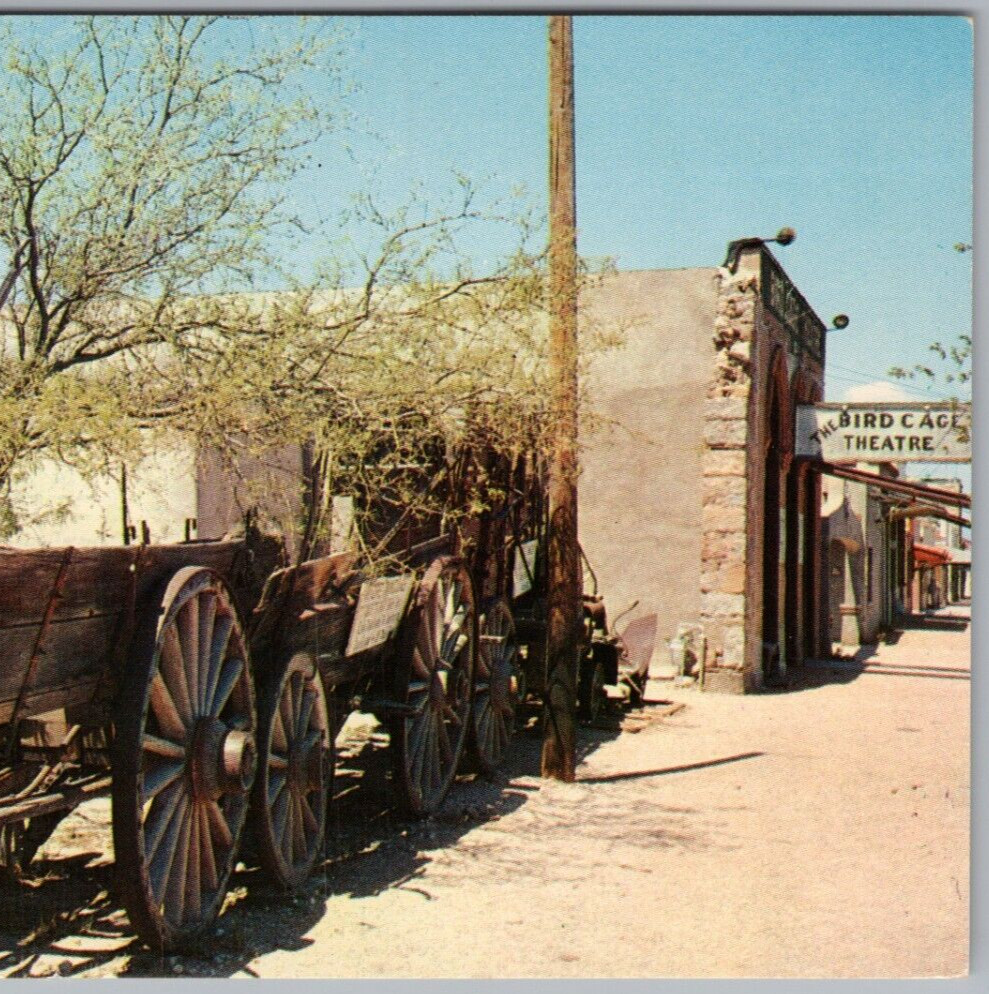
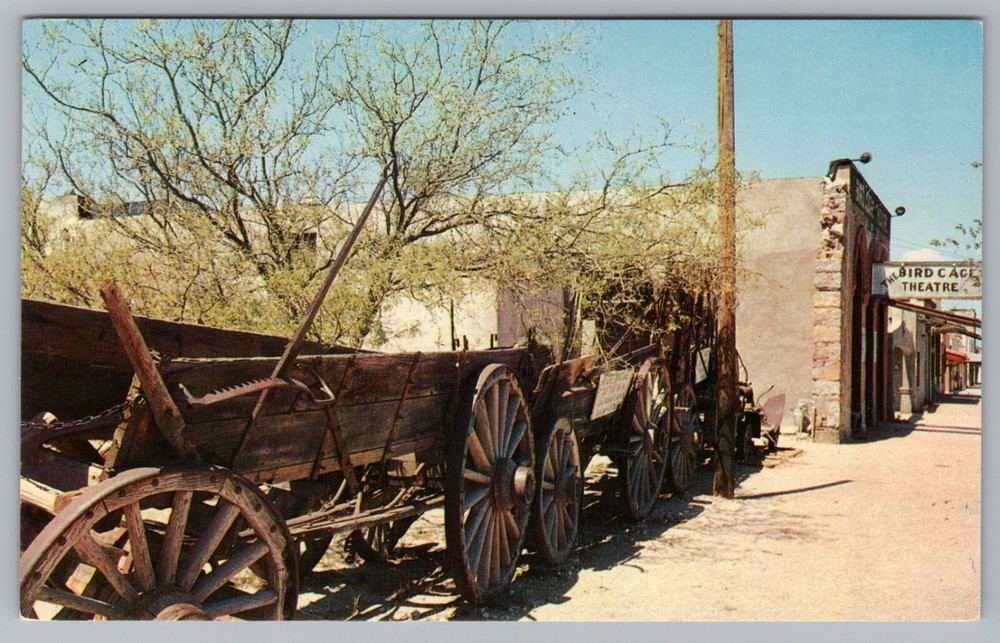
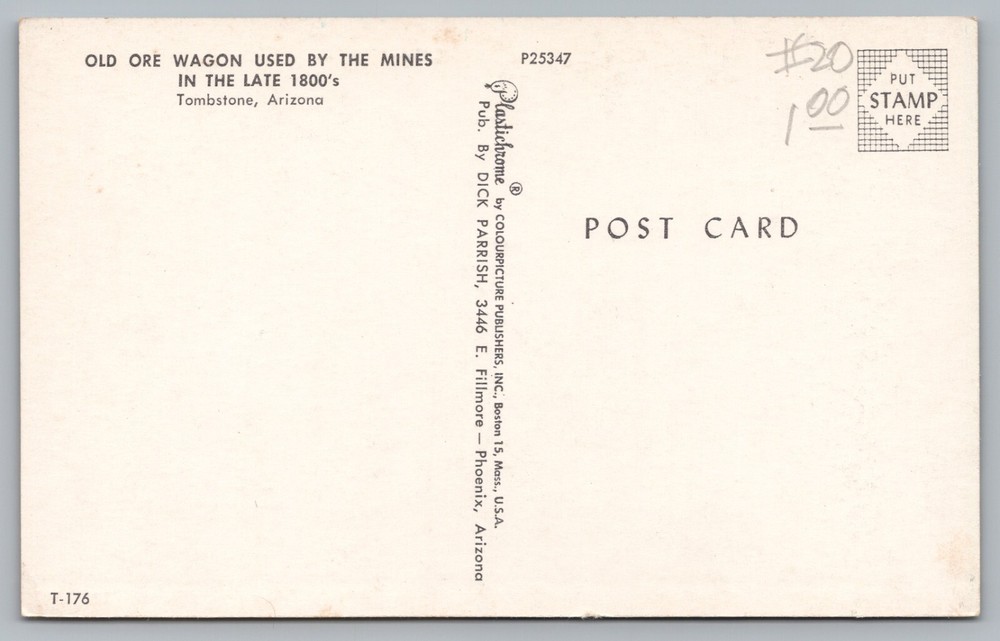
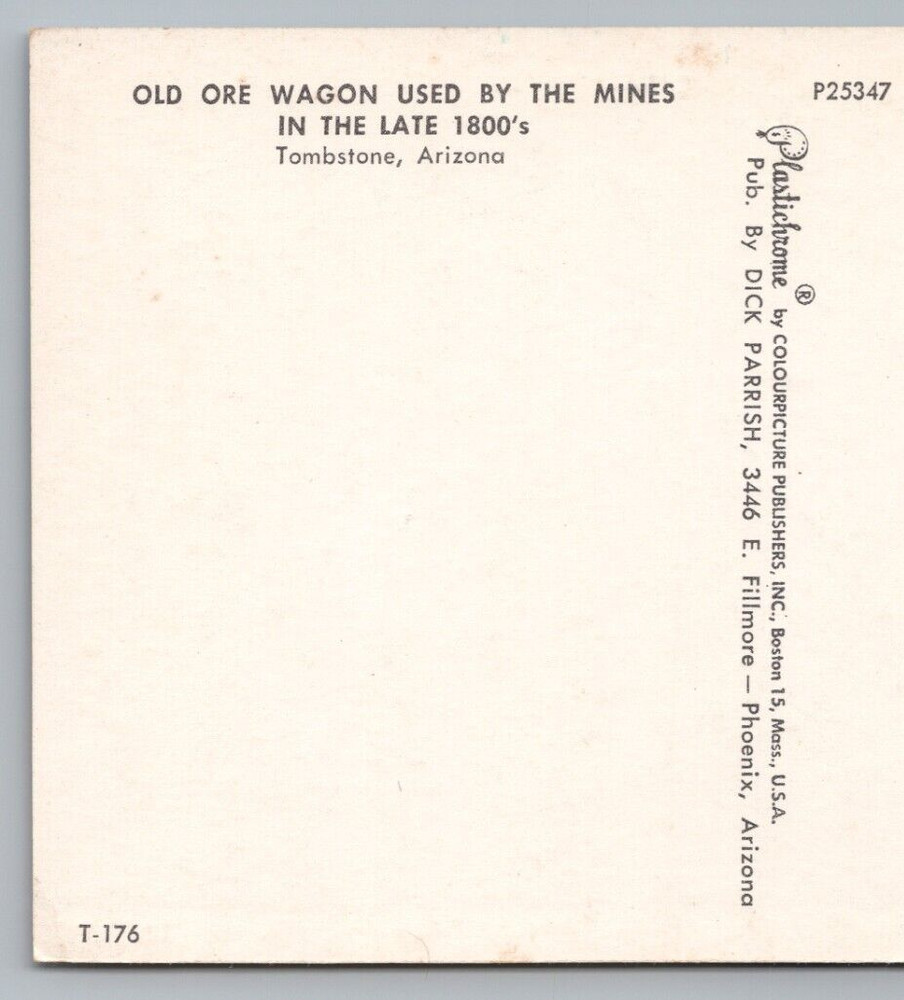
1950s Bird Cage Theatre, Old Ore Wagon, Tombstone, Cochise County, AZ Postcard. Tombstone, Cochise County, Arizona. Tombstone is a city in Cochise County, Arizona, United States, founded in 1879 by prospector Ed Schieffelin inwhat was then Pima County, Arizona Territory. Its population grew from 100 to around 14,000 in less than seven years. P25347 T-176 OLD ORE WAGON USED BY THE MINES IN THE LATE 1800s Tombstone, Cochise County, Arizona Published by DICK PARRISH, 3446 East Fillmore, Phoenix, Arizona Plastichrome ® by COLOURPICTURE PUBLISHERS, INC., Boston 15, Mass., USA ............... The Bird Cage Theatre was a theater in Tombstone, Arizona , United States. It operated intermittently from December 1881 to 1894. When the silver mines closed, the theatre was also closed in 1892. It was leased as a coffee shop starting in 1934. History The Bird Cage Theatre opened on December 26, 1881. It was owned by Lottie and William "Billy" Hutchinson . Hutchison, a variety performer, originally intended to present respectable family shows like he'd seen in San Francisco that were thronged by large crowds. After the Theatre opened, they hosted a Ladies Night for the respectable women of Tombstone, who could attend for free. But the economics of Tombstone didn't support their aspirations. They soon canceled the Ladies Night and began offering baser entertainment that appealed to the rough mining crowd. . Tombstone is a city in Cochise County, Arizona , United States, founded in 1879 by prospector Ed Schieffelin in what was then Pima County, Arizona Territory. It became one of the last boomtowns in the American frontier. The town grew significantly into the mid-1880s as the local mines produced $40 to $85 million in silver bullion, the largest productive silver district in Arizona. Its population grew from 100 to around 14,000 in less than seven years. It is best known as the site of the Gunfight at the O.K. Corral and presently draws most of its revenue from tourism. History The town was established on Goose Flats , a mesa above the Goodenough Mine . Within two years of its founding, although far distant from any other metropolitan area, Tombstone had a bowling alley, four churches, an ice house, a school, two banks, three newspapers, and an ice-cream parlor, alongside 110 saloons, 14 gambling halls, and numerous dance halls and brothels. All of these businesses were situated among and atop many silver mines. The gentlemen and ladies of Tombstone attended operas presented by visiting acting troupes at the Schieffelin Hall opera house, while the miners and cowboys saw shows at the Bird Cage Theatre and brothel. Under the surface were tensions that grew into deadly conflict. The mining capitalists and the townspeople were largely Republicans from the Northern states. Many of the ranchers (some of whom—like the Clantons—were also rustlers or other criminal varieties) were Confederate sympathizers and Democrats. The booming city was only 30 miles (48 km) from the U.S.–Mexico border and was an open market for cattle stolen from ranches in Sonora, Mexico, by a loosely organized band of outlaws known as The Cowboys. The Earp brothers—Wyatt, Virgil and Morgan—as well as Doc Holliday, arrived in December 1879 and mid-1880. The Earps had ongoing conflicts with Cowboys Ike and Billy Clanton, Frank and Tom McLaury, and Billy Claiborne. The Cowboys repeatedly threatened the Earps over many months until the conflict escalated into a shootout on October 26, 1881. The historic gunfight is often portrayed as occurring at the O.K. Corral, though it actually occurred a short distance away in an empty lot on Fremont Street. In the mid-1880s, the silver mines penetrated the water table and the mining companies made significant investments in specialized pumps. A fire in 1886 destroyed the Grand Central hoist and the pumping plant, and it was deemed unprofitable to rebuild the costly pumps. The city nearly became a ghost town, saved only because it was the Cochise County seat until 1929. The city's population dwindled to a low of 646 in 1910, but grew to 1,380 by 2010. Tombstone has frequently been noted on lists of unusual place names. Geography & Geology The Tombstone District located at 31°42′57″N 110°3′53″W (31.715940, −110.064827) sits atop a mesa (elevation 4,539 feet [1,383 m]) in the San Pedro River valley between the Huachuca Mountains and Whetstone Mountains to the west, and the Mules and the Dragoon Mountains to the east. According to the United States Census Bureau, the city has a total area of 4.3 square miles (11.2 km2), all land. The silver-bearing Tombstone Hills around the city are caused by a local intrusion of porphyry through a limestone capping. When actively mined, the silver vein of argentiferous galena (silver-bearing lead ore) was large and well defined. The silver and lead was easily milled and smelted. The lead content sometimes was as much as 50 per cent of the ore, and assays proved the silver content ran as high as $105.00 per ton in 1881 dollars. The underlying basement rocks are fine-grained Pinal Schist which is intruded by gneissic granite. The outcrop is in a small area south of the principal mines. The overlying Paleozoic quartzite and limestones rock lies on an unconformity with a total thickness ranging from 4,000 to 5,000 feet (1,200 to 1,500 m), and contains 2,500 to 3,500 feet (760 to 1,070 m) of Mississippian Escabrosa Limestone and the Naco Formation limestone of Pennsylvanian age in the upper formations. Overlying the Naco Limestone is an unconformable Mesozoic series of conglomerate, thick-bedded quartzites, and shales, with two or three lenses of soft, bluish-gray limestone. Into these formations intruded large bodies of quartz monzonite and by dikes of quartz monzonite-porphyry and diorite-porphyry. Structural faulting occurs throughout the district especially immediately south of Tombstone, where the strata are closely folded. Tombstone District ores have been produced geologically in three or more ways. They may have been formed in argentiferous (silver-bearing) lead sulfide containing spotty amounts of copper and zinc. These deposits are usually deeply oxidized and enriched by irregular replacement bodies along mineralized fissure zones and anticlinal rolls cut by Paleozoic and Mesozoic sedimentary formations. Ore bodies are often closely associated with newer cross-cutting intrusive dikes of Laramide. Ore deposits were formed by base metal mineralization occurring with oxidation found in fault and fracture zones in Laramide volcanics and quartz latite porphyry intrusives. Silver ore was also occurred in manganese oxides with some argentiferous deposits in lenticular or pipe-like replacement bodies along fracture and fault zones, usually in Pennsylvanian-Permian age Naco Group limestones.