Aeroplane Spotter # 31, 1941 (Messerschmitt Me 109F Cutaway, RAF Short Stirling)
$ 1.82
Description
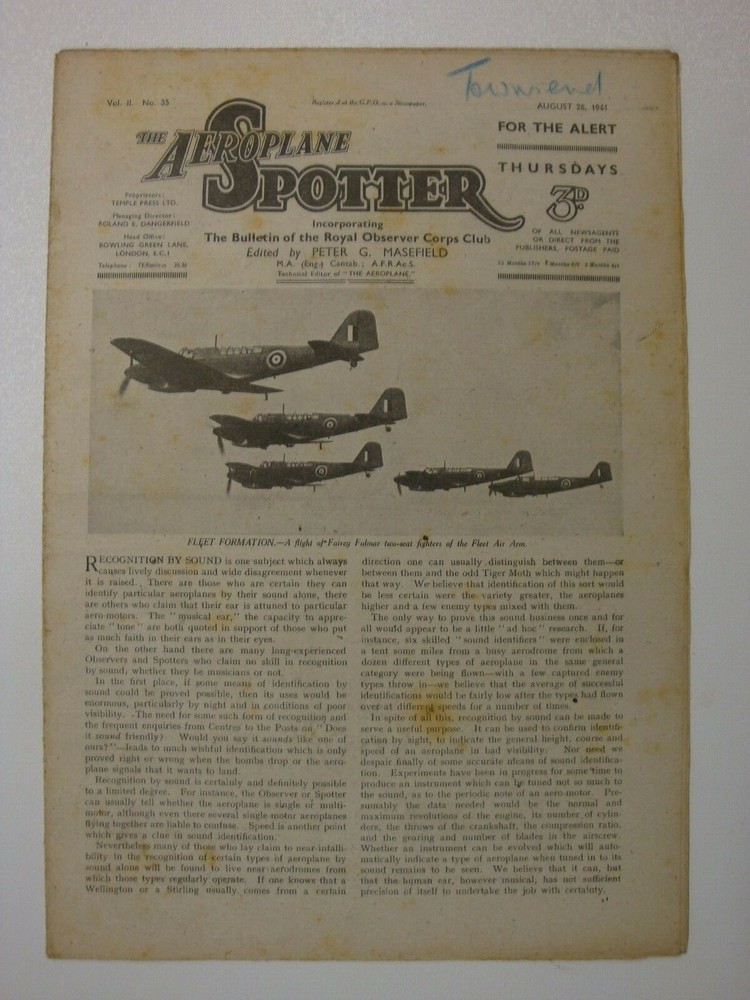
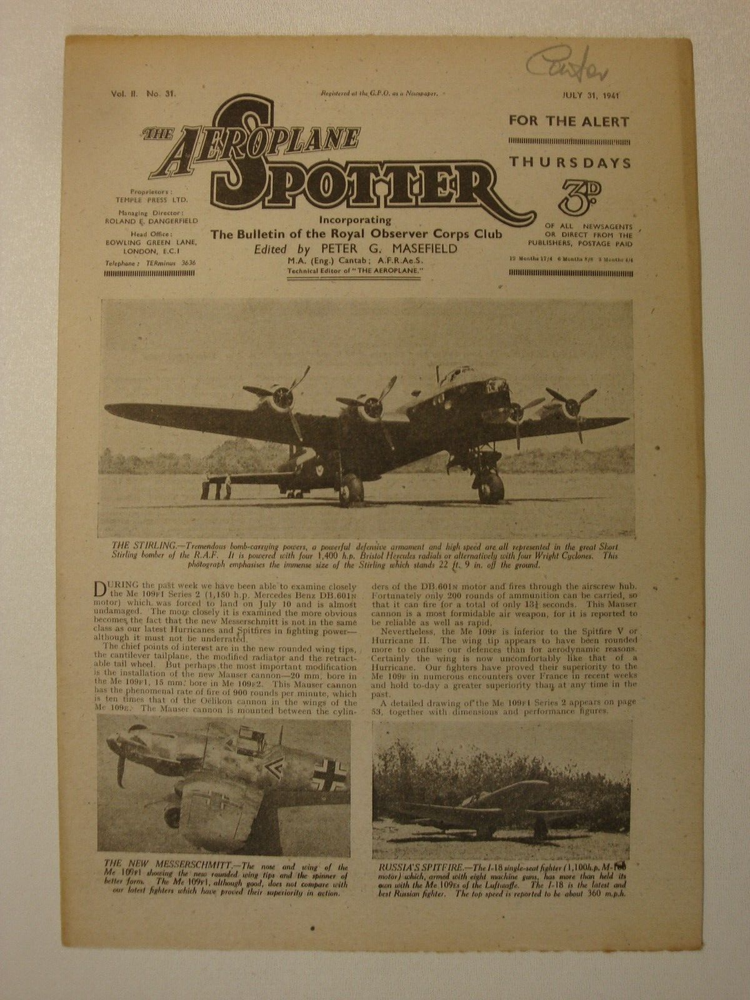
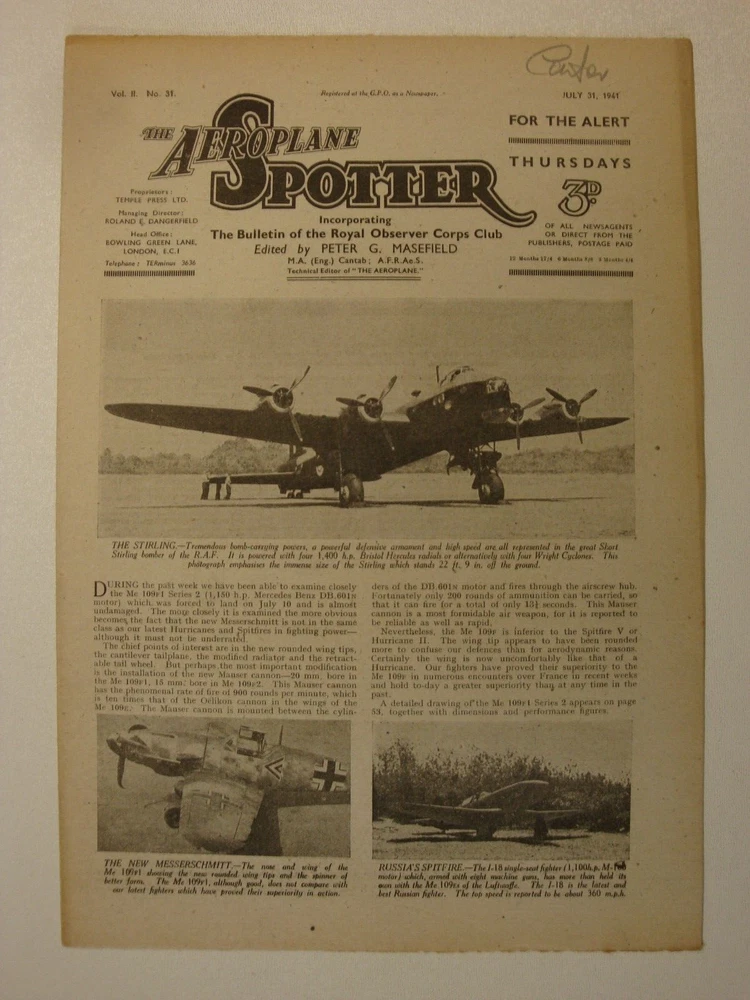
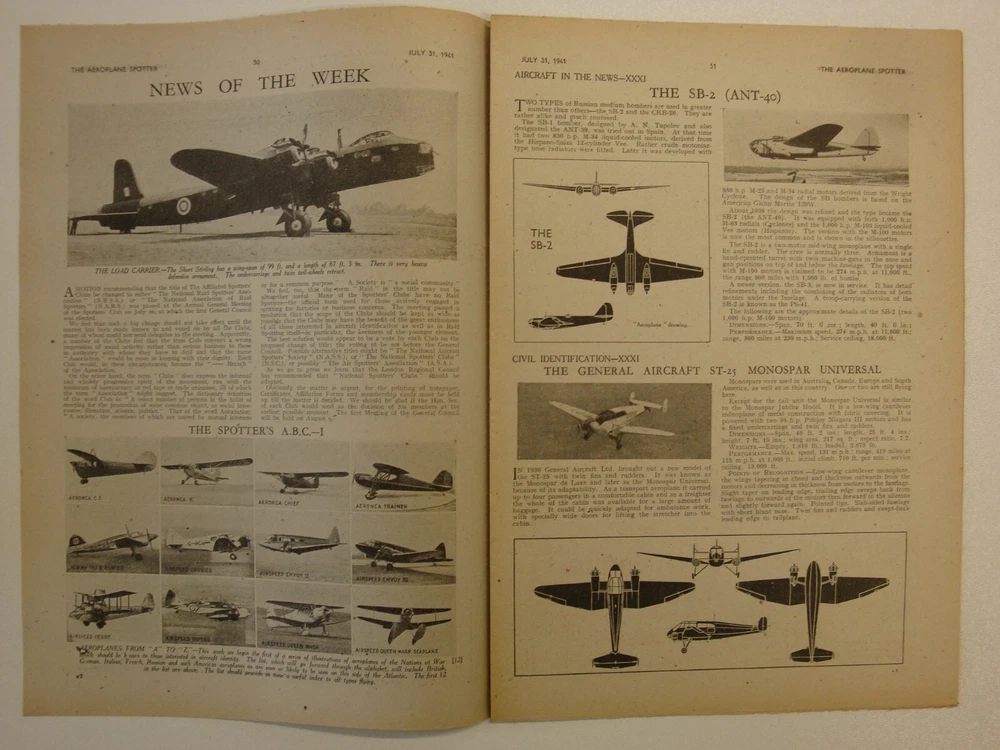
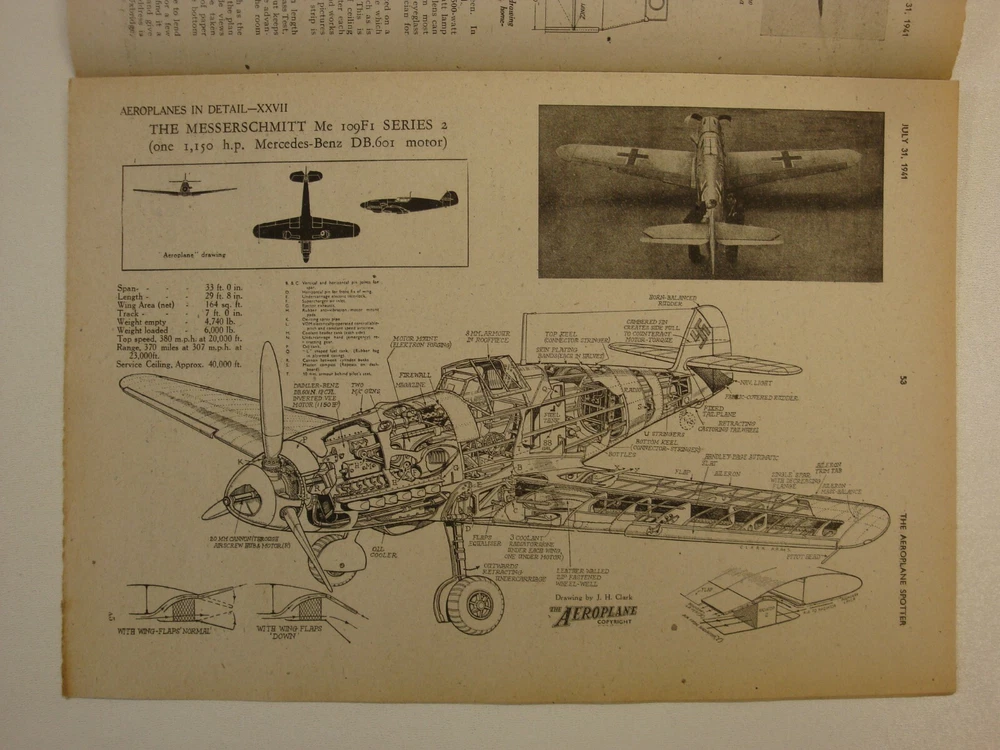
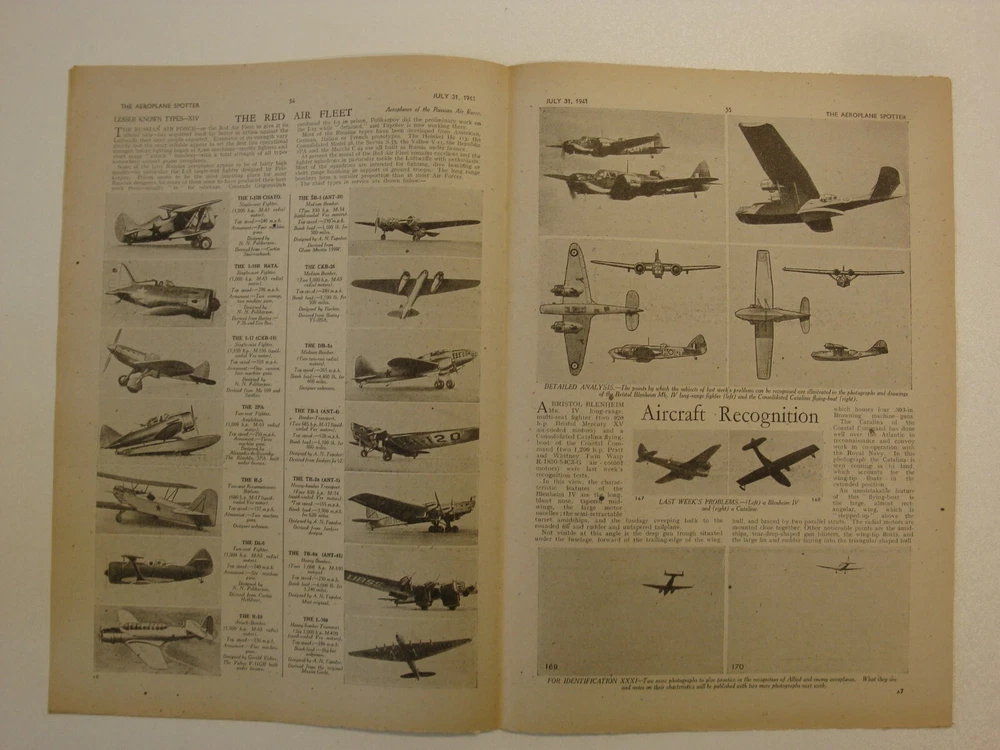
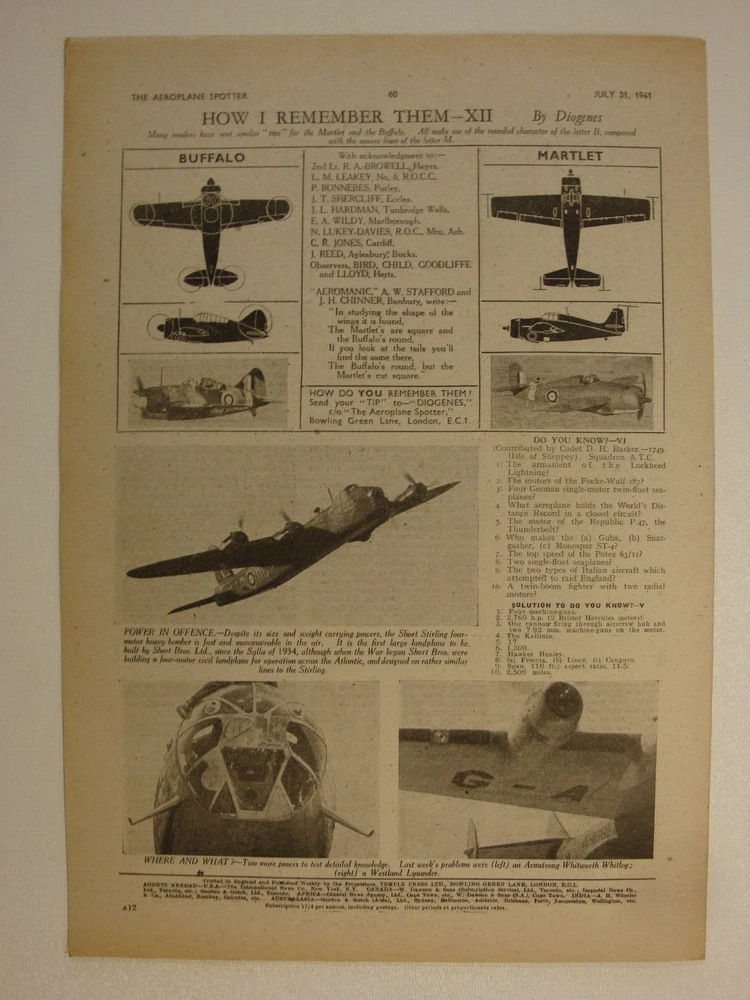
Please Read Item Description AEROPLANE SPOTTER Incorporating THE BULLETIN OF THE OBSERVER CORPS CLUB July 31, 1941 Volume 2 No. 31 Contents: Cover page - Short Stirling bomber of the RAF News of the Week - Short Stirling , The Spotter's ABC: 1 - Aeroplanes from A-Z Aircraft in the News - The Tupolev Ant-40 [SB-2] Civil Identification - The General Aircraft ST-25 Monospar Universal A Home-Made Epidiascope Aeroplanes in Detail - The Messerschmitt Me 109F1 Series 2, 3-view silhouette, photograph and large cutaway drawing with key points identified Lesser Known Types - The Red Air Fleet Aircraft Recognition - The Bristol Blenheim Mk. IV, Consolidated Catalina flying boat The Observer Corps Club Bulletin Aircraft Comparison - Consolidated Model 28-5 Catalina, Consolidated Model 29 Coronado, Consolidated Model 31 Corregidor, Consolidated Model 32 Liberator II Correspondence How I Remember Them - Brewster Buffalo, Grumman Martlet Pages 12 (30.5cm x 20.5cm) 'The Aeroplane Spotter' ran from January 2, 1941 through the war years; initially as a weekly periodical and then later every alternate week. In line with other publications of the period it was produced under 'wartime economy standards', that is poor, thin paper - prone to foxing and rapid age-related discolouration (yellowing). No staples were used, the pages were simply folded - at least this prevented the rust staining associated with other similar publications of the time caused by the poor quality thin wire staples used. Initially 8 pages of information, within a few months (May) this was extended to 12 pages where it remained until it ceased publication in this format during 1948. Please note, these are original publications (not reprints or photocopies) and due to the age and quality of materials available these publications display varying degrees of wear - see item description and photographs. AEROPLANE SPOTTER At the start of the Second World War, the subject of aircraft recognition had a very low priority among the British armed forces with the exception of the Army Anti-Aircraft Command. It was also a topic that was outside the brief of the Observer Corps whose duties were limited to the reporting of aircraft as "Friendly Fighters", "Bombers", "Hostile" or "Unidentified. However many members of the Observer Corps did take an active interest in the subject of aircraft recognition. The only aids issued to assist with aircraft recognition were the Air Ministry Publications AP.1480, official silhouettes of aircraft, and AP.1764, Aircraft Recognition. The low priority afforded to the topic was highlighted as early as September 6, 1939 when a friendly fire incident resulted in the death of a British fighter pilot and the loss of two Hawker Hurricanes. Other friendly fire incidents and the paucity of material on the subject of aircraft recognition led to the formation of an Aircraft Recognition Wing within the Army Anti-Aircraft Command. On a very limited budget the first course started at RAF Biggin Hill in February 1940 training 36 officers and men in the subject of aircraft recognition. The topic also started to come to the attention of the Inter-Service Recognition Committee that had been formed in 1939 to deal mainly with air-to-ground and air-to-sea signalling to indicate friendly status and by the end of 1940 all three services realised that more work was needed to improve aircraft recognition. Concurrently, there were a number of developments taking place outside the armed services. In December 1939 a group of Observer Corps volunteers in Guildford organised a meeting to discuss improving aircraft recognition, the meeting became known as the "Hearkers' Club School of Instruction" and the first lecture was delivered by Peter Masefield, technical editor of 'The Aeroplane' magazine. Masefield was to play a leading role in the launch and direction taken by Aircraft Recognition. The first Hearkers' Club was such a success that others followed and by Spring 1940 there were nine branches and a supporting publication - The Hearkers' Club Bulletin. Throughout the rest of 1940 Masefield campaigned for a separate publication dedicated to aircraft recognition and on 2 January 1941, Temple Press, the publishers of 'The Aeroplane' launched 'The Aeroplane Spotter' edited by Masefield. It incorporated The Hearkers' Club Bulletin; changing to the Bulletin of the Observer Corps Club on February 6, 1941; then to the Bulletin of the Royal Observer Club on April 24, 1941. The Aeroplane Spotter remained an independent publication but received official backing when the Air Ministry and the War Office placed subscriptions for the magazine for all RAF stations and Anti-Aircraft Command units. As well as the armed forces and the Observer Corps there were a large number of civilian "Spotters Clubs" formed who also contributed information towards the air defence of Great Britain despite not receiving any official recognition. Please visit my eBay shop for Military History books, magazines, newspapers, documents and other ephemera. New stock added every week. Please Note: Some international eBay sites will only show a limited number of 'seller's other items'. To see a complete list of my shop and auction listings please copy and paste the following link to my eBay shop in your browser: https://www.ebay.co.uk/str/ett1954?_trksid=p2047675.l2563