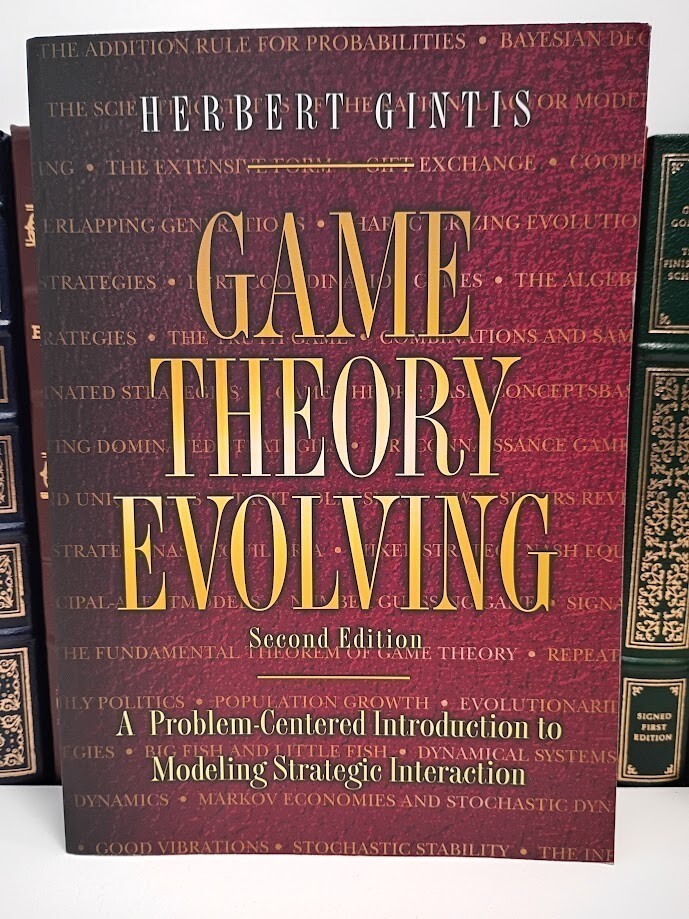


Game Theory Evolving Herbert Gintis Princeton 2009 2nd Ed PB Evolutionary Nash
$ 10.54
Description
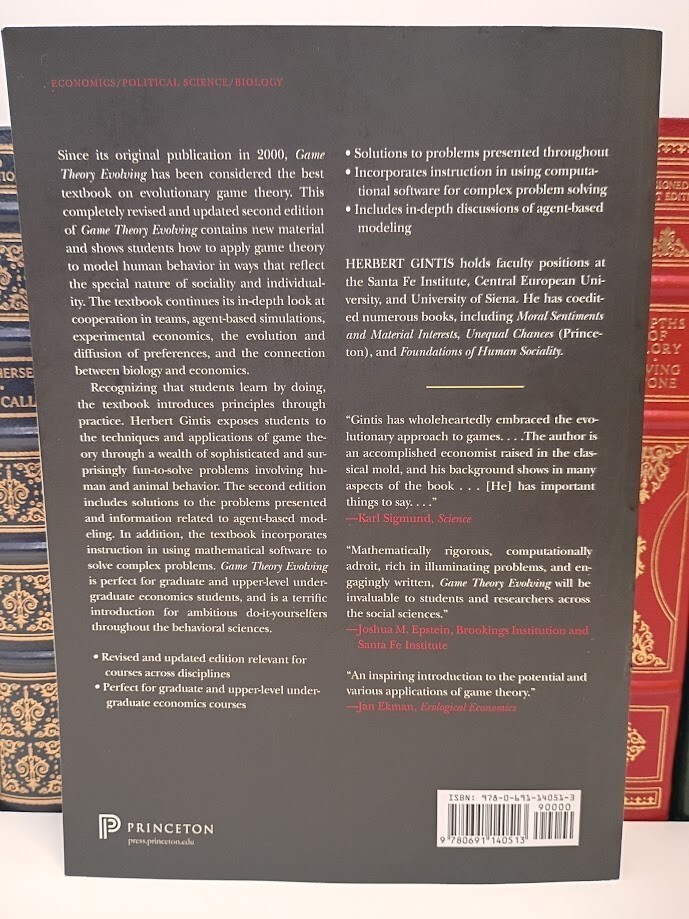
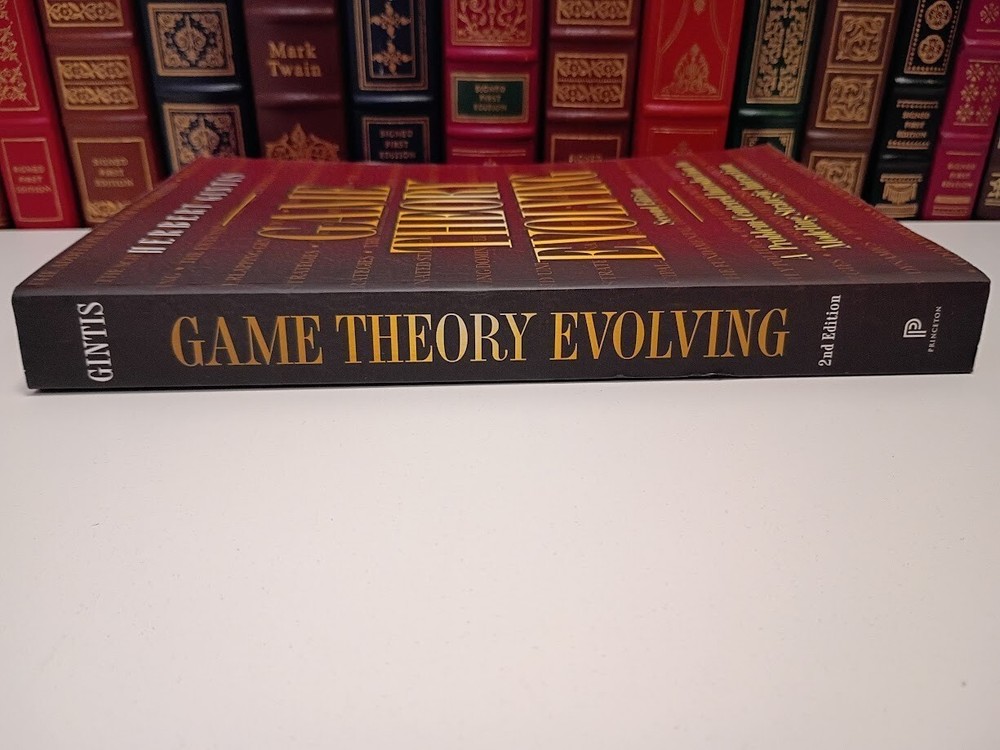
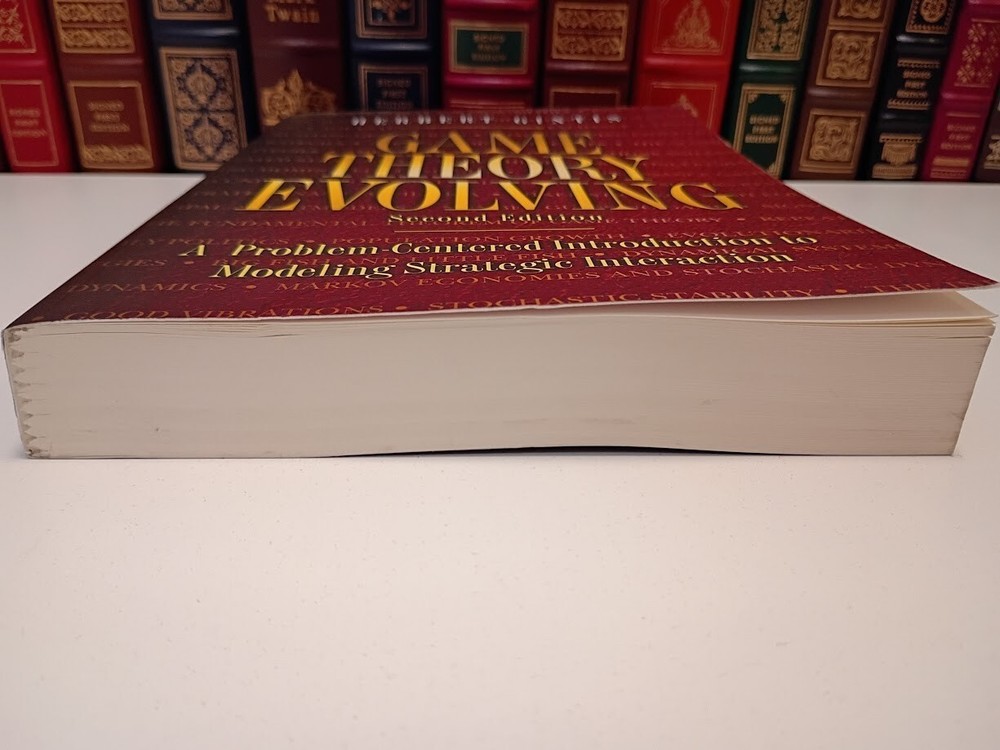
Game Theory Evolving Herbert Gintis Princeton 2009 2nd Ed PB Evolutionary Nash. Herbert Gintis. Author Herbert Gintis. Evolutionary Stable Strategies — ESS theory; Prisoner's Dilemma; Hawk-Dove; the evolution of cooperation; applications in biology and economics. Princeton University Press • 2nd Edition • 2009 • Trade Paperback • ISBN 978-0-691-14051-3. Game Theory Evolving – Herbert Gintis – Princeton University Press 2009 2nd Ed Princeton University Press • 2nd Edition 2009 Economics / Game Theory / Evolutionary Biology / Behavioral Science Santa Fe Institute • "Best Textbook on Evolutionary Game Theory" Game Theory Evolving A Problem-Centered Introduction to Modeling Strategic Interaction — Second Edition, Completely Revised & Updated Herbert Gintis • Santa Fe Institute • Central European University • University of Siena Princeton University Press • 2nd Edition • 2009 • Trade Paperback • ISBN 978-0-691-14051-3 About This Book Since its first edition in 2000, Game Theory Evolving has been widely regarded as the definitive textbook on evolutionary game theory — the field that applies the mathematics of strategic interaction to model not just rational agents but actual behavior across economics, biology, and the social sciences. This completely revised and updated second edition from Princeton University Press is the standard text for graduate and advanced undergraduate courses at the intersection of game theory, behavioral economics, and evolutionary biology. The book's central innovation is pedagogical: rather than presenting theory first and problems second, Gintis introduces principles through practice — a wealth of problems involving human and animal behavior that range from the elegantly simple to the richly challenging. The scope is comprehensive: Nash equilibria and dominated strategies; principal-agent models and signaling games; repeated games; evolutionary stable strategies; replicator dynamics; stochastic dynamical systems; and agent-based modeling. Throughout, Gintis draws on experimental economics, evolutionary biology, and anthropology to show how the theory illuminates real behavior that rational-choice models alone cannot explain. New to this edition: solutions to problems, expanded coverage of agent-based modeling, and instruction in mathematical software tools for solving complex problems. The result is the most up-to-date, rigorous, and practically focused game theory textbook available — equally valuable as a course text and a reference for working researchers across the behavioral and social sciences. "Mathematically rigorous, computationally adroit, rich in illuminating problems, and engagingly written, Game Theory Evolving will be invaluable to students and researchers across the social sciences." — Joshua M. Epstein, Brookings Institution & Santa Fe Institute "Game Theory Evolving is the most up-to-date textbook in game theory on the market. Gintis covers an extraordinary range of topics, including some of the most recent developments in theory, with both stylistic verve and mathematical rigor." — H. Peyton Young, University of Oxford ✦ About the Author ✦ Herbert Gintis Santa Fe Institute • Central European University • University of Siena • Behavioral Economist, Game Theorist, Evolutionary Biologist Herbert Gintis (1940–2023) was one of the most wide-ranging and intellectually adventurous economists of his generation. Holding positions at the Santa Fe Institute, Central European University (Budapest), and the University of Siena, he worked across the boundaries of economics, evolutionary biology, anthropology, and psychology — always pushing toward a more empirically grounded and evolutionarily informed picture of human behavior. His major contributions include the theory of strong reciprocity (the human propensity to cooperate with cooperators and punish defectors at personal cost), work on the evolution of altruistic punishment, and the gene-culture co-evolutionary framework developed with Samuel Bowles and others. His other books include A Cooperative Species: Human Reciprocity and Its Evolution (Princeton, 2011, with Bowles), The Bounds of Reason: Game Theory and the Unification of the Behavioral Sciences (Princeton, 2009), and Individuality and Entanglement (Princeton, 2017). He was a Fellow of the Econometric Society. What This Edition Covers — A Problem-Centered Tour of Game Theory Foundations — Probability, decision theory, and Bayesian reasoning; basic game-theoretic concepts; Nash equilibrium; dominated strategies; pure and mixed strategies Principal-Agent & Signaling — Information asymmetries; moral hazard; adverse selection; signaling games and pooling vs. separating equilibria Repeated Games — Folk theorems; reputation; cooperation and punishment over time; trigger strategies; applications in economics and social science Evolutionary Stable Strategies — ESS theory; Prisoner's Dilemma; Hawk-Dove; the evolution of cooperation; applications in biology and economics Replicator Dynamics — Dynamical systems; evolutionary dynamics; basin of attraction; stochastic evolutionary games; finite population dynamics Agent-Based Modeling — Simulation methods; artificial life; complex adaptive systems; programming tips; connections to experimental economics Title Game Theory Evolving Subtitle A Problem-Centered Introduction to Modeling Strategic Interaction Author Herbert Gintis Publisher Princeton University Press Edition Second Edition — Completely Revised & Updated Year 2009 Format Trade Paperback ISBN-13 978-0-691-14051-3 New in 2nd Ed Problem Solutions • Agent-Based Modeling • Math Software Subject Game Theory / Evolutionary Economics / Behavioral Science Condition VG — Very Good ⚠ Note: Edges of the cover and pages show some minor wear. No writing or highlighting anywhere in the text. Binding is tight. Pages are crisp. Please see photos. ✦ Ideal For Graduate students and advanced undergraduates in economics, political science, biology, and psychology taking courses in game theory, evolutionary economics, or behavioral science. An essential reference for researchers working on evolutionary game theory, experimental economics, or agent-based modeling. A natural companion to Axelrod's The Evolution of Cooperation, Maynard Smith's Evolution and the Theory of Games, and Gintis's own The Bounds of Reason. Regularly assigned in graduate programs across economics, biology, and the social sciences — this second edition is the standard text. JT Enterportals Rare, Academic & Scholarly Books 📦 Same or Next Business Day Shipping >>Powered by WonderLister App