Great American Documents Independence Constitution Lincoln Jfk Emancipation
$ 5.26
Description
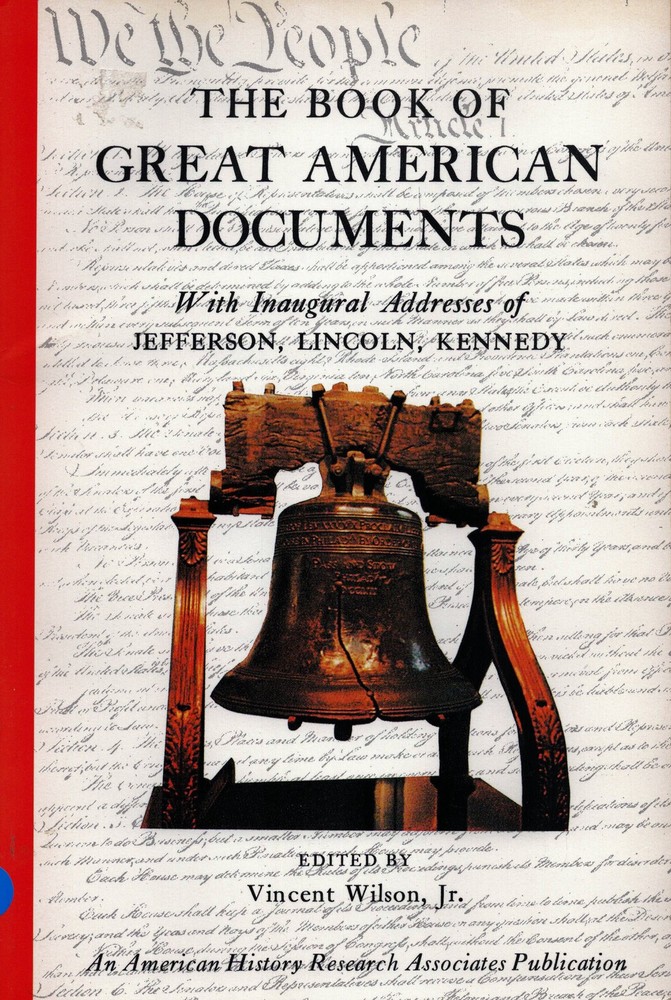
GREAT AMERICAN DOCUMENTS INDEPENDENCE CONSTITUTION LINCOLN JFK EMANCIPATION. The Emancipation Proclamation played a significant part in the end of slavery in the United States. The process is known as incorporation. Any powers not listed in the Constitution reside with the states or the people themselves. GREAT AMERICAN DOCUMENTS – INDEPENDENCE CONSTITUTION LINCOLN JFK EMANCIPATION THE BOOK OF GREAT AMERICAN DOCUMENTS – INDEPENDENCE CONSTITUTION LINCOLN JFK EMANCIPATION BILL OF RIGHTS GETTYSBURG SOFTBOUND BOOK in ENGLISH edited by VINCENT WILSON, Jr. THE FUNDAMENTAL ORDERS, 1639 - The Fundamental Orders were adopted by the Connecticut Colony council on January 24 [O.S. January 14] 1639. The Fundamental Orders describe the structure and powers of the government set up by the Connecticut River towns in a driven attempt for the folks of Connecticut to lead Godly lives. The Orders were also designed to give the government access to the open ocean for trading. The Orders are often considered to be the first example of a written constitution in America, and within the orders, there is an emphasis on the limitation of powers of certain government positions and involvement of the common folk within government rather than exclusively by the gentry. Connecticut has even earned its nickname of The Constitution State because of this. The document is also notable as it assigns supreme authority in the colony to the elected general court, omitting any reference to the authority of the British Crown or other external authority. In 1662, the colony petitioned the king for a royal charter, which substantially secured the colony's right to self-govern following the same form of government established by the Fundamental Orders. However, most consider the Charter as just a reiteration of the policies found in the Fundamental Orders. With the involvement of common folk within government, as well as other rights such as not having requirements for the Freedmen to vote and giving them access to said vote, the document could be considered one of the more democratic constitutions of its time and is vital to the blueprint for democracy within the American government. THE DECLARATION OF INDEPENDENCE, 1776 - The Declaration of Independence, formally The unanimous Declaration of the thirteen united States of America in the original printing, is the founding document of the United States. On July 4, 1776, it was adopted unanimously by the Second Continental Congress, who were convened at Pennsylvania State House, later renamed Independence Hall, in the colonial city of Philadelphia. These delegates became known as the nation's Founding Fathers. The Declaration explains why the Thirteen Colonies regarded themselves as independent sovereign states no longer subject to British colonial rule, and has become one of the most circulated, reprinted, and influential documents in history. Jefferson largely wrote the Declaration of Independence in isolation between June 11, 1776, and June 28, 1776, from the second floor of a three-story home he was renting at 700 Market Street in Philadelphia, now called the Declaration House and within walking distance of Independence Hall. Considering Congress's busy schedule, Jefferson probably had limited time for writing over these 17 days, and he likely wrote his first draft quickly. Examination of the text of the early Declaration drafts reflects the influence that John Locke and Thomas Paine, author of Common Sense had on Jefferson. He then consulted the other members of the Committee of Five who offered minor changes, and then produced another copy incorporating these alterations. The committee presented this copy to the Congress on June 28, 1776. The title of the document was "A Declaration by the Representatives of the United States of America, in General Congress assembled." Congress ordered that the draft "lie on the table" and then methodically edited Jefferson's primary document for the next two days, shortening it by a fourth, removing unnecessary wording, and improving sentence structure. They removed Jefferson's assertion that King George III had forced slavery onto the colonies, in order to moderate the document and appease those in South Carolina and Georgia, both states which had significant involvement in the slave trade. Jefferson later wrote in his autobiography that Northern states were also supportive towards the clauses removal, "for though their people had very few slaves themselves, yet they had been pretty considerable carriers of them to others." Jefferson wrote that Congress had "mangled" his draft version, but the Declaration that was finally produced was "the majestic document that inspired both contemporaries and posterity", in the words of his biographer John Ferling. THE NORTHWEST ORDINANCE, 1787 - The Northwest Ordinance (formally An Ordinance for the Government of the Territory of the United States, North-West of the River Ohio and also known as the Ordinance of 1787), enacted July 13, 1787, was an organic act of the Congress of the Confederation of the United States. It created the Northwest Territory, the new nation's first organized incorporated territories between British North America and the Great Lakes to the north and the Ohio River to the south. The upper Mississippi River formed the territory's western boundary. Pennsylvania was the eastern boundary. In the 1783 Treaty of Paris, which formally ended the American Revolutionary War, Great Britain ceded the region to the United States. However, the Confederation Congress faced numerous problems gaining control of the land such as the unsanctioned movement of American settlers into the Ohio Valley; violent resistance from the region's indigenous peoples; the continued presence of British outposts in the region and an empty U.S. treasury. The ordinance superseded the Land Ordinance of 1784, which declared that states would one day be formed within the region, and the Land Ordinance of 1785, which described how the Confederation Congress would sell the land to private citizens. Designed to serve as a plan for the development and settlement of the region, the 1787 ordinance lacked a strong central government to implement it. That need was addressed shortly with the formation of the U.S. federal government in 1789. The First Congress reaffirmed the 1787 ordinance and, with slight modifications, renewed it with the Northwest Ordinance of 1789. Considered one of the most important legislative acts of the Confederation Congress, it established the precedent by which the federal government would be sovereign and expand westward with the admission of new states, rather than with the expansion of existing states and their established sovereignty under the Articles of Confederation. It also set legislative precedent with regard to American public domain lands. The U.S. Supreme Court recognized the authority of the Northwest Ordinance of 1789 within the applicable Northwest Territory as constitutional in Strader v. Graham, but it did not extend the ordinance to cover the respective states once they were admitted to the Union. The prohibition of slavery in the territory had the practical effect of establishing the Ohio River as the geographic divide between slave states and free states from the Appalachian Mountains to the Mississippi River, an extension of the Mason–Dixon line. It also helped set the stage for later federal political conflicts over slavery during the 19th century until the American Civil War THE CONSTITUTION OF THE UNITED STATES OF AMERICA, 1787 - The Constitution of the United States is the supreme law of the United States of America. It superseded the Articles of Confederation, the nation's first constitution, on March 4, 1789. Originally including seven articles, the Constitution defined the foundational structure of the federal government. The drafting of the Constitution by many of the nation's Founding Fathers, often referred to as its framing, was completed at the Constitutional Convention, which assembled at Independence Hall in Philadelphia between May 25 and September 17, 1787. Influenced by English common law and the Enlightenment liberalism of philosophers like John Locke and Montesquieu, the Constitution's first three articles embody the doctrine of the separation of powers, in which the federal government is divided into the legislative, bicameral Congress;[a] the executive, led by the president;[b] and the judiciary, within which the Supreme Court has apex jurisdiction.[c] Articles IV, V, and VI embody concepts of federalism, describing the rights and responsibilities of state governments, the states in relationship to the federal government, and the process of constitutional amendment. Article VII establishes the procedure used to ratify the constitution. THE BILL OF RIGHTS, 1791 - The United States Bill of Rights comprises the first ten amendments to the United States Constitution. It was proposed following the often bitter 1787–88 debate over the ratification of the Constitution and written to address the objections raised by Anti-Federalists. The amendments of the Bill of Rights add to the Constitution specific guarantees of personal freedoms, such as freedom of speech, the right to publish, practice religion, possess firearms, to assemble, and other natural and legal rights. Its clear limitations on the government's power in judicial and other proceedings include explicit declarations that all powers not specifically granted to the federal government by the Constitution are reserved to the states or the people. The concepts codified in these amendments are built upon those in earlier documents, especially the Virginia Declaration of Rights (1776), as well as the Northwest Ordinance (1787), the English Bill of Rights (1689), and Magna Carta (1215). Largely because of the efforts of Representative James Madison, who studied the deficiencies of the Constitution pointed out by Anti-Federalists and then crafted a series of corrective proposals, Congress approved twelve articles of amendment on September 25, 1789, and submitted them to the states for ratification. Contrary to Madison's proposal that the proposed amendments be incorporated into the main body of the Constitution (at the relevant articles and sections of the document), they were proposed as supplemental additions (codicils) to it. Articles Three through Twelve were ratified as additions to the Constitution on December 15, 1791, and became Amendments One through Ten of the Constitution. Article Two became part of the Constitution on May 5, 1992, as the Twenty-seventh Amendment. Article One is still pending before the states. Although Madison's proposed amendments included a provision to extend the protection of some of the Bill of Rights to the states, the amendments that were finally submitted for ratification applied only to the federal government. The door for their application upon state governments was opened in the 1860s, following ratification of the Fourteenth Amendment. Since the early 20th century both federal and state courts have used the Fourteenth Amendment to apply portions of the Bill of Rights to state and local governments. The process is known as incorporation. James Madison initially opposed the idea of creating a bill of rights, primarily for two reasons: The Constitution did not grant the federal government the power to take away people’s rights. The federal government’s powers are "few and defined" (listed in Article I, Section 8 of the Constitution). Any powers not listed in the Constitution reside with the states or the people themselves. By creating a list of people’s rights, then anything not on the list was therefore not protected. Madison and the other Framers believed that we have natural rights and they are too numerous to list. So, writing a list would be counterproductive. However, opponents of the ratification of the Constitution objected that it contained no bill of rights. So, in order to secure ratification, Madison agreed to support adding a bill of rights, and even served as its author. He resolved the dilemma mentioned in Item 2 above by including the 9th Amendment, which states that just because a right has not been listed in the Bill of Rights does not mean that it does not exist. THOMAS JEFFERSON’S FIRST INAUGURAL ADDRESS, 1801 - The first inauguration of Thomas Jefferson as the third president of the United States was held on Wednesday, March 4, 1801. The inauguration marked the commencement of the first four-year term of Thomas Jefferson as president and the only four-year term of Aaron Burr as vice president. Jefferson was sworn in by Supreme Court Chief Justice John Marshall. THE EMANCIPATION PROCLAMATION, 1863 - The Emancipation Proclamation, officially Proclamation 95, was a presidential proclamation and executive order issued by United States president Abraham Lincoln on January 1, 1863, during the American Civil War. The Proclamation had the effect of changing the legal status of more than 3.5 million enslaved African Americans in the secessionist Confederate states from enslaved to free. As soon as slaves escaped the control of their enslavers, either by fleeing to Union lines or through the advance of federal troops, they were permanently free. In addition, the Proclamation allowed for former slaves to "be received into the armed service of the United States". The Emancipation Proclamation played a significant part in the end of slavery in the United States. THE GETTYSBURG ADDRESS, 1863 - The Gettysburg Address is a speech delivered by Abraham Lincoln, the 16th U.S. president, following the Battle of Gettysburg during the American Civil War. The speech has come to be viewed as one of the most famous, enduring, and historically significant speeches in American history. Lincoln delivered the speech on the afternoon of November 19, 1863, during a formal dedication of Soldiers' National Cemetery, now known as Gettysburg National Cemetery, on the grounds where the Battle of Gettysburg was fought four and a half months earlier, between July 1 and July 3, 1863, in Gettysburg, Pennsylvania. In the battle, Union army soldiers successfully repelled and defeated Confederate forces in what proved to be the Civil War's deadliest and most decisive battle, resulting in more than 50,000 Confederate and Union army casualties in a Union victory that altered the war's course in the Union's favor. The historical and enduring significance and fame of the Gettysburg Address is at least partly attributable to its brevity; it has only 271 words and read in less than two minutes before approximately 15,000 people who had gathered to commemorate the sacrifice of the Union soldiers, over 3,000 of whom were killed during the three-day battle. Lincoln began with a reference to the Declaration of Independence of 1776: Four score and seven years ago our fathers brought forth on this continent, a new nation, conceived in Liberty, and dedicated to the proposition that all men are created equal. He said that the Civil War was "testing whether that nation, or any nation so conceived and so dedicated, can long endure". Lincoln then extolled the sacrifices of the thousands who died in the Battle of Gettysburg in defense of those principles, and he argued that their sacrifice should elevate the nation's commitment to ensuring the Union prevailed and the nation endured, famously saying: “that these dead shall not have died in vain—that this nation, under God, shall have a new birth of freedom—and that government of the people, by the people, for the people, shall not perish from the earth. Despite the historical significance and fame that the speech ultimately obtained, Lincoln was scheduled to give only brief dedicatory remarks, following the main oration given by the elder statesman Edward Everett. Thus, Lincoln's closing remarks consumed a very small fraction of the day's event, which lasted for several hours. Nor was Lincoln's address immediately recognized as particularly significant. Over time, however, it came to be widely viewed as one of the greatest and most influential statements ever delivered on the American national purpose, and it came to be seen as one of the most prominent examples of the successful use of the English language and rhetoric to advance a political cause. "The Gettysburg Address did not enter the broader American canon until decades after Lincoln's death, following World War I and the 1922 opening of the Lincoln Memorial, where the speech is etched in marble. As the Gettysburg Address gained in popularity, it became a staple of school textbooks and readers, and the succinctness of the three paragraph oration permitted it to be memorized by generations of American school children," ABRAHAM LINCOLN’S SECOND INAUGURAL ADDRESS, 1865 - Abraham Lincoln delivered his second inaugural address on Saturday, March 4, 1865, during his second inauguration as President of the United States. At a time when victory over secessionists in the American Civil War was within days and slavery in all of the U.S. was near an end, Lincoln did not speak of happiness, but of sadness. Some see this speech as a defense of his pragmatic approach to Reconstruction, in which he sought to avoid harsh treatment of the defeated rebels by reminding his listeners of how wrong both sides had been in imagining what lay before them when the war began four years earlier. Lincoln balanced that rejection of triumphalism, however, with recognition of the unmistakable evil of slavery. The address is inscribed, along with the Gettysburg Address, in the Lincoln Memorial. Lincoln used his second inaugural address to touch on the question of Divine providence. He wondered what God's will might have been in allowing the war to come, and why it had assumed such terrible dimensions. He endeavored to address some of these dilemmas, using allusions taken from the Bible. Lincoln reiterated the cause of the war, slavery, in saying that "slaves constituted a peculiar and powerful interest. All knew that this interest was somehow the cause of the war." The words "wringing their bread from the sweat of other men's faces" are an allusion to the Fall of Man in the Book of Genesis. As a result of Adam's sin, God tells Adam that henceforth "In the sweat of thy face shalt thou eat bread, till thou return unto the ground; for out of it wast thou taken: for dust thou art, and unto dust shalt thou return" (Genesis 3:19). Lincoln's phrase, "but let us judge not, that we be not judged," is an allusion to the words of Jesus in Matthew 7:1 which in the King James Version reads, "Judge not, that ye be not judged." Lincoln quoted another of Jesus' sayings: "Woe unto the world because of offenses; for it must needs be that offenses come, but woe to that man by whom the offense cometh." Lincoln's quoted language comes from Matthew 18:7; a similar discourse by Jesus appears in Luke 17:1. Lincoln suggested that the death and destruction wrought by the civil war was divine retribution to the U.S. for 250 years of slavery, saying that God may will that the war continue "until every drop of blood drawn with the lash shall be paid by another drawn with the sword", and that the war was the country's "woe due". The quotation "the judgments of the Lord are true and righteous altogether" is from Psalm 19:9. The closing paragraph contains two additional glosses from scripture. "[L]et us strive on to ... bind up the nation's wounds" is a reworking of Psalm 147:3. "[T]o care for him who shall have borne the battle and for his widow and his orphan" comes from James 1:27. Lincoln's point seems to be that God's purposes are not directly knowable to humans. After Lincoln's death, his secretaries found among his papers an undated manuscript now generally known as the "Meditations on the Divine Will." In that manuscript, Lincoln wrote: The will of God prevails—In great contests each party claims to act in accordance with the will of God. Both may be, and one must be wrong. God cannot be for, and against the same thing at the same time. In the present civil war it is quite possible that God's purpose is somewhat different from the purpose of either party—and yet the human instrumentalities, working just as they do, are of the best adaptation to effect this. Lincoln's sense that the divine will was unknowable stood in marked contrast to sentiments popular at the time. In the popular mind, both sides of the Civil War assumed that they could read God's will and assumed His favor in their opposing causes. Julia Ward Howe's "Battle Hymn of the Republic" expressed the sentiment common among the supporters of the U.S. cause, that the U.S. was waging a righteous war that served God's purposes. "Mine eyes have seen the glory of the coming of the Lord...." Similarly, the Confederacy chose Deo vindice as its motto, often translated as "God will vindicate us."Lincoln, responding to compliments from Thurlow Weed on the speech, said, "I believe it is not immediately popular. Men are not flattered by being shown that there has been a difference of purpose between the Almighty and them." JOHN F. KENNEDY’S INAUGURAL ADDRESS, 1961 - Immediately after reciting the oath of office, President Kennedy turned to address the crowd gathered at the Capitol. His 1366-word inaugural address, the first delivered to a televised audience in color, is considered one of the best presidential inaugural speeches in American history. “Let the word go forth from this time and place, to friend and foe alike, that the torch has been passed to a new generation of Americans—born in this century, tempered by war, disciplined by a hard and bitter peace, proud of our ancient heritage—and unwilling to witness or permit the slow undoing of those human rights to which this nation has always been committed, and to which we are committed today at home and around the world. And so, my fellow Americans: ask not what your country can do for you—ask what you can do for your country”. The speech was crafted by Kennedy and his speech writer Ted Sorensen. Kennedy had Sorensen study President Abraham Lincoln's Gettysburg Address as well as other inaugural speeches. Kennedy began collecting thoughts and ideas for his inauguration speech in late November 1960. He took suggestions from various friends, aides and counselors, including suggestions from clergymen for biblical quotations. Kennedy then made several drafts using his own thoughts and some of those suggestions. Kennedy included in his speech several suggestions made by Harvard economist John Kenneth Galbraith and by the former Democratic presidential candidate Adlai Stevenson II. Kennedy's line "Let us never negotiate out of fear. But let us never fear to negotiate." is nearly identical to Galbraith's suggestion. FREE scheduling, supersized images and templates. Get Vendio Sales Manager. Make your listings stand out with FREE Vendio custom templates! FREE scheduling, supersized images and templates. Get Vendio Sales Manager. Over 100,000,000 served. Get FREE counters from Vendio today!