Herkimer NY Postcard: Mohawk River Barge Canal Route 5S - 1950s Linen Canal+Road
$ 3.8
Description
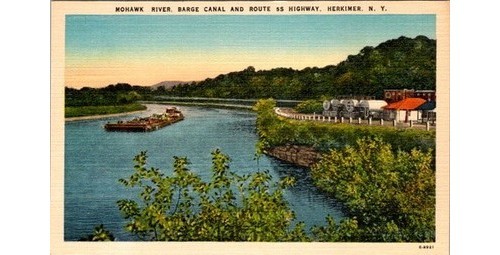
Herkimer NY Postcard: Mohawk River Barge Canal Route 5S - 1950s Linen Canal+Road. This unused postcard presents a classic mid-century view of industrial and transportation infrastructure in Herkimer, Herkimer County, New York. The scene captures the confluence of the historic Mohawk River, the Barge Canal, and Route 5S Highway, illustrating a period when commercial shipping via the canal system coexisted with the expanding automobile highway network. A laden barge is visible on the waterway, emphasizing the canal's continued utilitarian role, while the paved road and telegraph poles along its bank signal the modernization of overland travel. The image, published by Wm. Juss Co., Inc. of Syracuse, N.Y., and bearing the catalog number E-9921, is a fine example of a linen-era chrome postcard, characterized by its textured paper stock and vibrant color saturation used to depict everyday American scenes. The verso is standard for the period, designated for a one-cent stamp, confirming its production prior to the postal rate increases of the mid-20th century. The card serves as a valuable piece of New York State ephemera, documenting a specific moment in the evolution of the Erie Canal system, here specifically referenced as the Barge Canal following its early 20th-century improvements. This view is particularly significant for collectors of transportation history, canal memorabilia, or Mohawk Valley regional studies. The absence of a cancellation or manuscript message indicates it was never posted, preserving it in excellent collectible condition. For the specialist, this postcard offers a clear snapshot of pre-interstate highway logistics, where major routes like 5S were built parallel to and often upon the rights-of-way of their 19th-century canal predecessors, a common practice in the topographic development of the Northeastern United States.