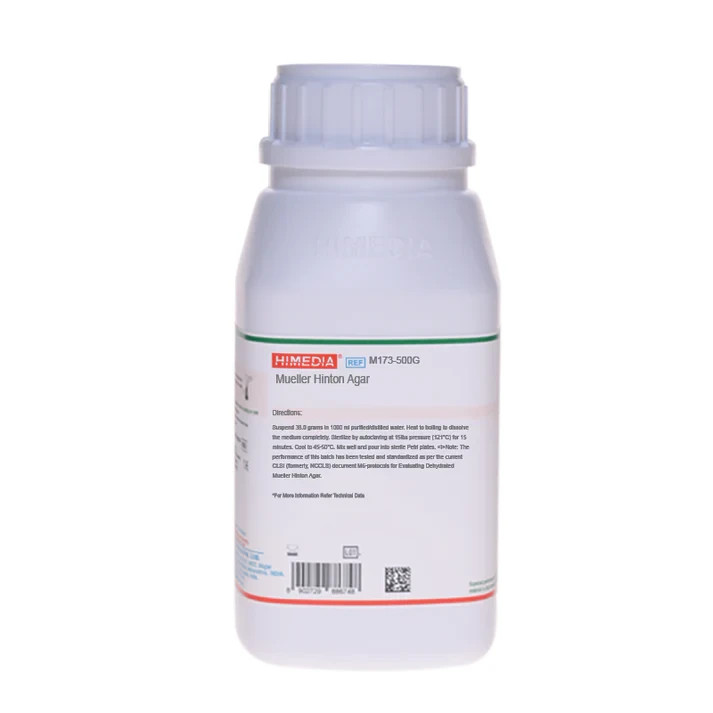
HiMedia - Mueller Hinton Agar (M173) | Laboratory Reagent | Free Ship
$ 69.7
Description
HiMedia - Mueller Hinton Agar (M173) | Laboratory Reagent | Free Ship. Mueller Hinton Agar has been selected by the CLSI for several reasons With slow growing organisms, increased incubation may cause deterioration of diffusing antibiotic and produce unprecise readings (9). For determination of susceptibility of microorganisms to antimicrobial agents. Intended Use Recommended for determination of susceptibility of microorganisms to antimicrobial agents isolated from clinical samples. Composition** Ingredientsg / LHM infusion solids B # (from 300g) 2.000 Acicase ## 17.500 Starch 1.500 Agar 17.000 Final pH (at 25°C): 7.3±0.1 **Formula adjusted, standardized to suit performance parameters # - Equivalent to Beef heart infusion ## - Equivalent to Casein acid hydrolysate Directions Suspend 38.0 grams in 1000 ml purified/ distilled water. Heat to boiling to dissolve the medium completely. Sterilize by autoclaving at 15 lbs pressure (121°C) for 15 minutes. Cool to 45-50°C. Mix well and pour into sterile Petri plates. Note: The performance of this batch has been tested and standardised as per the current CLSI (formerly, NCCLS) document M6-protocols for Evaluating Dehydrated Mueller Hinton Agar. Principle And Interpretation The Mueller Hinton formulation was originally developed as a simple, transparent agar medium for the cultivation of pathogenic Neisseria species (1). Other media were subsequently developed that replaced the use of Mueller Hinton Agar for the cultivation of pathogenic Neisseria species, but it became widely used in the determination of sulfonamide resistance of gonococci and other organisms. Mueller Hinton Agar is now used as a test medium for antimicrobial susceptibility testing (2). Mueller Hinton Agar is recommended for the diffusion of antimicrobial agents impregnated on paper disc through an agar gel as described in CLSI Approved Standard (3). Mueller Hinton Agar has been selected by the CLSI for several reasons: It demonstrates good batch-to-batch reproducibility for susceptible testing. It is low in sulfonamide, trimethoprim and tetracycline inhibitors. It supports the growth of most non-fastidious bacterial pathogens and Many data and much experience regarding its performance have been recorded (4). Kirby-Bauer et al recommended this medium for performing antibiotic susceptibility tests using a single disc of high concentration (5). WHO Committee on Standardization of Susceptibility Testing has accepted Mueller Hinton Agar for determining the susceptibility of microorganisms because of its reproducibility (6). Mueller Hinton Agar with 5% sheep blood and Mueller Hinton Agar with Hemoglobin have been recommended for antimicrobial susceptibility testing of Streptococcus pneumoniae and Haemophilus influenzae . HM infusion B from and acicase provide nitrogenous compounds, carbon, sulphur and other essential nutrients. Starch acts as a protective colloid against toxic substances present in the medium. Starch hydrolysis yields dextrose, which serves as a source of energy. These ingredients are selected for low thymine and thymidine content as determined by MIC values for Enterococcus faecalis with sulfamethoxazole trimethoprim (SXT). The Kirby-Bauer procedure is based on agar diffusion of antimicrobial substances impregnated on paper discs. This method employs disc with a single concentration of antimicrobial agent and the zone diameters observed are correlated with minimum inhibitory concentration (MIC) values (7,1,2). A standardized suspension of the organism is swabbed over the entire surface of the medium. Paper discs impregnated with specific amounts of antimicrobial agents are then placed on the surface of the medium, incubated and zones of inhibition around each disc are measured. The susceptibility is determined by comparing with CLSI standards (4). The various factors, which influence disc diffusion susceptibility tests, are agar depth, disc potency, inoculum concentration, pH of the medium and beta-lactamase production by test organisms (4,8). Mueller Hinton Agar is not appropriate for assay by disc diffusion method with slow growing organisms, anaerobes and capnophiles. With slow growing organisms, increased incubation may cause deterioration of diffusing antibiotic and produce unprecise readings (9). Mueller Hinton Agar is recommended for the diffusion of antimicrobial agents impregnated on paper disc through an agar gel as described in NCCLS (National Committee for Clinical Laboratory Standards), now CLSI (Clinical and Laboratory Standards Institute) Approved Standard (10). Type of specimen Clinical samples: Pure cultures isolated from urine, stool, blood etc. Specimen Collection and Handling For clinical samples follow appropriate techniques for handling specimens as per established guidelines (2,10-13). After use, contaminated materials must be sterilized by autoclaving before discarding. Warning and Precautions In Vitro diagnostic use only. For professional use only. Read the label before opening the container. Wear protective gloves/protective clothing/eye protection/face protection. Follow good microbiological lab practices while handling specimens and culture. Standard precautions as per established guidelines should be followed while handling clinical specimens. Safety guidelines may be referred in individual safety data sheets. Limitations This medium is recommended for susceptibility testing of pure cultures only. Inoculum density may affect the zone size. Heavy inoculum may result in smaller zones or too less inoculum may result in bigger zones. Fastidious organisms may not grow on this medium and may require supplementation of blood. Fastidious anaerobes may not grow on this medium. As antimicrobial susceptibility is carried with antibiotic disc, proper storage of the disc is desired which may affect the potency of the disc. Under certain circumstances, the in vitro results of antibiotic susceptibility may not show the same in vivo. Performance and Evaluation Performance of the medium is expected when used as per the direction on the label within the expiry period when stored at recommended temperature. Quality Control Appearance: Cream to yellow homogeneous free flowing powder Gelling: Firm, comparable with 1.7% agar gel. Colour and Clarity of prepared medium: Light amber coloured clear to slightly opalescent gel forms in Petri plates Reaction: Reaction of 3.8% w/v aqueous solution at 25°C. pH : 7.3±0.1 pH: 7.20-7.40 Cultural Response Antibiotic susceptibility tests are performed in accordance with, and meet the acceptance limits of the current ISO/TS 16782 (15). Performance of the medium is checked in accordance with the CLSI/ EUCAST guidelines. For testing S. pneumoniae : The medium was supplemented with 5% Horse blood and 20 mg/l NAD, incubated at 34-36°C for 18-20 hours in 5% CO2. For testing H. influenzae : The medium was supplemented with 5% Horse blood and 20 mg/l NAD, incubated at 34-36°C for 18-20 hours in 5% CO2. Antibiotic Sensitivity test Various discs were tested for standard ATCC strains and zone of inhibition were measured after an incubation 30-35°C for 18 hours. (As per the latest CLSI Protocol M6 & Standards as per the current CLSI M100). Thymine/Thymidine Content # The zones for these discs are indicative of the Thymine/Thymidine content of the medium. Divalent Cation Content $ The zones for these discs are indicative of the Divalent Cation content of the medium OrganismGrowthAntimicrobial Agent / Disc ContentZone DiameterIncubationEscherichia coli ATCC 25922 (00013*) luxuriant Cephalothin CEP 30mcg 15-21 mm 34-36°C 16-20 hours Ampicillin AMP 10mcg 15-22 mm Chloramphenicol C 30 mcg 21-27 mm Gentamicin GEN 10mcg 19-26 mm Co-Trimoxazole (COT) 25 mcg 23-29 mm Sulphafurazole SF 300 mcg 15-23 mm Cefotaxime CTX 5 mcg 25-31 mm Tigecycline TGC 15mcg 20-27 mm Tetracycline TE 30 mcg 18-25 mm Amoxicillin-clavulanate AMC 30 mcg 18-24 mm Ciprofloxacin CIP 5mcg 29-38 mm Escherichia coli ATCC 35218 luxuriant Amoxicillin-clavulanate AMC 30 mcg 17-22 mm 34-36°C 16-20 hours Piperacillin/Tazobactam PIT 100/10 mcg 24-30 mm Ticarcillin TI 75 mcg 6 mm Ticarcillin/Clavulanic acid TCC 75/10mcg 21-25 mm Ampicillin AMP 10 mcg 6 mm Ampicillin/Sulbactam A/S 10/10 mcg 13-19 mm Staphylococcus aureus subsp. aureus ATCC 25923 (00034*) luxuriant Erythromycin E 15 mcg 22-30 mm 34-36°C 16-20 hours Linezolid LZ 30 mcg 24-30 mm Tetracycline TE 30 mcg 24-30 mm Ciprofloxacin CIP 5mcg 22-30 mm Amoxyclav (AMC) 30 mcg 28-36 mm Co-Trimoxazole COT 25 mcg 24-32 mm Cefoxitin CX 30 mcg 23-29 mm Oxacillin OX 1mcg 18-24 mm Pristinomycin RP 15 mcg 21-28 mm Gentamicin GEN 10 mcg 19-27 mm Penicillin-G 10 units 26-37 mm Ampicillin/Sulbactam A/S 10/10 mcg 29-37 mm Staphylococcus aureus subsp. aureus ATCC 29213 (00131*) luxuriant Penicillin-G P 1 unit 12-18 mm 34-36°C 16-20 hours Cefoxitin CX 30 mcg 24-30 mm Erythromycin E 15 mcg 23-29 mm Linezolid LZ 10 mcg 21-27 mm Gentamicin GEN 10 mcg 19-25 mm Tetracycline TE 30 mcg $ 23-31 mm Ciprofloxacin CIP 5mcg 21-27 mm Staphylococcus aureus subsp. aureus ATCC 43300 (MRSA) (00211*) luxuriant Oxacillin OX 1 mcg Very Hazy to No Zone 34-36°C 24 hours Cefoxitin CX 30 mcg