
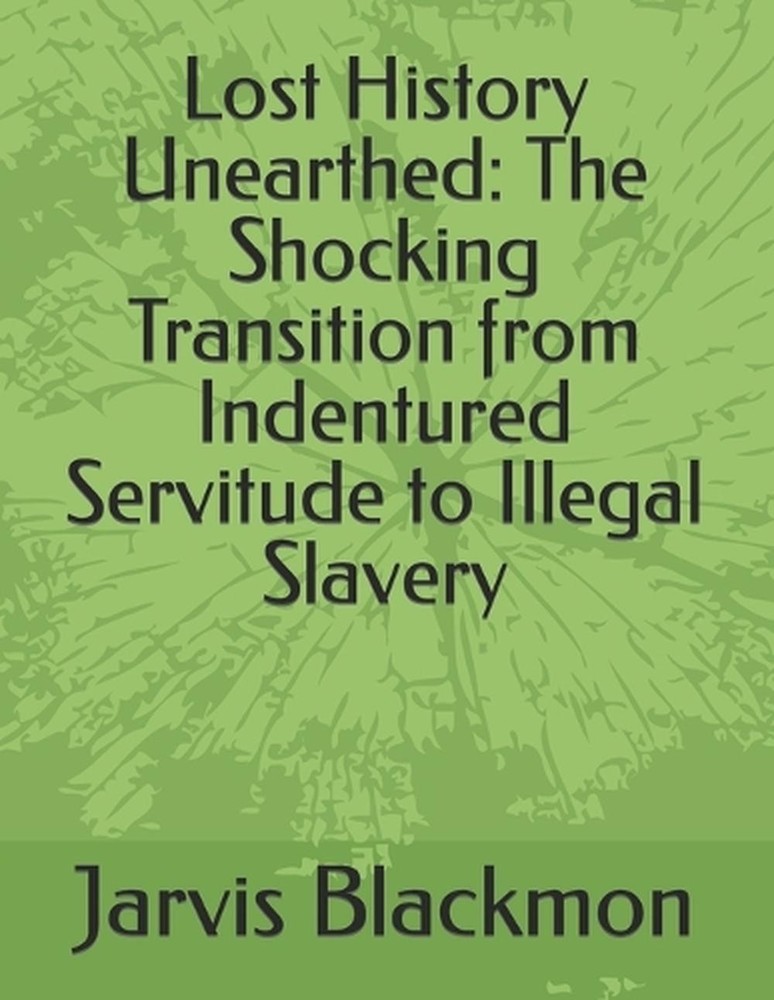
Lost History Unearthed: The Shocking Transition from Indentured Servitude to Ill
$ 21.02
Description
Lost History Unearthed: The Shocking Transition from Indentured Servitude to Ill. The laws designated church wardens as overseers of the poor, responsible for finding work for impoverished children and unemployed adults. Yet, despite these efforts, poverty remained entrenched, and a novel solution was needed. Lost History Unearthed by Jarvis Quinnon Blackmon, Jr, Jarvis Quinnon Blackmon Estimated delivery 3-12 business days Format Paperback Condition Brand New Description "Lost History Unearthed: The Shocking Transition from Indentured Servitude to Illegal Slavery" The pages of history often hold stories that challenge our perceptions and beliefs, revealing the complexities of humanity's past. The captivating tale of the transition from indentured servitude to illegal slavery during the Elizabethan era in England and its subsequent impact on the birth of slavery in North America is one such revelation. Delving into this lost history, we uncover a shocking journey that spans continents and centuries, shedding light on the indifference and inaction that perpetuated a reprehensible system. The Elizabethan period in England was plagued by soaring unemployment and widespread poverty, leading to the introduction of the Statute of Apprentices in 1562. This statute, drawing inspiration from London's guild system, aimed to combat poverty through forced labor. It allowed householders to take on apprentices, mostly the sons of freemen, for a seven-year term to learn a trade. However, this approach proved ineffective, and famine gripped England in the 1590s, highlighting the inadequacy of existing measures. In 1601, the English Parliament passed the Poor Laws in an attempt to address the persistent unemployment and poverty. The laws designated church wardens as overseers of the poor, responsible for finding work for impoverished children and unemployed adults. Yet, despite these efforts, poverty remained entrenched, and a novel solution was needed. The turning point came in 1606 when the Virginia Company was chartered with establishing a colony in North America. Drawing inspiration from the English Poor Laws, the concept of bonded labor took hold. This arrangement involved privately indentured servants, who signed contracts agreeing to work for a specified term upon arrival in Jamestown. The term usually lasted seven years, mirroring the Statute of Apprentices back in England. The seeds of slavery were sown in 1619 when the first African slaves arrived at the Jamestown dock. Initially, these Africans were treated as indentured servants with limited terms of service, similar to their European counterparts. However, a significant shift occurred in 1662 when the Virginia Assembly enacted the "partus sequitur" doctrine, stating that the offspring of an enslaved woman would inherit her status as a slave, a departure from English common law. This, combined with a 1699 act ordering the deportation of all free Negroes, solidified the notion that being black equated to lifelong enslavement. Surprisingly, despite the dissolution of the Virginia Company in 1624, the Crown and Parliament showed little interference as colonial legislative bodies allowed slavery to grow unimpeded. The indifference of English society further perpetuated this reprehensible practice, with profitable trade in enslaved individuals becoming too enticing to challenge. The historical account offers two vital lessons in jurisprudence. Firstly, it warns of the dangers of adopting legal institutions without the necessary safeguards, as the lack of protections surrounding English slavery laid the groundwork for the horrors of chattel slavery. Secondly, it underscores the consequences of governmental passivity in the face of economic exploitation and social injustice, enabling the dehumanization of African slaves. As we reflect on this lost history, let us be inspired by those who eventually rose against injustice, striving to build a society where all individuals are treated with dignity and respect. Understanding the mistakes of the past can empower us to forge a future free from the shackles of indifference and inaction, ensuring that such horrors never stain our collective conscience again. Details ISBN-13 9798853574984 Title Lost History Unearthed Author Jarvis Quinnon Blackmon, Jr, Jarvis Quinnon Blackmon Format Paperback Year 2023 Pages 32 Publisher Independently Published GEItemID:143328587; About Us Grand Eagle Retail is the ideal place for all your shopping needs! With fast shipping, low prices, friendly service and over 1,000,000 in stock items - you're bound to find what you want, at a price you'll love! Shipping & Delivery Times Shipping is FREE to any address in USA. Please view eBay estimated delivery times at the top of the listing. Deliveries are made by either USPS or Courier. We are unable to deliver faster than stated. International deliveries will take 1-6 weeks. NOTE: We are unable to offer combined shipping for multiple items purchased. This is because our items are shipped from different locations. Returns If you wish to return an item, please consult our Returns Policy as below: Please contact Customer Services and request "Return Authorisation" before you send your item back to us. Unauthorised returns will not be accepted. Returns must be postmarked within 4 business days of authorisation and must be in resellable condition. Returns are shipped at the customer's risk. We cannot take responsibility for items which are lost or damaged in transit. For purchases where a shipping charge was paid, there will be no refund of the original shipping charge. Additional Questions If you have any questions please feel free to Contact Us. Categories Baby Books Electronics Fashion Games Health & Beauty Home, Garden & Pets Movies Music Sports & Outdoors Toys