
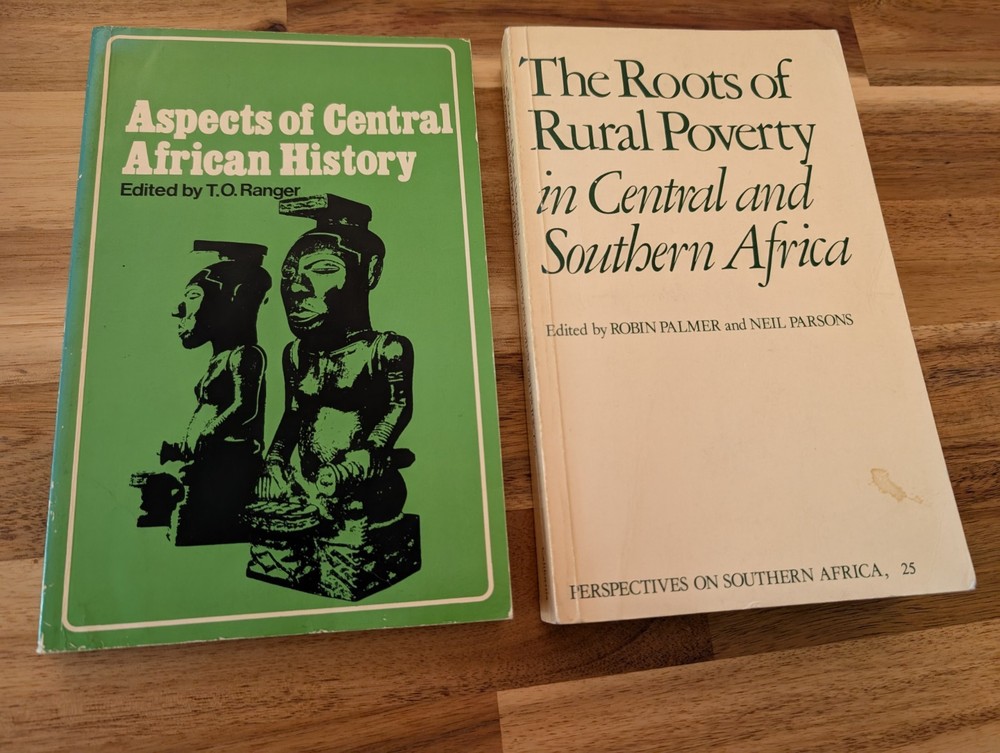


Lot of 2: Aspects of Central African History &The Roots of Rural Poverty in Book
$ 11.23
Description
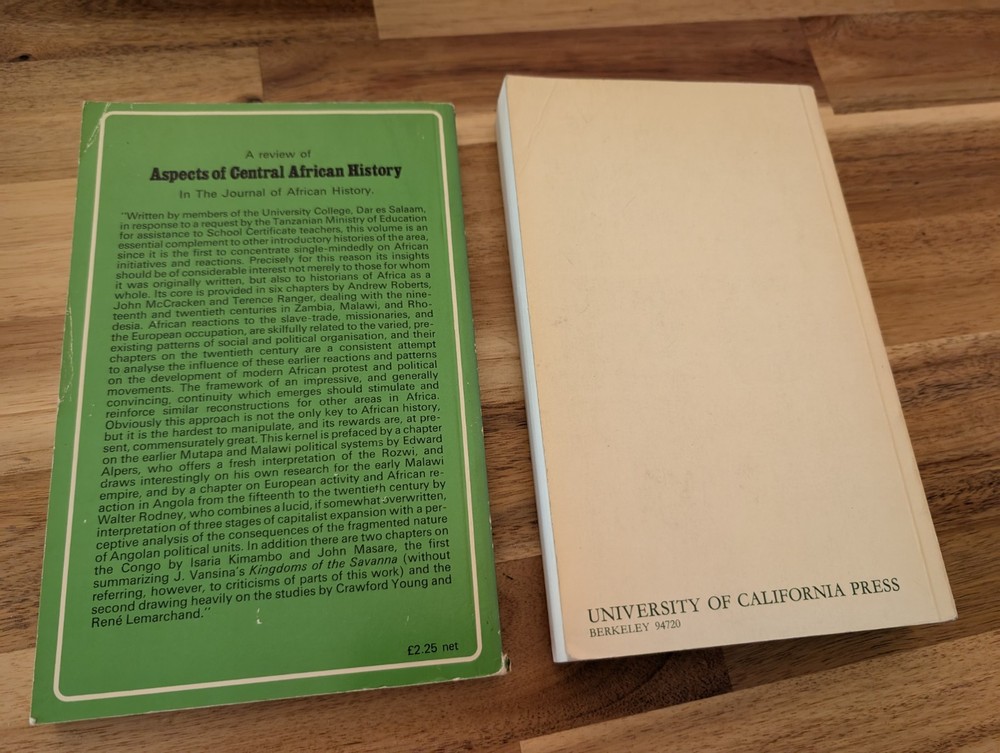
Lot of 2: Aspects of Central African History &The Roots of Rural Poverty in Book. Its core is provided in six chapters by Andrew Roberts. John McCracken and Terence Ranger, dealing with the nineteenth and twentieth centuries in Zambia, Malawi, and Rhodesia. In addition there are two chapters on the Congo by Isaria Kimambo and John Masare, the first summarizing J. Vansina's Kingdoms of the Savanna (without referring, however, to criticisms of parts of this work) and the second drawing heavily on the studies by Crawford Young and René Lemarchand.". Aspects of Central African History: "Written by members of the University College, Dar es Salaam, in response to a request by the Tanzanian Ministry of Education for assistance to School Certificate teachers, this volume is an essential complement to other introductory histories of the area. since it is the first to concentrate single-mindedly on African initiatives and reactions. Precisely for this reason its insights should be of considerable interest not merely to those for whom it was originally written, but also to historians of Africa as a whole. Its core is provided in six chapters by Andrew Roberts. John McCracken and Terence Ranger, dealing with the nineteenth and twentieth centuries in Zambia, Malawi, and Rhodesia. African reactions to the slave-trade, missionaries, and the European occupation, are skilfully related to the varied, pre-existing patterns of social and political organisation, and their chapters on the twentieth century are a consistent attempt to analyse the influence of these earlier reactions and patterns on the development of modern African protest and political movements. The framework of an impressive, and generally convincing, continuity which emerges should stimulate and reinforce similar reconstructions for other areas in Africa. Obviously this approach is not the only key to African history, but it is the hardest to manipulate, and its rewards are, at present, commensurately great. This kernel is prefaced by a chapter on the earlier Mutapa and Malawi political systems by Edward Alpers, who offers a fresh interpretation of the Rozwi, and draws interestingly on his own research for the early Malawi empire, and by a chapter on European activity and African re-action in Angola from the fifteenth to the twentieth century by Walter Rodney, who combines a lucid, if somewhat overwritten, interpretation of three stages of capitalist expansion with a perspective analysis of the consequences of the fragmented nature of Angolan political units. In addition there are two chapters on the Congo by Isaria Kimambo and John Masare, the first summarizing J. Vansina's Kingdoms of the Savanna (without referring, however, to criticisms of parts of this work) and the second drawing heavily on the studies by Crawford Young and René Lemarchand." The Roots of Rural Poverty in Central and Southern Africa: Governments throughout Africa talk today of the need to promote 'rural development. The problem has proved remarkably intractable and has attracted the attention of social scientists of all disciplines, who have come to recognize that its dimensions stretch well beyond the particular expertise of the agricultural scientist. The Roots of Rural Poverty in Central and Southern Africa offers a historical perspective to this ongoing debate, while being in no way constrained by traditional academic boundaries. Ideally, a work such as this should be the product of a single author, or at least a single point of view. We are conscious that published symposia of this kind are open to the criticism that they lack overall coherence, and we have endeavoured to overcome the problem by rigorous editing and by involving our contributors in a substantial exercise in mutual criticism and subsequent revision, designed to achieve maximum thematic unity. We would point out that the rural economic history of Central and Southern Africa has only just begun to be written, and that a great deal more research will be necessary before a work of synthesis comparable to A. G. Hopkins's An Economic History of West Africa (London, 1973) can be produced. This present book should thus be seen as a first step towards such a work for Central and Southern Africa, where studies have previously been largely industrial and national rather than peasant and regional, and as a stimulus to present and future research. The Roots of Rural Poverty lays its emphasis on the black rural areas previously neglected in formal history books. It moves towards a continental perspective by cutting across colonial linguistic boundaries. And it extends back into the pre-colonial era to search for the origins of underdevelopment that pre-date the formal hoisting of colonial flags.