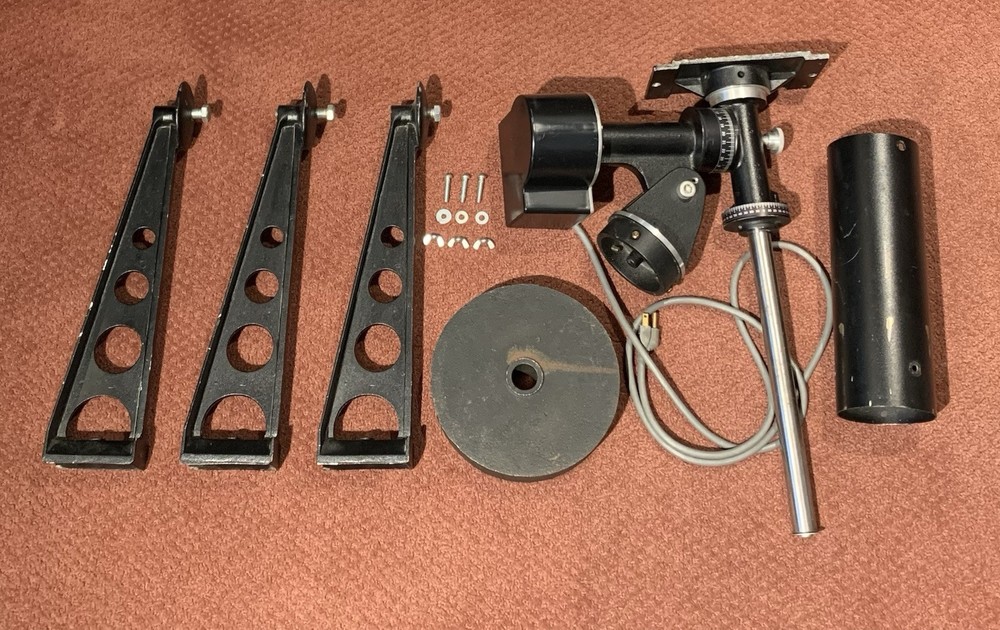
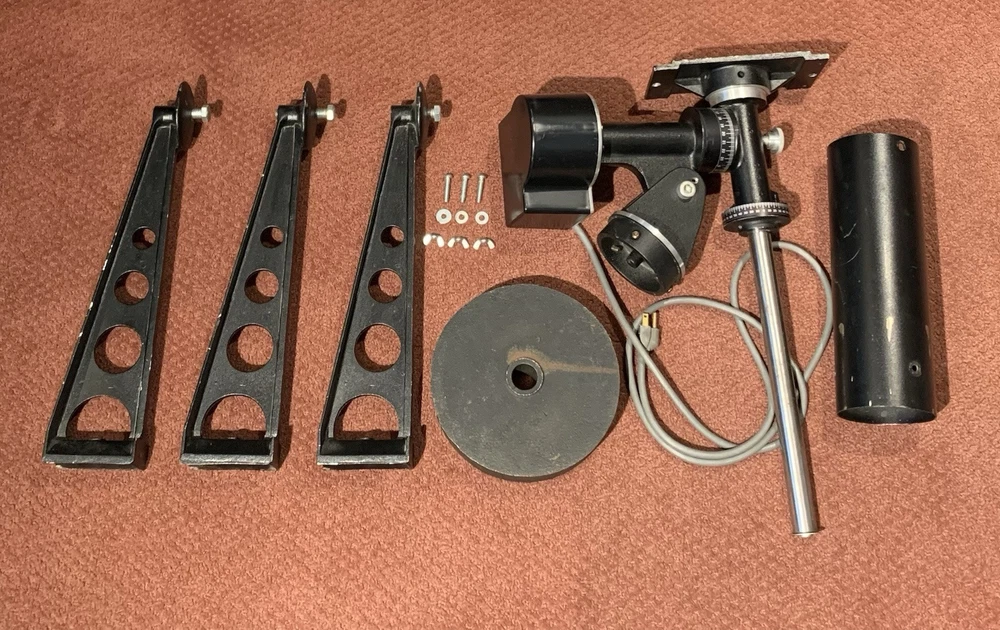


Meade telescope reflector Deep Space Telescopes DS-10A equatorial mount 1989 USA
$ 13.2
Description
This auction is for a 1989 Meade (Costa Mesa, CA, USA) DS-10A series equatorial mount. This is nearly 100% complete to code and missing only (2) screws for holding the motor drive housing aluminum cover. It has the other (3) screws securely holding this cover currently and you won't need to replace the missing (2) unless you are concerned about aesthetics. They can be found at a hardware store for a few cents.. Now then, in this auction you will receive: * equatorial head assembly with 110v AC RA motor drive * (1) 24.2 pound counterweight with locking setscrew * (1) milled aluminum low profile pedestal stand * (3) milled aluminum pier feet * (3) #1/2-13 steel machined hex bolts for leveling pier * (3) #1/4-20 domed setscrews for mount-to-pier fastening * (3) #1/4-20 screws and wingnuts for pier feet-to-pier fastening * (1) #1/4-20 flathead screw-with-washer for the toe-saver All of this is complete and original from Meade and in great condition. All you will need to get this mount assembled is a #5/32 allen wrench for the counterweight setscrew (locks the weight in position on the counterweight shaft) and for removing/fastening the (3) setscrews for mount head-to-pedestal attachment. This is an exceptionally rigid and highly approachable equatorial mount for the lone observer with their larger newtonian reflector. So, this mount you see here, in its beautiful, nearly all-black semi-gloss appearance, is the 2nd and final generation of the Deep Space Telescopes equatorial mounts. Falling under only one mpn code, 05028, it would be a more memorable code under 05042, in which this series of numbers referenced the entire DS-10A setup; both the 10-inch reflector in blue (or older years white) and this squat-sitting, pedestal-mounted equatorial mount. And perhaps you ask with curiosity, "what is a DS-10A"? The Meade Deep Space (DS) Telescopes are an interesting generation of the big Meade reflectors and were 10-inch and 16-inch equatorially-mounted, sapphire-blue sonatubed reflectors; a line that ran from right about winter of 1982 to December of 1991. The DS reflectors are the fathers of the Starfinder 10 Equatorial and Starfinder 16 Equatorial, and the DS-16 is Meade's first 16-inch reflector...No, there are no 16-inch Research Grades. By 1984, the catalogs would now offer both the DS mirrors for individual purchase and will exist as an option to the customer until the next great Meade shift in January of 1992. The seemingly brutishly-standing, zolatone-blue (yes, there are rarer white ones as well) DS-10 and DS-16 share qualities with the big gun, ultra-poised Research Grades of the 1970s and 80s (such as the Model 680 2-inch Nihon Seiko of Japan focusers and highly reliable, all aluminum, steel, and brass pedestal equatorial mounts), but begin to show the age of economics that would come into play strongly by 1992-93. In this, they are neither the expensive, complex, and lavishly beautiful RGs, nor are they anywhere near the rough-milled Starfinders. They are the medium "in betweens" and perfect for the exact market Meade was targeting at the time. In their time, they still had many OUSTANDING qualities that garnered much respect with the backyard astronomer. For a fun fact, the Deep Space Series telescopes that did not include the “A” suffix came with the Model 640 1.25-inch focuser. The “A” stood for coming with the 2-inch Model 680 focuser. So, with the DS-10 and DS-16 you had a marvelous, low profile equatorial mount that would be equal to the "C" Classic generation 6-inch and 8-inch 600 and 800 reflectors with perfect-fitting, no slop metal parts and casings at a thicker gauge, not to mention the top-of-the-line Model 680 2-inch focuser, but then you had a sonatube, a semi-particle wood cell, and a non-adjustable secondary mirror brace. So a mix of both worlds are experienced for sure. In contrast, the Starfinder 10 mirrors, though of the same pyrex quality, had a reputation for poorer optics on average due to lax on the quality control line, and these reflectors had lack-luster, weaker focusers, sporadic-tracking mounts on some, yet had excellent 4-vane secondary spider assemblies that you could collimate and a clock drive that could be operated by AA batteries for 50 hours. The Starfinders Eqs do have fine moments and both eras of these large reflectors brought many of us closer to our appreciation of backyard astronomy. Model: 05028 DS-10 Type: German equatorial pedestal-mounted Shaft size: 1.00-inches Counterweight shaft length: 12.63-inches Payload: 38 pounds visually Maximum tube length usage: 47-inches Motor drive: Model 787 Cramer Company right ascension stepper Type: synchronous with 3-inch spur gear reduction Clutched motor drive: yes Power source: 115v AC/60Hz AC cable length: 65-inches (5.4 feet) Top plate size: 8.09-in. L x 4.08-in. W Bolt pattern on top plate: (2) holes 7.33-inches apart Maximum bolt size for (2) holes: #5/16-18 or M7 Attachment of head to pier: (3) equidistant #1/4-20 button head machine screws Diameter of pier: 4.00-inches Height of mount at center of top plate: 22.89-inches Spread size of total foot coverage: 40.0-inch circle Construction: milled and cast aluminum, steel, brass, zinc Weight of head: 15 pounds 14 ounces Weight of pier with feet: 8 pounds 7 ounces Counterweight: 24 pounds 5 ounces Complete weight of equatorial mount: 48 pounds 10 ounces The Deep Space Telescopes mounts only ever came in (2) models; for the 10-inch reflector and for the 16-inch reflector. Their official model names were: * German Equatorial Mount with motor drive (As supplied with #DS-10A) * German Equatorial Mount with motor drive (As supplied with #DS-16AB) These mounts differed in their shaft sizes, load capacities, and top plate dimensions. The actual equatorial mount head for the DS-10 (and "A") is the very same as present on the 628, 645, 826, 856, 628C, 645C, and 826C. The only difference is that the Deep Space series German Equatorials sat on considerably shorter piers. The mount, feet assembly, motor drive, capacities; they are all the same. The DS-16AB mount was the exact same size as the Research Grade 880, 1060, and 1266; sporting 2-inch shafts. However, unlike the RG mounts (exact equivalent to the Cave Astrola and Parks Superior Nightlite), which were poised in polished aluminum and gray colors, had larger milled aluminum setting circle discs, and had casters on the pier feet, the DS-16ABs were devoid of the prettier colors and polished metals. Instead, like this DS-10A mount, was guised in all-black semi-gloss paint, did not have casters (though the pier feet do have holes for them as an additional purchase option), and had simpler setting circles. Both mounts used the same speed motor drives. Unlike the DS-16AB equatorial, the DS-10 (also "-A") equatorial head existed in (3) generations, keep in mind that the DS Series reflectors were not made until 1982: 1976-1985 brilliant silver and black color, no micro latitude adjuster 1982-1991 black semi gloss color, no micro latitude adjuster 1986-1991 black semi gloss color, micro latitude adjuster It is interesting to me that only when this mount is made for the DS-10 is it without the micro latitude adjuster. Only the "C" or "Classic" era fiberlite-tubed 6-inch and 8-inch reflectors from 1986-1991 get this much-loved accessory. Unlike the non-DS variants of these mounts, collectors will notice the top plate of the head has a set of (2) holes on the forward end of the plate, yet only (1) central hole on the rear section. This is specific to the DS-tailored mounts because the optical tubes for these large reflectors were fashioned from the very thick-skinned cardboard sonatubes, not the thinner fiberlites. Making rings to fit over tubes like these would be exceptionally expensive (by 1992 Meade will switch to the cost-effective, but fussy steel tape straps) to produce. They were not produced because the whole point of the DS-10A and DS-16AB was to have serious deep space observation capability at an affordable price without forgoing quality features. Therefore, these optical tubes fastened to the mount with dual, milled aluminum cradle rests. These were curved, C-shaped supports that were bolted directly to the optical tube and then their central steel studs (#5/16-18) ran through the holes of the plate and completed purchase with the aid of a large washer-and-wingnut. The Meade DS reflectors are the ONLY large-scale reflectors I know to have used this method of attachment to a German equatorial mount. The next generation Starfinder Equatorial Reflecting Telescopes also utilized these "C" brackets; however, they attached to the Starfinder Equatorial Mount with (2) studs, not (1) on each end of the top plate. Therefore, this mount CAN be used with large 8-inch to 10-inch class hinged tube rings (tube cradles) for both fiberglass-style and the more recent thin steel optical tubes, but you will need to drill (2) holes in the rear end of the top plate of this mount for that to work. Not a major task by any means, but it will be a modification apart from the original product. As discussed earlier, this equatorial mount would have originally held the DS-10A reflector, which, with its inclusive accessories in the day, to include the marvelous 680 2-inch focuser, would have weighed-in just a few ounces shy of 30 pounds. By comparison, the newer Starfinder Equatorial 10 optical tube weighed right about 27 pounds. So, this mount will easily hold any of the USA-made 10-inch class reflectors. It can also hold ANY 8-inch or 6-inch reflector tube, though in conjunction with the short pier, may have ground clearance issues with an 8-inch f/7 to 8-inch f/9 OR 6-inch f/10 tube. What is nifty here, is that because the DS-10 series equatorial head shares the exact same dimensions as all the other non-Research Grade mounts, the head will immediately fit into those models' longer piers. Yes, you heard that correctly; you can place this DS-10 equatorial head into the pier of a 1986 826C or perhaps a 1978 645. Furthermore, there is a very high probability that these Meade 1976-1991 smaller-class, pedestal-style equatorial heads will fit to the Criterion RV-6 and RV-8 piers. Both these mounts share MANY dimensional similarities. Just check beforehand. On an additional note, to pier fitment, I do know that this mount will not fit to the Edmund pedestals because they are too narrow and the Cave and Parks pedestals are generally too wide from what I have witnessed firsthand. Performance of this mount is simplistic by design, yet not only is it fool-proof and highly durable both against the elements and harsh handling, because it has virtually no exposed internals and no polar scope, it will be a mount that is going to outlive both you and myself. Already it runs and functions just like the day it was taken out of the shipping crate some 37 years ago. Before we wrap-up our conclusion of this fine equatorial, let us look into both its good points and not so good points. Why we love it: * The right ascension motor drive is internally clutched. This means there is no "locking" the RA axis in order to conduct tracking. Instead, the drive is to remain on (plugged-in) and you simply move the reflector to where you want to go. Then, the moment you stop manually slewing the scope, it resumes clocking. * Meade, Parks, Cave, Orion, and University Optics all catered RA drive correctors for these very types of RA motor drives. Though the mount will only clock in sideral rate, you can easily find a used, good-working, single axis drive corrector and accurately track faster-moving objects, like Jupiter, or the Moon. * The mount disassembles into many subsections, making this mount exceptionally easy to transport in highly manageable parcels. You do not need to be a Muscle Beach human in order to assemble/disassemble this equatorial mount. * Nearly ALL of the outer and inner components of this mount are either aluminum or brass. Not only that, the motor drive itself is deeply encased in an aluminum shell with a thick AC power cable. This ensures the mount is dew and mist resistant. It will even handle being under a weather-proof tarp left outside for periods of time. Rust will only come to the counterweight shaft and/or the counterweight itself. * The equatorial head is interchangeable to other piers made by Meade and possibly Criterion. And if one wishes to make a custom-height pier, it will be a very affordable and simple process. * If certain internals or outer components (such as the pier feet or declination lock clamp) need to be replaced, many other years of Meade and Criterion German Equatorials are interchangeable. And these mounts were numerous enough that even today their parts are not hard to find. * Those who want the mount to be moveable on wood or concrete can easily find original or aftermarket castors to fit the base pads of the pier feet. It is a common size. Why you may not like it as much: * These mounts far predate go-to computer technology. There is absolutely no way to alter this equatorial system to utilize an automatic slewing system. * The motor drive can only clock in sideral speed; the average motion of the stars as they cross the sky. Planets and the Moon will move faster than this and although the RA drive will definitely aid in high power observing, it will still not be fast enough to keep up. Only with the aid of a single axis drive corrector will this speed deficit be remedied. * Because these mounts were primarily aimed at serious visual observing, the mount does not feature the ability to clock in declination. * This mount will not work well in high latitude (north or south) locations because when angled high, the motor drive housing will bump into the pier. * The mount does not have manual slow motion capability. You cannot add slow motion cables to it. Movement in right ascension even at high power is easy. However, in declination, it can be a frustrating task at over 100x because the declination axis clamp must be disengaged in order to slew. If tube balance is spot-on, the declination axis can remain unlocked and slewing will then be a smooth process. * There is no ability for a polar scope. Polar alignment will need to be done through the reflector telescope itself. Using a compass for positioning the mount prior to mounting the telescope will ease the process. * The counterweight shaft is a permanent, unitary portion of the T-shaped axis shaft. Therefore, unlike conventional equatorial mounts, which can remove or recess their counterweight shafts completely, the shaft on this mount is permanently stationary. * The setscrew for the counterweight is deeply recessed inside the weight and specifically requires a 4mm allen wrench to loosen it for balancing the telescope. It can place the operator in an awkward position when adjusting and will be frustrating in the dark. * The setscrew for the counterweight is solid steel and will pit-and-scratch the counterweight shaft, which will, in turn, invite rust. * Because of the squat design of the pier, though the mount will be able to accommodate smaller reflector tubes with ease, if those tubes are longer than 46-inches, the cell-end of those optical tubes will contact the ground when aimed near the zenith. * The black pier feet will be a tripping hazard to other people unaware of this mount's design. They are very hard to see in the dark. * The AC power cable is a tripping hazard if this mount is being used around the public. Operation of this mount is dead-simple. The large, protruding aluminum grip knob jutting out in front of the polar axis is the declination axis clamp. Simply loosen it while loading your telescope and then tighten it once you are on your object of interest. It is an adjustable tension unit. So, if you want to have minor allowed movement (slew ability) while observing, then don't fully lock the clamp. If you keep it slightly loose, the telescope will move easily with a nudge of your hand, yet remain stationary when untouched. To operate the clock drive, first make sure your reflector is properly balanced on the right ascension axis. Then, once balance is proper, plug the AC cable into any wall outlet or 3-prong adapter. You do not need to worry about very minor unbalance issues, like when you change-out an eyepiece. Even if the mount is unbalanced, the drive will not strain. However, for the most accurate tracking performance, the optical tube must be balanced exactly. To adjust for latitude on the polar axis, simply have your allen wrench handy and loosen the large bolt near the base of the mount. Make sure to angle the mount PRIOR to mounting the counterweight on the counterweight shaft. This is an outstanding equatorial mount to use with your converted dobsonian reflectors. I have used final generation Celestron Starhopper 10 and 12 on this mount as well as an Orion Deep Space 10. This made using newer-era reflectors at high power an easy and enjoyable task. For those weary of the religious task of assembling and aligning a computer-driven equatorial mount (or equatorial drive table), this mount can be a godsend. It will work and work and ask very little in return aside from proper storage when not in use. It is a stark reminder of the golden years of Meade when even the budget-minded observer still got excellent quality performance and craftsmanship with minimal compromise. Veradale Mobile Observatory misses those years potently. This auction ad was completely, organically written by Veradale Mobile Observatory, not an A.I. software device; an actual honest-to-goodness, real human with over 20 years experience with now over 1000 telescopes made from today and all the way back to 1948. Packed with extreme care so that nothing in the box will be able to scrape/damage other items. And yes, I made sure to fully disengage the declination clamp so that the mount may safely flex during transit to you.