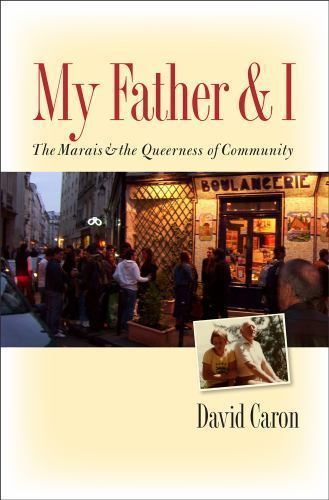
My Father and I The Marais Queer Community by David Caron 2009 Hardcover

$ 15.38

Illustrator: Yes Grade From: College Graduate Student Language: English Genre: Literary Criticism, Social Science, Biography & Autobiography, History Format: Hardcover Item Weight: 32.1 Oz Book Title: My Father and I : the Marais and the Queerness of Community ISBN-13: 9780801447730 Author: David Caron LCCN: 2008-043686 Synopsis: Beginning with the history of the Marais and his personal connection to the district, David Caron proposes a rethinking of community and looks at how Jews, Chinese immigrants, and gays have made the Marais theirs., "It is a living museum of a long-gone Jewish life and, supposedly, a testimony to the success of the French model of social integration. It is a communal home where gay men and women are said to stand in defiance of the French model of social integration. It is a place of freedom and tolerance where people of color and lesbians nevertheless feel unwanted and where young Zionists from the suburbs gather every Sunday and sometimes harass Arabs. It is a hot topic in the press and on television. It is open to the world and open for business. It is a place to be seen and a place of invisibility. It is like a home to me, a place where I feel both safe and out of place and where my father felt comfortable and alienated at the same time. It is a place of nostalgia, innovation, shame, pride, and anxiety, where the local and the global intersect for better and for worse. And for better and for worse, it is a French neighborhood."--from My Father and I Mixing personal memoir, urban studies, cultural history, and literary criticism, as well as a generous selection of photographs, My Father and I focuses on the Marais, the oldest surviving neighborhood of Paris. It also beautifully reveals the intricacies of the relationship between a Jewish father and a gay son, each claiming the same neighborhood as his own. Beginning with the history of the Marais and its significance in the construction of a French national identity, David Caron proposes a rethinking of community and looks at how Jews, Chinese immigrants, and gays have made the Marais theirs.These communities embody, in their engagement of urban space, a daily challenge to the French concept of universal citizenship that denies them all political legitimacy. Caron moves from the strictly French context to more theoretical issues such as social and political archaism, immigration and diaspora, survival and haunting, the public/private divide, and group friendship as metaphor for unruly and dynamic forms of community, and founding disasters such as AIDS and the Holocaust. Caron also tells the story of his father, a Hungarian Jew and Holocaust survivor who immigrated to France and once called the Marais home., "It is a living museum of a long-gone Jewish life and, supposedly, a testimony to the success of the French model of social integration. It is a communal home where gay men and women are said to stand in defiance of the French model of social integration. It is a place of freedom and tolerance where people of color and lesbians nevertheless feel unwanted and where young Zionists from the suburbs gather every Sunday and sometimes harass Arabs. It is a hot topic in the press and on television. It is open to the world and open for business. It is a place to be seen and a place of invisibility. It is like a home to me, a place where I feel both safe and out of place and where my father felt comfortable and alienated at the same time. It is a place of nostalgia, innovation, shame, pride, and anxiety, where the local and the global intersect for better and for worse. And for better and for worse, it is a French neighborhood."--from My Father and I Mixing personal memoir, urban studies, cultural history, and literary criticism, as well as a generous selection of photographs, My Father and I focuses on the Marais, the oldest surviving neighborhood of Paris. It also beautifully reveals the intricacies of the relationship between a Jewish father and a gay son, each claiming the same neighborhood as his own. Beginning with the history of the Marais and its significance in the construction of a French national identity, David Caron proposes a rethinking of community and looks at how Jews, Chinese immigrants, and gays have made the Marais theirs. These communities embody, in their engagement of urban space, a daily challenge to the French concept of universal citizenship that denies them all political legitimacy. Caron moves from the strictly French context to more theoretical issues such as social and political archaism, immigration and diaspora, survival and haunting, the public/private divide, and group friendship as metaphor for unruly and dynamic forms of community, and founding disasters such as AIDS and the Holocaust. Caron also tells the story of his father, a Hungarian Jew and Holocaust survivor who immigrated to France and once called the Marais home. Dewey Decimal: 306.76/6092244361 brand: Cornell University Press Intended Audience: Trade Publication Year: 2009 Publisher: Cornell University Press LC Classification Number: DC752.M37C37 2009 ISBN-10: 0801447739 Number of Pages: 288 Pages Topic: Lgbt Studies / General, European / French, Europe / France, Sociology / General, Personal Memoirs, Jewish Item Width: 6.1 in Item Height: 0.9 in Dewey Edition: 22 Reviews: My Father and I is beautifully written and often quite moving. David Caron's superb book uses the private as a template to analyze the public: his own story intersects with history and the result is a critical tour de force., David Caron's book is engaging and erudite, intellectually ambitious and historically varied. The author's elegant style and self-deprecatory wit keep us entertained through some pretty heavy subjects., "My Father and I is beautifully written and often quite moving. David Caron's superb book uses the private as a template to analyze the public: his own story intersects with history and the result is a critical tour de force."--Lawrence D. Kritzman, Dartmouth College, "David Caron's absorbing book about the historical Parisian coincidence between Jews and queers in the Marais contains a provocative blend of history and theory bound together with autobiography. My Father and I is smart, original and compelling. Anyone interested in queer studies, Jewish studies, or the history of Paris should read this book."-Elisabeth Ladenson, Columbia University, "In this engaging work, David Caron invites us on a journey that blends personal narrative with academic pursuit. . . . Caron poses the question of what makes a neighborhood . . . [and] questions the narrative of progress and authenticity and the limiting powers these discourse have on those who do not fit into nineteenth-century bourgeois norms of development. . . . Weaving in historical and literary analysis with ethnographic fieldwork, Caron crafts a wonderfully compelling book. Written in an accessible style that does not shy away from dense theoretical discussions, his work speaks to many research fields (film studies, Jewish studies, queer studies, urban studies, etc.)."-Luke L. Eilderts, French Review (January 2011), "My Father and I . . . is a beautifully written, cunningly shaped work. . . . Caron is cruising, as it were, two different readerships: one of them academic yet not necessarily queer; the other both gay and non-academic. I think, and hope, that he'll reach both."--Romanic Review, My Father and I... is a beautifully written, cunningly shaped work.... Caron is cruising, as it were, two different readerships: one of them academic yet not necessarily queer; the other both gay and non-academic. I think, and hope, that he'll reach both., "This is an extraordinary achievement and one of the most moving and exciting books I've read in quite some time. David Caron draws on personal, historical, literary, theoretical, geographical, and ethnographic narratives to paint a complex picture of a 'queer community' in twenty-first-century France. Caron skillfully weaves a story about collective identity, loss, and transformation that includes his own life as a queer son, the very different life of his Jewish father, and the multiple narratives in which those two lives are historically inscribed. Caron's book is a paradoxical affirmation of the failed encounter that is community on the model of the 'disaster' that defines the relationship between father and son. In Caron and his father, who always just missed each other in their attempts at connection, we find, if not a model, perhaps an exemplum of a being-together as copains: what Caron calls in the final chapter the 'queerness of group friendship.' The result is a brilliant meditation on the modalities of existence of French communities and, more generally, on what it ultimately means to be in community: to be with other people."-Lynne Huffer, Emory University, author of Mad for Foucault, "A sophisticated treatment of the relationship between homosexuality and urban space."--Urban History, "A brilliant, insightful, and moving study. . . . A compelling combination of personal memoir, urban history, literary analysis, and critical theory. . . . A detailed, expansive, and ground-breaking book. In his role as one of America's leading French scholars of both Queer and Jewish identities, Caron will undoubtedly be in great demand to offer his further thoughts on these (among other) places where French and American Queers and Jews intersect."--South Central Review, "In this engaging work, David Caron invites us on a journey that blends personal narrative with academic pursuit. . . . Caron poses the question of what makes a neighborhood . . . [and] questions the narrative of progress and authenticity and the limiting powers these discourse have on those who do not fit into nineteenth-century bourgeois norms of development. . . . Weaving in historical and literary analysis with ethnographic fieldwork, Caron crafts a wonderfully compelling book. Written in an accessible style that does not shy away from dense theoretical discussions, his work speaks to many research fields (film studies, Jewish studies, queer studies, urban studies, etc.)."--Luke L. Eilderts, French Review (January 2011), This is an extraordinary achievement and one of the most moving and exciting books I've read in quite some time. David Caron draws on personal, historical, literary, theoretical, geographical, and ethnographic narratives to paint a complex picture of a 'queer community' in twenty-first-century France. Caron skillfully weaves a story about collective identity, loss, and transformation that includes his own life as a queer son, the very different life of his Jewish father, and the multiple narratives in which those two lives are historically inscribed. Caron's book is a paradoxical affirmation of the failed encounter that is community on the model of the 'disaster' that defines the relationship between father and son. In Caron and his father, who always just missed each other in their attempts at connection, we find, if not a model, perhaps an exemplum of a being-together as copains: what Caron calls in the final chapter the 'queerness of group friendship.' The result is a brilliant meditation on the modalities of existence of French communities and, more generally, on what it ultimately means to be in community: to be with other people., "An excellent, touching memoir. . . . No lover of Paris can fail to be touched by Caron's book. Yet just as importantly, it is a fascinating analysis of community and its affect, an illustration of what it means to belong, and what it means to be separated, to return, or to fail to return."--French Forum, "David Caron's absorbing book about the historical Parisian coincidence between Jews and queers in the Marais contains a provocative blend of history and theory bound together with autobiography. My Father and I is smart, original and compelling. Anyone interested in queer studies, Jewish studies, or the history of Paris should read this book."--Elisabeth Ladenson, Columbia University, David Caron is one of those rare intellectuals who manage to enliven debates about subjectivity, sexuality, and temporality. This volume, at once a personal memoir, a paean to the global capital of love, a belated letter to his father, and an essay on grief and the Holocaust, is peppered with witty excogitations about a gay man's life. An easy first read, it enthralls the reader and makes sure they will want to reread it., A brilliant, insightful, and moving study.... A compelling combination of personal memoir, urban history, literary analysis, and critical theory.... A detailed, expansive, and ground-breaking book. In his role as one of America's leading French scholars of both Queer and Jewish identities, Caron will undoubtedly be in great demand to offer his further thoughts on these (among other) places where French and American Queers and Jews intersect., "A fascinating and moving study . . . . Combining biography, memory, history, and theory, Caron offers a stirring meditation on and radical critique of the notion of community. . . . Undeniably bold."--Contemporary French Civilization, "David Caron's book is engaging and erudite, intellectually ambitious and historically varied. The author's elegant style and self-deprecatory wit keep us entertained through some pretty heavy subjects."--French Studies, "Caron's insightful book offers a poignant exploration of issues of otherness and belonging."--Choice, I loved this book! It made me cry, think, and once I even threw it down saying, 'This is bullshit!'.... It is a brilliant piece of cultural analysis., A fascinating and moving study.... Combining biography, memory, history, and theory, Caron offers a stirring meditation on and radical critique of the notion of community.... Undeniably bold., In this engaging work, David Caron invites us on a journey that blends personal narrative with academic pursuit.... Caron poses the question of what makes a neighborhood... [and] questions the narrative of progress and authenticity and the limiting powers these discourse have on those who do not fit into nineteenth-century bourgeois norms of development.... Weaving in historical and literary analysis with ethnographic fieldwork, Caron crafts a wonderfully compelling book. Written in an accessible style that does not shy away from dense theoretical discussions, his work speaks to many research fields (film studies, Jewish studies, queer studies, urban studies, etc.)., "David Caron is one of those rare intellectuals who manage to enliven debates about subjectivity, sexuality, and temporality. This volume, at once a personal memoir, a paean to the global capital of love, a belated letter to his father, and an essay on grief and the Holocaust, is peppered with witty excogitations about a gay man's life. An easy first read, it enthralls the reader and makes sure they will want to reread it."--Sexualities, "This is an extraordinary achievement and one of the most moving and exciting books I've read in quite some time. David Caron draws on personal, historical, literary, theoretical, geographical, and ethnographic narratives to paint a complex picture of a 'queer community' in twenty-first-century France. Caron skillfully weaves a story about collective identity, loss, and transformation that includes his own life as a queer son, the very different life of his Jewish father, and the multiple narratives in which those two lives are historically inscribed. Caron's book is a paradoxical affirmation of the failed encounter that is community on the model of the 'disaster' that defines the relationship between father and son. In Caron and his father, who always just missed each other in their attempts at connection, we find, if not a model, perhaps an exemplum of a being-together as copains: what Caron calls in the final chapter the 'queerness of group friendship.' The result is a brilliant meditation on the modalities of existence of French communities and, more generally, on what it ultimately means to be in community: to be with other people."--Lynne Huffer, Emory University, author of Mad for Foucault, An excellent, touching memoir.... No lover of Paris can fail to be touched by Caron's book. Yet just as importantly, it is a fascinating analysis of community and its affect, an illustration of what it means to belong, and what it means to be separated, to return, or to fail to return., "I loved this book! It made me cry, think, and once I even threw it down saying, 'This is bullshit!' . . . . It is a brilliant piece of cultural analysis."--AJS Review, David Caron's absorbing book about the historical Parisian coincidence between Jews and queers in the Marais contains a provocative blend of history and theory bound together with autobiography. My Father and I is smart, original and compelling. Anyone interested in queer studies, Jewish studies, or the history of Paris should read this book. gtin13: 9780801447730 Item Length: 9.2 in

Description

  1. This book is a heartfelt exploration of identity, memory, and queer community through the lens of Paris’s Marais district. David Caron weaves personal and historical narratives beautifully, making it both intimate and insightful. The hardcover edition feels sturdy and well-crafted, perfect for revisiting its poignant reflections. A must-read for anyone interested in LGBTQ+ history or father-son relationships. Engaging and deeply moving!

    John94ce65e8