Vatican Pavilion, 1964/5 World's Fair, Flushing Meadows–Corona Park, NY Postcard
$ 3.7
Description
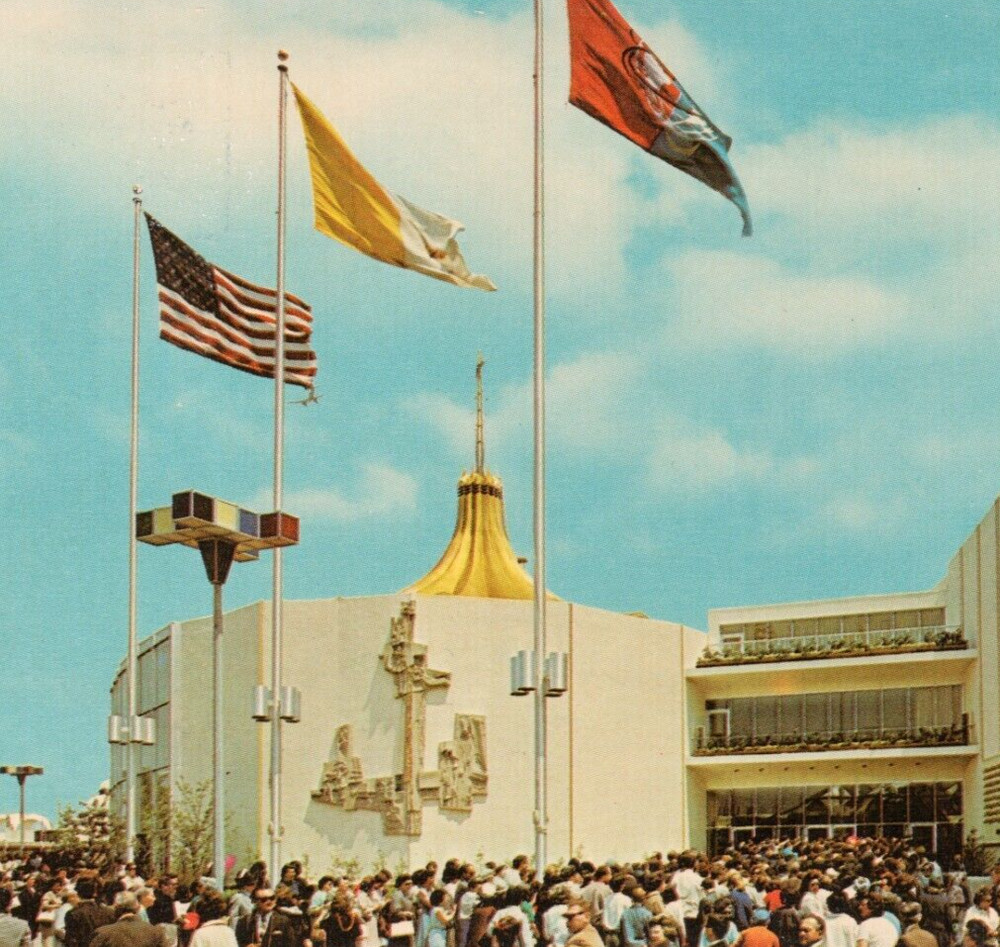
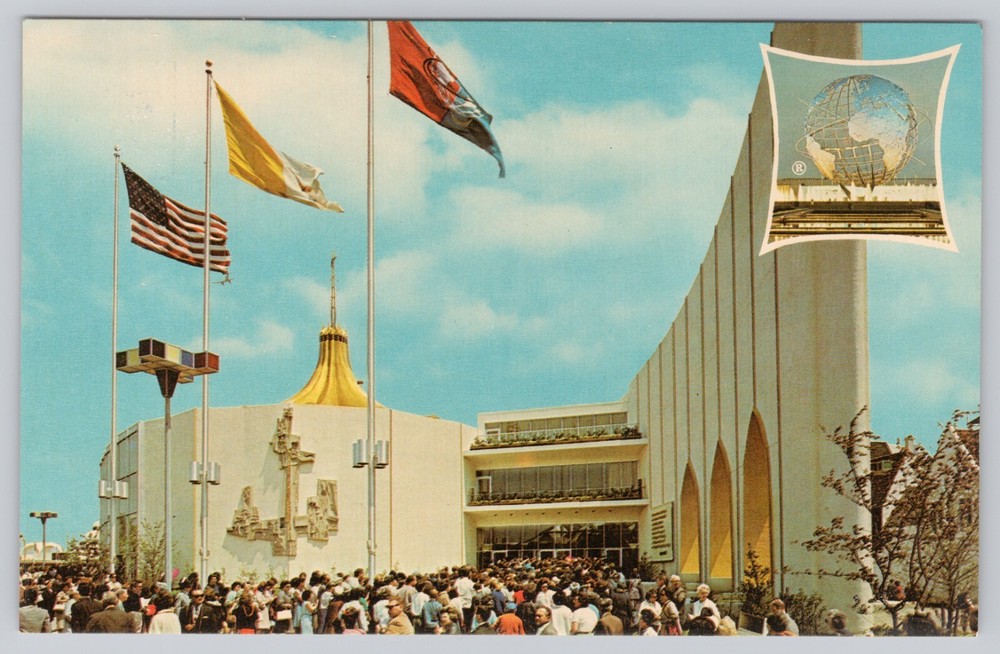
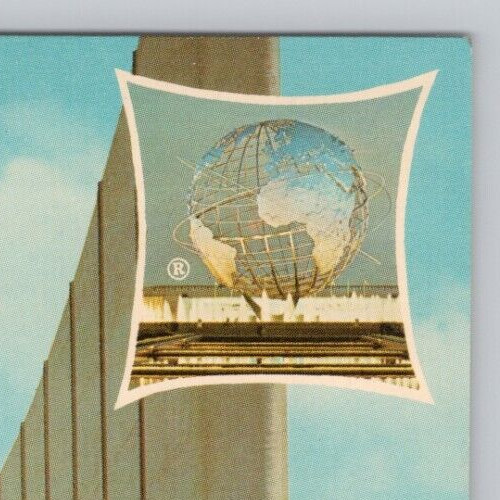
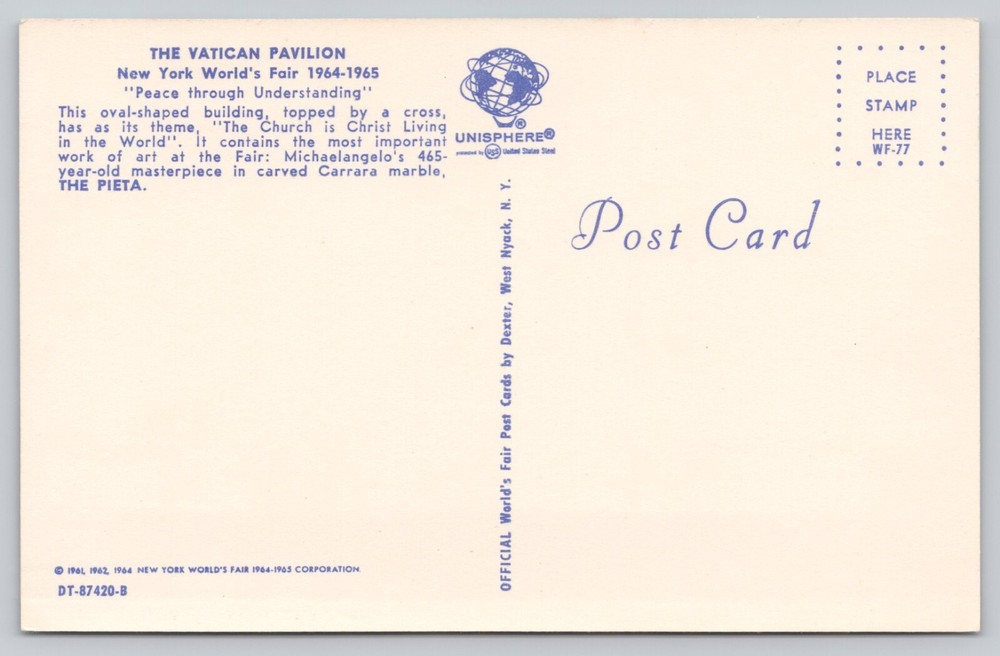
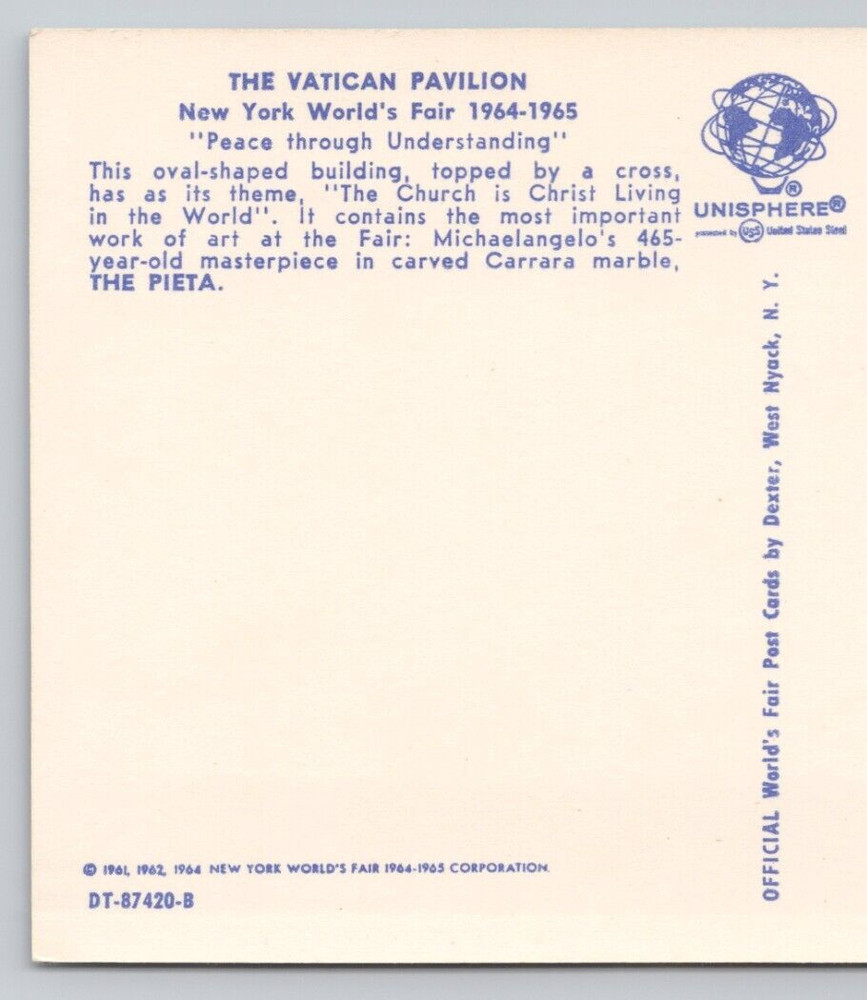
Vatican Pavilion, 1964/5 World's Fair, Flushing Meadows–Corona Park, NY Postcard. Initially, the fair had 139 pavilions, in addition to 34 concessions and shows. The fair had 198 restaurants at its peak, and dishes served at these restaurants, such as Belgian waffles, were popularized through the fair. DT-87420-B WF-77 THE VATICAN PAVILION New York World's Fair 1964-1965. “Peace through Understanding" This oval-shaped building, topped by a cross, has as its theme, “The Church is Christ Living in the World". It contains the most important work of art at the Fair: Michaelangelo's 465-year-old masterpiece in carved Carrara marble THE PIETA. UNISPHERE® Presented by USS United States Steel © 1961, 1962, 1964 NEW YORK WORLD'S FAIR 1964-1965 CORPORATION OFFICIAL World's Fair Post Cards by Dexter, West Nyack, New York Flushing Meadows–Corona Park, Grand Central Parkway and Van Wyck Expressway, Queens, Queens County, New York 11354 "The Vatican pavilion proved to be the most popular of the religious exhibits at the Fair; in fact, it was the second-most popular pavilion overall, with General Motors being the first ranked. A very visible location next to the Astral Fountain and at the bridge to the Lake Amusement Area certainly helped, but by far the largest reason for its success was Michelangelo's Pietà." - worldsfairphotos vatican The Madonna della Pietà (Italian: [pjeˈta]; 1498–1499), informally known as La Pietà, is a marble sculpture of Jesus and Mary at Mount Golgotha representing the "Sixth Sorrow" of the Blessed Virgin Mary by Michelangelo Buonarroti, now in Saint Peter's Basilica, Vatican City. It is a key work of Italian Renaissance sculpture and often taken as the start of the High Renaissance. The 1964–1965 New York World's Fair was an international exposition at Flushing Meadows–Corona Park in Queens, New York City, United States. The fair included exhibitions, activities, performances, films, art, and food presented by 80 nations, 24 U.S. states, and nearly 350 American companies. The 646-acre (261 ha) fairground consisted of five sections: the Federal and State, International, Transportation, Lake Amusement, and Industrial areas. The fair was themed to "peace through understanding" and was centered on the Unisphere, a stainless-steel model of the Earth. Initially, the fair had 139 pavilions, in addition to 34 concessions and shows. The site had previously hosted the 1939 New York World's Fair. Several businessmen devised plans for a 1964 fair in the 1950s, and the New York World's Fair 1964 Corporation (WFC) was formed in 1959. Although U.S. president Dwight D. Eisenhower approved the fair, the Bureau International des Expositions never recognized it. Construction began in late 1960, and over a hundred exhibitors signed up for the fair over the next three years. The fair ran for two six-month seasons: April 22 to October 18, 1964, and April 21 to October 17, 1965. Despite initial projections of 70 million visitors, the fair had just over 51.6 million guests. After the fair, some pavilions were preserved or relocated, but most structures were demolished. The fair showcased mid-20th-century American culture and technology. The different sections were designed in various architectural styles, though anyone could host an exhibit if they could afford to rent the land and pay for a pavilion. The fairground had several amusement and transport rides, as well as various plazas and fountains. The fair had 198 restaurants at its peak, and dishes served at these restaurants, such as Belgian waffles, were popularized through the fair. There were more than 30 entertainment events at the fair, in addition to 40 theaters and various music performances. Exhibitors also displayed sculptures, visual art, and artifacts, along with consumer products such as electronics and cars. The contemporary press criticized the event as a financial failure. Nonetheless, the fair helped influence 21st-century technologies and popularized consumer products such as Belgian waffles and the Ford Mustang. Flushing Meadows–Corona Park, Queens, Queens County, New York (often referred to as Flushing Meadows Park or simply Flushing Meadows) is a public park in the northern part of Queens in New York City, New York, U.S. It is bounded by I-678 (Van Wyck Expressway) on the east, Grand Central Parkway on the west, Flushing Bay on the north, and Union Turnpike on the south. Flushing Meadows–Corona Park is the fourth-largest public park in New York City, with a total area of 897 acres (363 ha). Until the 19th century, the site consisted of wetlands straddling the Flushing River, which traverses the region from north to south. Starting in the first decade of the 20th century, it was used as a dumping ground for ashes, since at the time, the land was so far away from the developed parts of New York City as to be considered almost worthless. New York City Parks Commissioner Robert Moses first conceived the idea of developing a large park in Flushing Meadow in the 1920s as part of a system of parks across eastern Queens. Flushing Meadows–Corona Park was created as the site of the 1939 New York World's Fair and also hosted the 1964 New York World's Fair. Following the 1964 fair, the park fell into disrepair, although some improvements have taken place since the 1990s and 2000s. Flushing Meadows–Corona Park retains much of the layout from the 1939 World's Fair. Its attractions include the USTA Billie Jean King National Tennis Center, the current venue for the US Open tennis tournament; Citi Field, the home of the New York Mets baseball team; the New York Hall of Science; the Queens Museum; the Queens Theatre in the Park; the Queens Zoo; the Unisphere; and the New York State Pavilion. It formerly contained Shea Stadium, demolished in 2009. The Flushing River continues to run through the park, and two large lakes called Meadow and Willow Lakes take up much of the park's area south of the Long Island Expressway. 1964–1965 New York City Unisphere viewed from observation towers of the New York State Pavilion Overview BIE-class Unrecognized exposition Name 1964–1965 New York World's Fair Motto Peace through Understanding[1] Building(s) Unisphere,[1] 139 pavilions, 34 concessions[2] Area 646 acres (2.61 km2)[3] Visitors 51,607,448[4][5] Organized by Robert Moses Participant(s) Countries 66[6][7] (80 including nations without full exhibits[1]) Business Nearly 350 companies Location Country United States City New York City Venue Flushing Meadows–Corona Park Timeline Bidding 1959[8] Awarded N/A[6] Opening April 22, 1964 (first season)[9] April 21, 1965 (second season)[10] Closure October 18, 1964 (first season)[11] October 17, 1965 (second season)[12] Universal Previous Century 21 Exposition in Seattle Next Expo 67 in Montreal Internet - nywf64 This vintage postcard features the Vatican Pavilion from the 1964/5 World's Fair in Flushing Meadows-Corona Park, NY. Published by the New York World's Fair 1964-1965 Corporation, the printed lithograph captures the essence of the event's theme of "Peace through Understanding." Made of cardboard and paper, this postcard measures a standard 5.5 x 3.5 inches and is divided back with chrome features. The postcard offers a glimpse into the art, architecture, and social history of the event, making it a desirable collectible for enthusiasts of American events and exhibitions.