


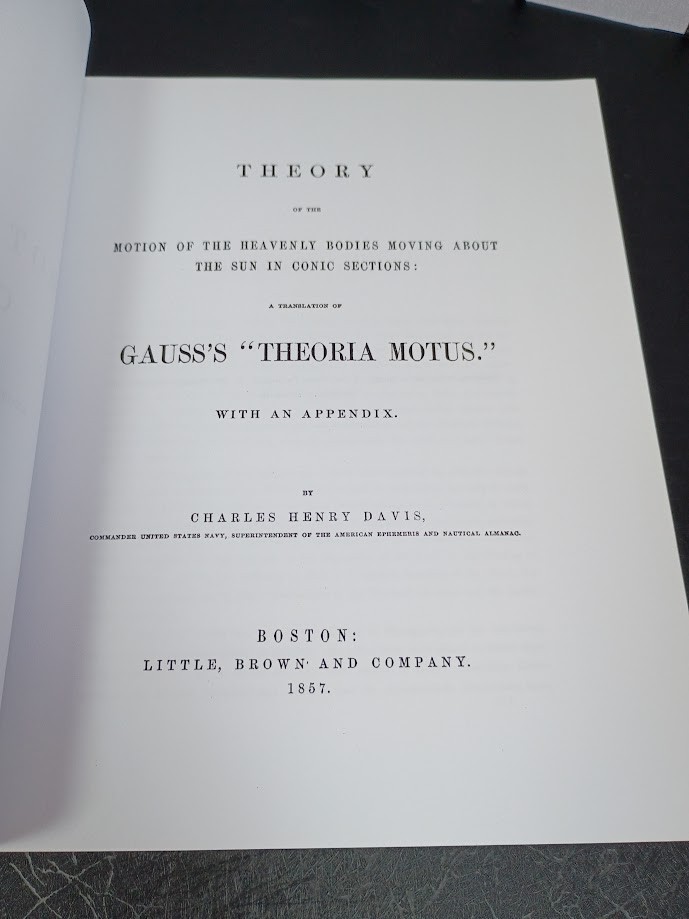




Gauss Theoria Motus Theory Motion Heavenly Bodies Davis 1857 1st English EC
$ 7.5
Description
Gauss Theoria Motus Theory Motion Heavenly Bodies Davis 1857 1st English EC. Gauss - Theory of the Motion of the Heavenly Bodies (Theoria Motus) - 1857. A Translation of Gauss's "Theoria Motus". Theoria Motus Corporum Coelestium in Sectionibus Conicis Solem Ambientium, originally published in Latin in 1809. Gauss - Theory of the Motion of the Heavenly Bodies (Theoria Motus) - 1857 First English Edition • 1857 Theory of the Motion of the Heavenly Bodies Moving About the Sun in Conic Sections A Translation of Gauss's "Theoria Motus" Carl Friedrich Gauss Translated by Charles Henry Davis, Commander U.S. Navy Superintendent of the American Ephemeris and Nautical Almanac Boston: Little, Brown and Company • 1857 ✦ A Landmark in the History of Mathematics & Astronomy ✦ "One of the most perfect books ever written on theoretical astronomy." — Contemporary Review About This Work This is the first English translation of Carl Friedrich Gauss's monumental Theoria Motus Corporum Coelestium in Sectionibus Conicis Solem Ambientium, originally published in Latin in 1809. It remains Gauss's chief work on celestial mechanics and established the mathematical foundations for calculating and predicting the orbits of planets, asteroids, and comets. In this work, Gauss introduced the principle of curvilinear triangulation and the four formulae in spherical trigonometry known as "Gauss's Analogies," which enabled astronomers to accurately calculate and predict orbit locations. He also presented the method of least squares — now one of the most widely used mathematical techniques in science, engineering, and data analysis. The astronomical methods described in this work are still in use today, with only minor modifications necessary to adapt them for modern computers. It became the standard reference for orbital mechanics for more than a century. The Discovery of Ceres — A Mathematical Triumph On January 1, 1801, Giuseppe Piazzi discovered a new celestial object — later named Ceres — the first known asteroid. After only 41 days of observation (covering just 3° of arc), Ceres disappeared behind the glare of the Sun. Astronomers faced a seemingly impossible challenge: with such meager data, how could they predict where Ceres would reappear? The 24-year-old Carl Friedrich Gauss applied his revolutionary methods and calculated Ceres's orbit with unprecedented accuracy. When astronomers turned their telescopes to Gauss's predicted location, they found Ceres within half a degree of where he said it would be. This triumph established Gauss's reputation worldwide and led to his appointment as Director of the Göttingen Observatory — a position he held for the rest of his life. Key Mathematical Contributions Method of Least Squares Now fundamental to GPS, data science, machine learning, and virtually all modern science Gauss's Analogies Four formulae in spherical trigonometry for calculating orbital positions Curvilinear Triangulation Revolutionary technique for determining orbits from limited observations Orbital Mechanics Systematic methods for calculating planetary and cometary orbits CFG Carl Friedrich Gauss 1777–1855 Known as the "Prince of Mathematicians," Gauss made transformative contributions to number theory, algebra, statistics, analysis, differential geometry, geodesy, geophysics, electrostatics, astronomy, and optics. His Disquisitiones Arithmeticae (1801) reshaped number theory; his Theoria Motus (1809) revolutionized celestial mechanics. CHD Charles Henry Davis 1807–1877 Rear Admiral, U.S. Navy. First Superintendent of the American Ephemeris and Nautical Almanac. Victor at the Battle of Memphis (1862). Director of the U.S. Naval Observatory. Founder of the National Academy of Sciences (1863). Made the first comprehensive survey of the New England coast. Author Carl Friedrich Gauss Translator Charles Henry Davis Publisher Little, Brown and Company Place Boston Year 1857 Edition First English Edition Original Latin 1809 Subject Celestial Mechanics / Astronomy Condition EC — Excellent Excellent book in unread/lightly read like-new condition. Clean, crisp, unmarked pages. Tight binding and uncreased spine. Cover is clean with minimal handling/shelf wear. Please see photos for complete condition assessment. 📚 Collector's Note Gauss's Theoria Motus is one of the foundational texts of modern science — essential for historians of mathematics, astronomers, and collectors of landmark scientific works. The Davis translation made this crucial work accessible to English-speaking astronomers and mathematicians for the first time. A significant addition to any collection of scientific classics. JT Enterportals Rare, Academic & Scholarly Books 📦 Same or Next Business Day Shipping >>Powered by WonderLister App