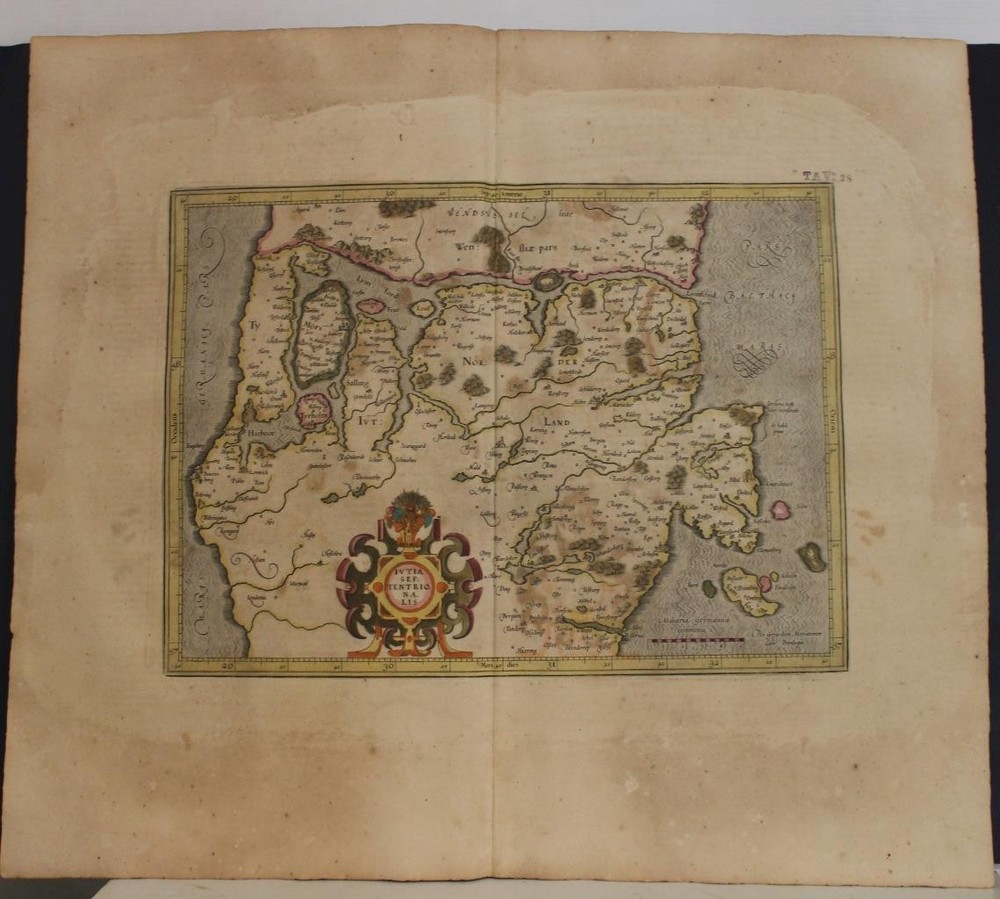
NORTH JUTLAND DENMARK 1630ca MERCATOR/HONDIUS UNUSUAL ANTIQUE COPPER ENGRAVEDMAPANTIQUE COPPER ENGRAVED MAP OF NORTHERN JUTLAND 1630ca
$ 10.56
Description
NORTH JUTLAND DENMARK 1630ca MERCATOR/HONDIUS UNUSUAL ANTIQUE COPPER ENGRAVEDMAP. The engraving technique used is characteristic of the period, with intricate line work and detailed depictions of geographical features. map of the northern Jutland (Jylland) in Denmark. Shows Midtjylland (Central Jutland) between the North Sea and Kattegat with Thisted, Aalborg, Randers, Aarhus, Horsens, Grenaa and the island of Samsø. NORTH JUTLAND DENMARK 1630ca MERCATOR/HONDIUS UNUSUAL ANTIQUE COPPER ENGRAVEDMAP NORTH JUTLAND DENMARK 1630ca MERCATOR/HONDIUS UNUSUAL ANTIQUE COPPER ENGRAVEDMAP Description Iutia Septentrionalis. Per Gerardum Mercatorem Cum privilegio. Description: Striking and highly detailed interesting unusual copper engraved map of the northern Jutland (Jylland) in Denmark. Shows Midtjylland (Central Jutland) between the North Sea and Kattegat with Thisted, Aalborg, Randers, Aarhus, Horsens, Grenaa and the island of Samsø. Composition and Medium: The map is an engraved representation of the northern part of the Jutland Peninsula, which is now part of modern-day Denmark. The engraving technique used is characteristic of the period, with intricate line work and detailed depictions of geographical features. The map includes a decorative cartouche, typical of the style used by Mercator and Hondius, adding an artistic element to the scientific representation. Style and Features: The style of the map is consistent with the early 17th-century cartographic standards, featuring a blend of artistic flair and scientific precision. The map utilizes hatching to depict relief and water bodies, with the North Sea and Baltic Sea prominently labeled. The typography includes italicized script, a style introduced by Mercator himself, which became standard in cartography for its readability and elegance. Notable Features: - Cartouche: The map features an ornate cartouche with the title "Jutia Septentrionalis," highlighting Mercator's influence in blending art with cartography. - Scale and Orientation: The map is oriented with north at the top, a standard orientation that became more prevalent due to Mercator's influence. The scale is approximately 1:700,000, allowing for detailed representation of the region. - Geographical Details: The map depicts rivers, forests, and settlements with precision. The topography is indicated through the use of hachures, and the coastlines are carefully outlined. - Inscriptions: Various regions and settlements are labeled with Latinized names, reflecting the academic and international nature of cartography at the time. Subject Matter and Context: The map focuses on the northern region of Jutland, a significant area in Denmark known for its historical and strategic importance. During the early 17th century, maps like this were crucial for navigation, trade, and territorial understanding. The detailed depiction of the landscape would have been valuable for explorers and merchants navigating the complex waterways of Scandinavia. Cultural and Historical Context: Gerard Mercator was a pioneering figure in cartography, introducing the Mercator projection, which revolutionized navigation. His collaboration with Jodocus Hondius, who acquired Mercator’s plates after his death, allowed for the continued influence and dissemination of Mercator's work. This map is a testament to their partnership and the enduring legacy of their contributions to geography. The map was published during a period of significant exploration and expansion in Europe, where accurate maps were essential for maritime navigation. The detailed representation of Jutland reflects the region's importance during this era, both politically and economically. Significance: This map is part of a broader atlas that played a crucial role in the dissemination of geographical knowledge during the Age of Exploration. The collaboration between Mercator and Hondius represents a pivotal moment in the history of cartography, marking the transition from medieval to modern map-making techniques. Conclusion: The "Jutia Septentrionalis" map by Gerard Mercator and Jodocus Hondius is a significant historical artifact that embodies the scientific and artistic achievements of early 17th-century cartography. Its detailed depiction of northern Jutland, combined with its ornate design, reflects the broader cultural and historical context of its creation, serving as a valuable resource for understanding the geography and exploration of the era. Latin text on the verso . Date: 1630 approx. ( undated ) Dimension: Paper size approx.: cm 57,1 x 50,3 Condition: Very strong and dark impression on good paper. Paper with chains and wiremarks. Map old original colored. Wide margins. Corners partially missing. Sheet with foxing and browning. Small moisture signs. M ap folded. Conditions are as you can see in the images. Mapmakers: The Hondius Family Jodocus Hondius the Elder (1563-1612) Joost d’Hondt was born at Wakken (Flanders) in 1563. Two years later, his family settled down in Ghent, where young Joost displayed a great gift for drawing and calligraphy. Through study and lessons, he developed his talents and became an engraver with a good reputation. Due to the circumstances of war, he moved in 1584 to London where he settled down as an engraver, instrument-maker and map-maker. In 1587, he married Coletta van den Keere, sister of the well-known engraver, Pieter van den Keere (Petrus Kaerius); some years earlier his sister, Jacomina, had married Pieter van den Berghe (Petrus Montanus). Joost, who had Latinized his name to Jodocus Hondius, closely co-operated with his two brothers-in-law. The political situation in the Northern Netherlands in 1593 was such that Jodocus seemed to be justified in establishing himself in Amsterdam, where so many Antwerp printers, publishers, and engravers had gone. In this new centre of cartography, Jodocus Hondius set up his business “In de Wackere Hondt” (in the vigilant dog), this name being an allusion to his birthplace and name. Here he engraved many maps and published atlases and many other works such as his continuation of Gerard Mercator’s Atlas. He suddenly passed away in February 1612. The publishing firm of Jodocus Hondius was continued by his widow; later on by his two sons Jodocus Jr., and Henricus, and by his son-in-law, J. Janssonius. Jodocus Hondius II (1594-1629) & Henricus Hondius (1597-1651) After the father’s death, the widow with her seven children continued publishing the atlases under the name of Jodocus Hondius till 1620. The firm was reinforced by the very welcome help of Joannes Janssonius (1588-1664), who married 24-year-old Elisabeth Hondius in 1612. After 1619 Mercator’s Atlas was published under the name of Henricus Hondius. One of the most dramatic events in the early history of commercial cartography in Amsterdam was the sale of Jodocus Hondius Jr.’s copper plates to Willem Jansz. Blaeu in 1629, the year of his death. At least 34 plates, from which Jodocus II had printed single-sheet maps for his own benefit, passed into the hands of his great competitor. Immediately after that, his brother, Henricus, and Joannes Janssonius ordered the engraving of identical plates. During a long period, Henricus devoted all his energy to the publication of the Atlas. He saw its growth up to, and including, the fourth part in 1646; after that, his name does not figure any more on the title-pages. After 1638, the title of the Atlas was changed to Atlas Novus; it was mainly carried on by Joannes Janssonius. The competition with the Blaeu's dates from 1630. In 1630, Willem Janszoon (=Blaeu) made the first attack with his Atlantis Appendix. In 1635, Blaeu completed his Theatrum orbis terrarum in two volumes with texts in French, Latin, Dutch, and German, which prompted Henricus Hondius to speed up the enlargement of his Atlas. Gerard Mercator (1512 – 1594) was born as Gerard de Cremere in Rupelmonde (near Antwerp) on 5 March 1512. Young Gerard learned what Latin he could in Rupelmonde, and when he was about fifteen, his uncle sent him to ’s Hertogenbosch to study at a school run by the Brothers of the Common Life. One of Mercator’s teachers was the celebrated humanist Macropedius. After three and a half years with the brothers, Gerard went to Louvain, where he enrolled in the university in 1530 as one of the poor students at Castle College. By this time, he had Latinized his name to Mercator. He studied philosophy and took his master’s degree in 1532. The problems of the creation of the Universe and the Earth interested him in particular; this is reflected by his works, written in later years. After spending a few years in Antwerp, he returned to Louvain c. 1535, where he took courses in mathematics under the guidance of Gemma Frisius. Soon he was recognised as an expert on the construction of mathematical instruments, as a land-surveyor and, after 1537, as a cartographer. He drew his income from these activities after his marriage on 3 August 1536. He also qualified himself as a copper-engraver; he was the first in history to introduce the italic handwriting to this trade. The first maps, drawn and engraved by Gerard Mercator are: Palestine, 1537; the world in double heart-shaped projection, 1538; and Flanders, 1540. In 1544, Mercator came into great danger: he was arrested on the accusation of heresy and put into jail. Thanks to intervention of the University of Louvain, he was released after four months. In 1552, he moved with his family into the city of Duisburg (Germany). In 1560, Mercator became cosmographer in service of the Duke of Jülich-Cleve-Berge and in 1563 he became lecturer at the Grammar School of the new University in Duisburg. During this period, he made wall-maps of Europe, 1554; of Loraine, 1564; the British Isles, 1564; and the famous map of the world with increasing latitudes, 1569. About this time, Mercator was also working on the project for a complete description of the Creation, the Heavens, Earth, and Sea and a world history. Out of this resulted his Atlas, sive cosmographicae meditationes de fabrica mundi et fabricati figura. He worked also on an edition of Ptolemy’s Geographia which appeared in 1578. The first part of his book with modern maps (France, Germany and the Netherlands) appeared in 1585. Shortly after the publication of the second part of his map-book (not yet called Atlas) with the maps of Italy (1589), he had a stroke which brought an end to his extremely great productivity. The great man passed away on 2 December 1594, leaving the responsibility of finishing the map-book to his son Rumold. The final part of it appeared in 1595. Its title is Pars Altera and it constitutes an essential part of what was then called Mercator’s Atlas. The map of Europe and the world map in the Atlas are by Rumold Mercator. After Rumold’s death in 1599, the Atlas was reissued once more in 1602. The plates of the maps, both of the Ptolemy edition and the Atlas, were sold in 1604 to Jodocus Hondius of Amsterdam. The following year Hondius managed to bring out Ptolemy’s Geographia. In the following year, 1606, the first Amsterdam edition of the Mercator Atlas appeared. From then to 1638, the Atlas saw many enlarged editions in various languages. All of the maps we sell are ORIGINALS. We guarantee all of our maps to be authentic. We do our best to describe the condition of our maps as accurately as possible. Due to the age and type of paper, some imperfections are to be expected. Please examine the images provided carefully, and if you have any questions please ask and we will be happy to help. A Certification of Authenticity ( COA ) can be issued on request I will send you all your item by FedEx/DHL with covering Insurance If you buy more than one item you have to pay just one only shipping cost Any map purchased from us may be returend for any reason for a full refund. Shipping: Customs may be charged on international shipments. All customs charges are the responsiblity of the buyer and are not included in the selling price. All goods destined for the United States are exempt from any taxation. About: Old Times Rare Antiquarian Books & Maps Sellers Our Firm was founded in 1983 and we are specialized on antiquarian works on paper concerning Antique Rare Maps, Atlases and Travel Books of all the World. Our Firm adheres to the Codes of Ethics outlined by the Italian Antiquarian Booksellers Association ( ALAI ) and International League of Antiquarian Booksellers ( ILAB ). All items sold by OLD TIMES are genuine and a Certificate of Authenticity (COA) will be happily supplied on request. Many Thanks View My Feedback View My Other Items For Sale View My About Me page Visit My eBay Store Add me to your Favorite Sellers Click images to enlarge Images sell! Get Supersized Images & Free Image Hosting Create your brand with Auctiva's Customizable Templates. Attention Sellers - Get Templates Image Hosting, Scheduling at Auctiva. Track Page Views With Auctiva's Counter