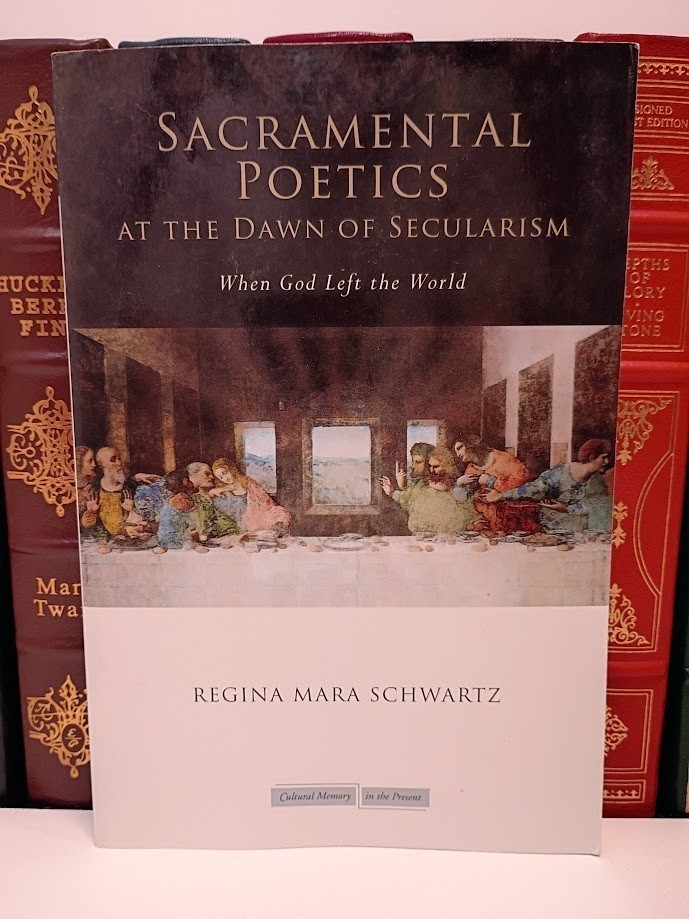
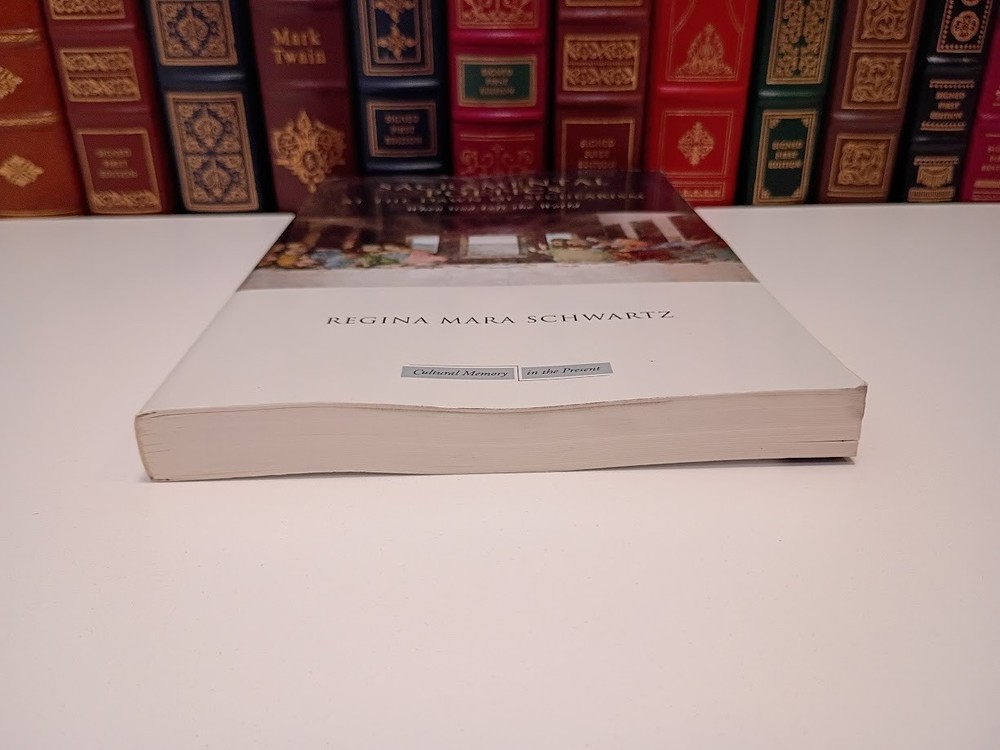
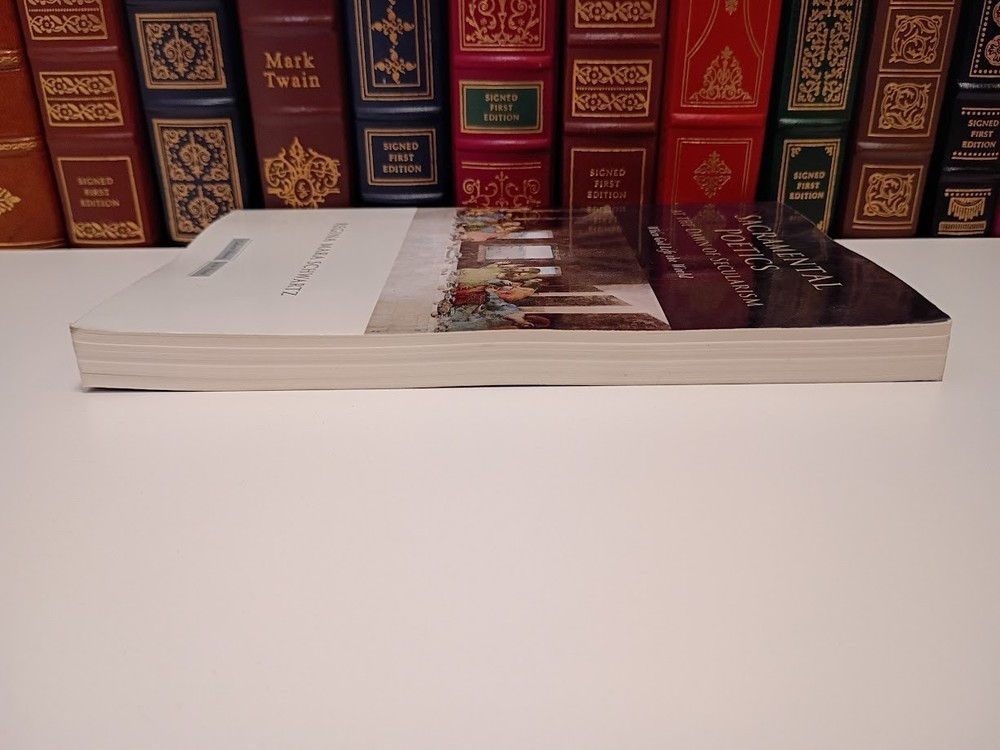
Sacramental Poetics at the Dawn of Secularism : When God Left the World - VG
$ 8.4
Description
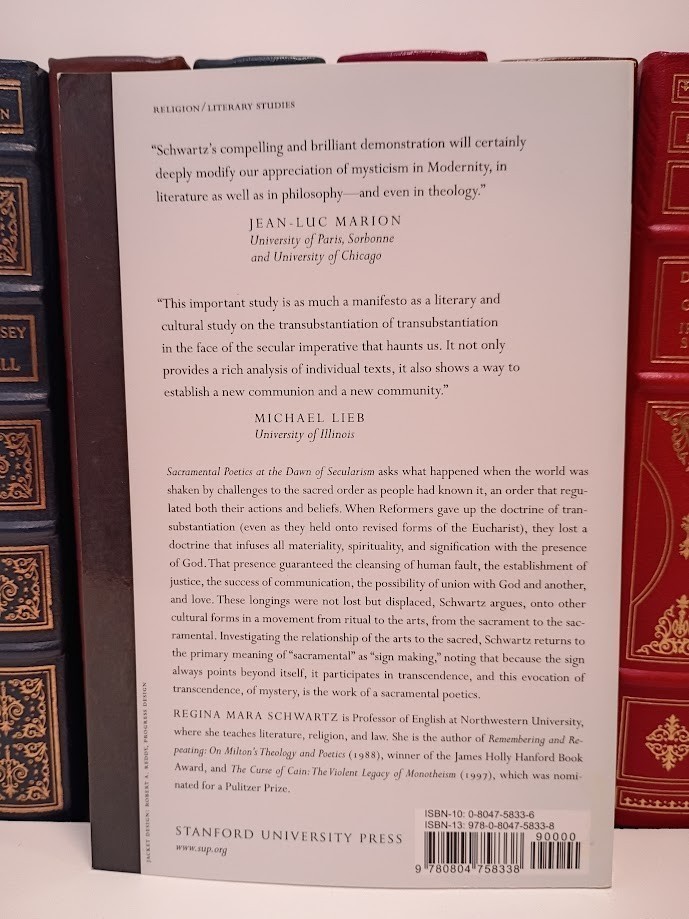
Sacramental Poetics at the Dawn of Secularism : When God Left the World - VG. Joseph Sterrett ― Cardiff University, Early Modern Literary Studies. POESIA MYSTICA...1. Mystical and Political Bodies...18II. (See Photos) Has the previous owners name written on the first page, but there are no other markings in the book. The cover has some minor shelf wear. The binding is tight. The pages are clean and crisp. Will be shipped carefully and quickly the same or next business day. "Schwartz offers us a rich feast of ideas and enables us to participate in a vital conversation; I have thoroughly enjoyed consuming what she has to say, and I urge others to take the opportunity to do likewise." -- Mark Knight ― Christianity and Literature "Unfailingly readable, clear and precise, Sacramental Poetics is one of the most important studies of our critical moment, allowing us to move beyond readings of early modern ritual and theatre as merely the emptied-out forms of an earlier age. Schwartz's book is an excavation of 'Cultural Memory' that not only recovers a lingering sense of loss, but also an imaginative reconfiguration in an effort to find a just and meaningful world." -- Joseph Sterrett ― Cardiff University, Early Modern Literary Studies " Sacramental Poetics is a significant contribution not only to sacramental theology, liturgical history and literary studies . . . but also stands as a fine example of interdisciplinary scholarship." -- Barnnon Hancock ― Reviews in Religion and Theology "Schwartz's compelling and brilliant demonstration will certainly deeply modify our appreciation of mysticism in Modernity, in literature as well as in philosophy―and even in theology." -- Jean-Luc Marion, University of Paris ― Sorbonne and University of Chicago "This important study is as much a manifesto as a literary and cultural study on the transubstantiation of transubstantiation in the face of the secular imperative that haunts us. It not only provides a rich analysis of individual texts, it also shows a way to establish a new communion and a new community." -- Michael Lieb ― University of Illinois "Written without technical jargon, this study will be an important resource not only for the students of Shakespeare, Milton, Donne, and George Herbert, but also for those interested in philosophy, theology, political theory, and the modern cultural heritage of the West." -- CHOICE "Many others have studied this movement from ritual to the arts, from the sacrament to the sacramental, but rarely with the literary sensitivity shown here." -- The Times Literary Supplement About the Author Regina Mara Schwartz is Professor of English at Northwestern University, where she teaches literature, religion, and law. She is the author of Remembering and Repeating: On Milton's Theology and Poetics (1988), winner of the James Holly Hanford Book Award, and The Curse of Cain: The Violent Legacy of Monotheism (1997), which was nominated for a Pulitzer. Excerpt. © Reprinted by permission. All rights reserved. SACRAMENTAL POETICS AT THE DAWN OF SECULARISM When God Left the World By Regina Mara Schwartz Stanford University Press Copyright © 2008 Board of Trustees of the Leland Stanford Junior UniversityAll rights reserved.ISBN: 978-0-8047-5833-8 Contents Preface....................................................................xiAcknowledgments............................................................xvI. POESIA MYSTICA..........................................................1. Sacramental Poetics.....................................................32. Mystical and Political Bodies...........................................18II. JUSTITIA MYSTICA.......................................................3. Shakespeare's Tragic Mass: Craving Justice..............................394. Milton's Cosmic Body: Doing Justice.....................................59III. AMOR MYSTICUS.........................................................5. Donne in Love: Communion of the Flesh...................................876. Herbert's Praise: Communion in Conversation.............................17Afterword..................................................................139Notes......................................................................145Index......................................................................179 CHAPTER 1 Sacramental Poetics The Oracles are dumb,No voice or hideous humRuns through the arched roof in words deceiving. Apollo from his shrineCan no more divine,With hollow shriek the steep of Delphos leaving.No nightly trance, or breathed spell,Inspires the pale-ey'd Priest from the prophetic cell.The lonely mountains o're,And the resounding shore,A voice of weeping heard, and loud lament;From haunted spring and daleEdg'd with poplar pale,The parting Genius is with sighing sent,With flow'r-inwov'n tresses tornThe Nymphs in twilight shade of tangled thickets mourn. —John Milton, "On the Morning of Christ's Nativity," 173–88 "Man is unavoidably a sacramentalist and his works are sacramental incharacter," writes the poet David Jones. My effort to draw attention to asacramental poetics is heir to a long discourse that links Ars to Sacre , both beforeand after the Christian Church Fathers explored the connection of artand the sacred. The explicit debts of literature to religion are immense: frommedieval Corpus Christi plays to Victorian devotional poetry, from Renaissancecantos to Romantic symbolism, from Donne's sonnets to Eliot's quartets.The relation is multifaceted: the poet as inspired prophet, the poet as acreator in the image of the Creator, words as grounded in the Word, inspirationas divine prompting, language as liturgical, drama as ritual, poetry ashymn. And despite recent trends in more scientifically oriented criticism—involvingquestions of textual production and dissemination—a theologicaland philosophical study of literature continues unabated. Nonetheless, we should still heed Jones's warning: "The terms 'sacrament'and 'sacramental' are apt to give off overtones and undertones that fora number of disparate reasons have a kind of narrowing effect. Thus, forChristians and especially for the Catholic Christian, those terms carry a specializedmeaning and a special aura surrounds them. On the other hand, forsecularized man in general, and especially for post-Christians or anti-Christianssuch terms are suspect or uncongenial. So that in various opposingways the wide significance and primary meaning is obscured." This "primarymeaning," Jones suggests simply, is sign-making. Mankind has, "forabout fifty millenn[ia] ... made works, handled material, in a fashion thatcan only be described as having the nature of a sign. We have ample archeologicalevidence to show us that paleolithic man was a sacramental animal,... this creature juxtaposed marks on surfaces [that] had not merely utile,but significant, intent; that is to say a 're-presenting,' a 'showing again underother forms,' an 'effective recalling' of something [that] was intended." The human urge to make signs is not at all restricted to the rituals ofthe Church, of any church. Not only are the arts characterized by the activityof sign-making; "ultimately, the very work of the sign implies the sacred."Somehow, a sign seems to inevitably evoke the sacred. But how?First, because it works by evoking something beyond itself, something thattranscends the sign. Insofar as it evokes something beyond, the sign participatesin transcendence, and transcendence—whether vertical or horizontal,above or beyond our comprehension, control, and use—is the realm of mystery.We can point to it, sign it, and by doing so evoke it, and sometimeseven more, manifest it. As Jacques Maritain summarized, for the scholasticphilosophers, "sign is that which renders present to knowledge somethingother than itself." Signum est id quod repræsentant aliud a se potentiæcognoscenti. A sign manifests . And as Augustine says simply, "Signs, whenthey pertain to divine things, are called sacraments." Even for Aristotle, ametaphor is not simply ornate language; it bears truth, like riddles thatcommunicate a truth almost incommunicable to human minds. Like signification, the riddle of transubstantiation, for Leibniz, resistssolution, on the one hand, and complete obscurity, on the other. " By virtueof being a metaphor it testifies to something other than the rational order ofthings" but in a manner that appears intelligible. Riddles, like that of transubstantiation,issue from the "voice of prophets, monsters, messengers andthe gods at the pivotal moments of destiny for many reasons, but chiefamong these is the vast discontinuity between human and divine experience.Charged on several occasions with speaking the 'unspeakable,' is itany wonder Tiresias sometimes resorts to what sound like riddles? Thewonder is that he can speak at all." Mystery is not hopelessly lost to us; itis manifest by virtue of an utterance that says more than it can say. When Samuel Johnson draws a distinction between didactic poetryand devotional poetry, he affirms the didactic, for it concerns the works ofGod rather than God Himself. Devotional poetry, on the other hand,faces two difficulties: the first is that while religion is truth, art is necessarilyfictional; the second is that when devotion is honest, the poetry that resultsis poor: "poetical devotion cannot often please.... Contemplativepiety, or the intercourse between God and the human soul, cannot be poetical"for "to ask for mercy from the Creator is a higher state than poetrycan confer." But both his conception of what religious devotion is and hisunderstanding of what counts as excellent poetry, indeed, as poetry itself,inform this judgment. Poetry pleases by exhibiting an idea more grateful to the mind than things themselvesafford. This effect proceeds from the display of those parts of nature whichattract, and the concealment of those which repel the imagination: but religionmust be shewn as it is; suppression and addition equally corrupt it; and such asit is, it is known already. From poetry the reader justly expects, and from goodpoetry always obtains, the enlargement of his comprehension and elevation of hisfancy; but ... Omnipotence cannot be exalted; Infinity cannot be amplified; Perfectioncannot be improved. As if he were addressing Johnson before his time, Herbert takes upthe very problem that preoccupies him here: the incommensurability ofverse to its sacred subject. Herbert, the poet who wrote in "Jordan (I),""Who sayes that fictions only and false hair /Become a verse? Is there intruth no beautie?" would surely agree with Johnson that theology is "toosacred for fiction, and too majestick for ornament." And yet Herbert findsa way—a compelling way—to write indisputably devotional verse. In hislyric, "A True Hymn," he concludes that "although the verse be somewhatscant, / God doth supplie the want." And then, in its final lines, the speakerexpresses his lack: " O, could I love! and stops: God writeth, Loved ."Herbert never makes the claim that his verse is adequate to his subject,that he can describe God; to the contrary, he writes verse about that inadequation.The true poem is only manifest in the last word, one written byGod, if in the poet's hand: " Loved ." Herbert's poetry does not try to offera mental or sensory picture of the miracle of divine love; it does not try tocontain its subject. Rather it somehow depicts a miracle that language canonly point toward. The art of language is to point beyond itself, swelling toward significancebeyond what is strictly signified. Maritain noted the important distinctionbetween the making of art and the contemplation of metaphysics:"the more-real-than-reality," which both seek, "metaphysics must attain inthe nature of things, while it suffices to poetry to touch it in any signwhatsoever." With its evocation of images and sounds, indeed, an entiresensory reservoir, poetry is especially suited to the surplus of meaning.And because drama, opera, and ritual call upon multiple senses, they havea similar evocative power. Sometimes this surplus is so great that a kind ofsensory exhilaration or confusion sets in: we seem to taste what we feel, tohear what we see. At the Eucharist, does the believer see God in the wine,taste him in the wafer, smell him in the incense, hear him in the hymns, oris God made present by means of all of these and more than all of these?Unsurprisingly, the blurring of sensory distinctions, synaesthesia, marksthe "spiritual senses" for apprehending God in the mystical tradition. Mining a sensory reservoir is also a hallmark of sacramental poetry—apoetry that is sacramental, not because it is an object of worship (an idol,an artifact), not because it is believed to be a sacred leftover of a divine presence(a relic), but sacramental in that it does not contain what it expresses;rather, it expresses far more than it contains. Sacramental poetry points to ameaning greater than and beyond itself. Valéry has written about poetry inways that sound remarkably like a description of liturgy: "All at once thistext is no longer one of those intended to teach us something and to vanishas soon as that something is understood; its effect is to make us live a differentlife, breathe according to this second life; and it implies a state or aworld in which the objects and beings found there, or rather their images,have other freedoms and other ties than those in the practical world.... allthis gives us the idea of an enchanted nature, subjected as by a spell to thewhims, the magic, and the powers of language." A sacramental poetry is apoetry that signifies more than it says, that creates more than its signs, yetdoes so, like liturgy, through image, sound, and time, in language that takesthe hearer beyond each of those elements. Beyond sign-making, there is another component of sacramentality:efficacy. The catechism of the Council of Trent addresses this aspectclearly: "A sacrament is a thing subjected to the senses, which has the powernot only of signifying but also of effecting grace." Rites make something happen . While many arguments took place about what made sacramentseffective—the agency of Christ, the faith of the believer, the signs themselves,signs empowered by Christ—the question of the efficacy of thesacraments and was never in doubt. They confer grace and create a world.And although philosophers and poets have debated the nature of the efficacyof art—its source located in inspiration, in the artist, or adhering inthe work itself—they also agree on the fundamental efficacy of art: tomanifest a world . This is the basis of the otherwise audacious comparisonof the artist to the Creator as well as the metaphor of the Creator assupreme Artist. In the Augustinian tradition as it is elaborated by Eriugenaand Bonaventure, the human artist imitates the supreme Artist, God.Here, art is not in the thing or in the work of making it; it "dwells beyondthe life and presence of the artist himself," in divine art. A sacramentalpoetics is not any sign-making, then, for it entails a radical understandingof signifying, one that points beyond the life and presence of theartist, to manifest a new world; in Valéry's phrase, "a second life." A sacramentalpoetics, hence, is not afflicted by embarrassment at the poverty ofsigns, at the inept ways in which language falls short of conveying the sacred.In it, signs are empowered to be effective—if not to confer grace, then tochange their hearer; if not to grant him eternity, then to manifest a world. To further illuminate this sacramental poetics, it is helpful to turn tothe quintessential sacrament in Christianity, the Eucharist, and to chart itsmovement from ritual to poetry. Obviously, by "movement," we do notmean that the Eucharist has left the Church; it certainly has not. But astriking and in many ways counter-intuitive phenomenon took place duringthe Reformation when the doctrine of transubstantiation was rejectedby many Reformers. Aspects of the Eucharist began showing up in thepoetry of the Reformation, albeit in completely unorthodox ways. Theworld manifest by the ritual was now manifest in poetry: a universe infusedwith divinity, a dialogue between God and man, physical union, arealm of justice. Sacramental poetics does not begin with these early modernpoets, and while they were often preoccupied with the Eucharist, thisis not what makes their poetry sacramental, for this is not a poetics oftheme. Rather, the Eucharist is a limited case that we can pursue here, tointerrogate why and how the impulse that informs the ritual could governthe poetry, how the spiritual cravings for communion with divinity addressedso fully by the Eucharist could also be addressed in poetry. Assign-making characterizes the sacrament of the Eucharist, it also does poetry,which is similarly engaged in making present what is absent—notjust in select figures of speech, like prosopopoeia, but in the very poeticenterprise. In this case, sign-making assumes a special form: in the Incarnation,the sign is identical to its referent. "The union of God and man ina single person is the union of divine art and one of its works in a singlebeing.... God can make a masterpiece by uniting himself to his work."In Christ the work of art is also the Artist. And this identity can enable usto venture further in our understanding of a sacramental poetics—as onein which the artist becomes indistinguishable from his art. The expressionand the subject that produce it are joined inseparably: in a deep sense, wesee the artist in his work. Conversely, a sacramental understanding of participationenfolds the reader or viewer into this process. Entering the worldof the poem, he participates in its discoveries, seeing what it sees, hearingwhat it says, feeling what it feels. No mere spectator of the work, theviewer is changed during his encounter with it, rendering a sacramentalpoetics effective. The Eucharist As the central religious controversy of the Reformation, the Eucharistwas a lightning rod, a focus where tremendous energy gathered, orbetter, a lightning bolt—for it jolted sensibilities into a new world order.Over the question of the Mass, heads rolled and ink spilled; religious institutionsconvulsed at the birth of new theologies and rituals and thedefamation and reformation of old ones. Debates about the Eucharistbecame the occasion for the worldview we regard as "modern" to begin tobe articulated. When the dust settled after the Reformers had redefined theEucharist, understandings of the material and immaterial, the visible and invisible,immanence and transcendence were revised. Theology, metaphysics,aesthetics, and politics were re-imagined. This fledgling modernism sweptinto its purview a vast array of concerns and disciplines—from the linguisticto the political, from the anthropological to the cosmological, fromthe private sanctuary of belief to the public forum of state ceremony. Inthe course of questioning the Eucharist, justice and sacrifice, cosmos andcreation, community and love, language and image were all implicated.These in no way exhaust the enormous theological implications of the Eucharist,but they do allow us to witness how questions so urgent for theologybecome the domain of secular thought as the ethical, the ontological,the erotic and the symbolic. That is why the Eucharist is a rich site forinvestigation about the infusion of sacramentality into the secular world. Until the Reformation, the Eucharist was largely understood as theoffering of the sacramental body of Christ. While that sacrifice was madehistorically on the cross, with his gift of the Eucharist, Christ enabled therest of humanity to share in his sacrifice—in the sacramental offering ofhis body and blood. The Eucharist offered the communicant participationin the sacrifice of Christ, with all its benefits, as surely as God entered historyand became man in the Incarnation. The organic image of the bodywas especially suited to accommodating both social differentiation (theparts of the body) and social cohesion (the one body). The image of thebody also suggested an intimacy lost in later Newtonian mechanistic metaphors:not only the social body but also each believer was changed decisivelyby partaking of the host. His sinful body formerly devoted to death was now cleansed for eternallife. He was no longer an exile from God, for he could enjoy a share ofhis divinity. He was no longer in exile from the created world, for he wasnow materially joined to it through the body of God. His fallen languagedid not inevitably fail, dooming him to misunderstanding and missedcommunication, for now, the words of institution— hoc est enim corpusmeum —broke through the tragedy of fallen signification. With justice restored,our social bond embodied, our dead flesh made to live, and ourparticipation in divine love assured, the Eucharist brought salvation into afallen world, restoring paradisal harmony. In the Mass the redemption of the world, wrought on Good Friday for once andfor all, was renewed and made fruitful for all who believed. Christ himself, immolatedon the altar of the cross, became present on the altar of the parishchurch, body, soul, and divinity, and his blood flowed once again, to nourishand renew Church and world. As kneeling congregations raised their eyes to seethe Host held high above the priest's head at the sacring, they were transportedto Calvary itself, and gathered not only into the passion and resurrection ofChrist, but into the full sweep of salvation history as a whole.... The sacrifice ofthe Mass was the act by which the world was renewed and the Church wasconstituted, the Body on the corporas the emblem and the instrument of all trulyhuman embodiment, whether it was understood as individual wholeness or asrightly ordered human community. (Continues...) Excerpted from SACRAMENTAL POETICS AT THE DAWN OF SECULARISM by Regina Mara Schwartz >>Powered by WonderLister App