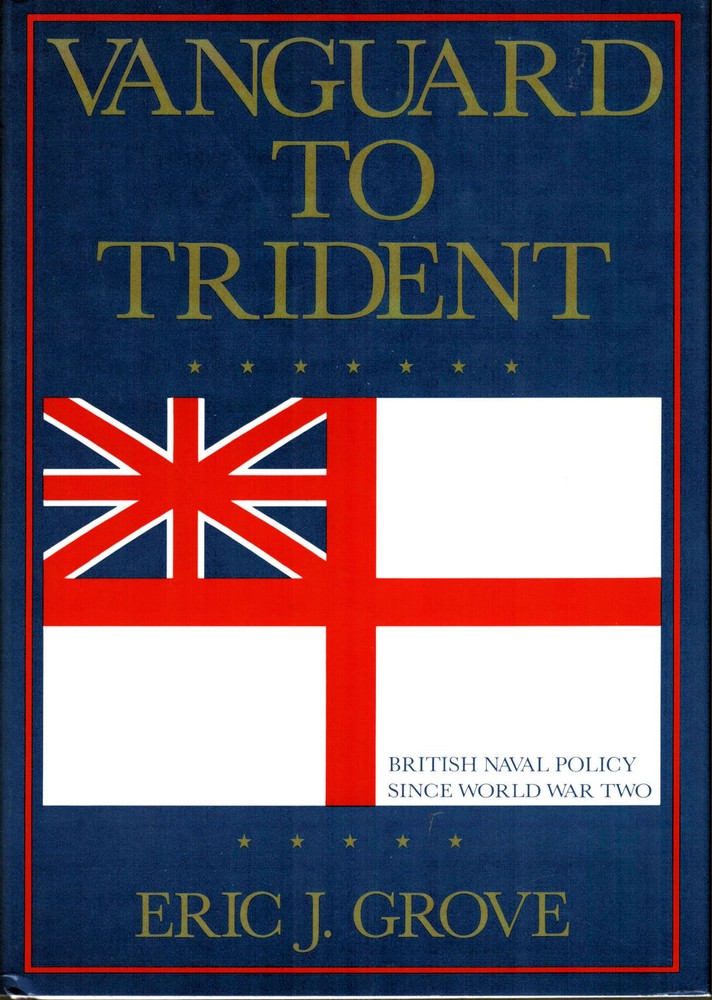
Vanguard To Trident Hbdj Royal Navy Taiwan Egypt Suez Falklands Polaris Eastlant
$ 5.26
Description
VANGUARD TO TRIDENT HBDJ ROYAL NAVY TAIWAN EGYPT SUEZ FALKLANDS POLARIS EASTLANT. In reviewing the operations of the Royal Navy since 1945, this book sheds new light on the Yangtze incident and British thoughts on military action against the Nationalist Chinese in China's civil war. Payment | Shipping VANGUARD TO TRIDENT HBDJ ROYAL NAVY TAIWAN EGYPT SUEZ FALKLANDS POLARIS EASTLANT VANGUARD TO TRIDENT HBDJ ROYAL NAVY TAIWAN EGYPT SUEZ FALKLANDS POLARIS EASTLANT NATO HARDBOUND BOOK WITH DUSTJACKET BY ERIC J. GROVE; PUBLISHER: NAVAL INSTITUTE PRESS, ANNAPOLIS, MD; 1987 PRINTING; 487 PAGES. **LIKE NEW CONDITION** BRITISH NAVAL POLICY SINCE WORLD WAR II -------------------------------------------------------------------------------- This ground-breaking new work represents the first serious attempt to analyze the influence of British politics and economics on the evolution of postwar naval policy in Great Britain. Thorough and well-documented, this study clearly demonstrates how cabinet-level decisions have shaped the Royal Navy, its size, capabilities, and activities. The author, Eric Grove, who taught strategic studies at the Royal Naval College in Dartmouth, England, for a decade, draws on recently released archival documents to detail the British government's attempts to come to terms with the financial realities of an austere postwar world in planning a future fleet. Described here for the first time, for example, is the Churchill government's highly secretive process of defense review and strategic revision, after acknowledgment that the country's defense effort had to be cut back despite growing confrontation with the Soviet Union. In reviewing the operations of the Royal Navy since 1945, this book sheds new light on the Yangtze incident and British thoughts on military action against the Nationalist Chinese in China's civil war. It describes plans for military intervention in Egypt in the early 1950s as well as British naval activities in the Korean War. In addition, it reveals little-known events in the Falklands some thirty years ago that presaged more recent actions there. Grove also examines the way the Royal Navy used the Suez crisis to challenge the Duncan Sandys defense review of 1957-58 and the defense reviews of the Wilson government in the 1960s, taking a fresh look at the controversy that led to the abandonment of the aircraft carrier program. His analysis of the factors that shaped the navy of the 1970s leads to an astute discussion of the John Nott defense review of 1981 and a full account of the Falklands War. The book concludes with a valuable assessment of British naval policy today, which Grove argues is at a major crossroad. Among the many illustrations that accompany the text are some fascinating drawings, reproduced here for the first time, of projected warships that never proceeded beyond the design stage. --------------------------------------------------------------------------------------------- Additional Information from Internet Encyclopedia After the Second World War, the decline of the British Empire and the economic hardships in Britain forced the reduction in the size and capability of the Royal Navy. All of the pre-war ships (except for the Town-class light cruisers) were quickly retired and most sold for scrapping over the years 1945–1948, and only the best condition ships (the four surviving King George V-class battleships, carriers, cruisers, and some destroyers) were retained and refitted for service. The increasingly powerful United States Navy took on the former role of the Royal Navy as global naval power and police force of the sea. The combination of the threat of the Soviet Union, and Britain's commitments throughout the world, created a new role for the Navy. Governments since the Second World War have had to balance commitments with increasing budgetary pressures, partly due to the increasing cost of weapons systems, what historian Paul Kennedy called the Upward Spiral. These pressures were exacerbated by bitter inter-service rivalry. A modest new construction programme was initiated with some new carriers (Majestic- and Centaur-class light carriers, and Audacious-class large carriers, such as HMS Ark Royal, being completed between 1948 through 1958), along with three Tiger-class cruisers (completed 1959–1961), the Daring-class destroyers in the 1950s, and finally the County-class guided missile destroyers completed in the 1960s. HMS Dreadnought, the Royal Navy's first nuclear submarine, was launched in the 1960s. The navy also received its first nuclear weapons with the introduction of the first of the Resolution-class submarines armed with the Polaris missile. The introduction of Polaris followed the cancellation of the GAM-87 Skybolt missile which had been proposed for use by the Air Force's V bomber force. By the 1990s, the navy became responsible for the maintenance of the UK's entire nuclear arsenal. The financial costs attached to nuclear deterrence became an increasingly significant issue for the navy. The Navy began plans to replace its fleet of aircraft carriers in the mid-1960s. A plan was drawn up for three large aircraft carriers, each displacing about 60,000 tons; the plan was designated CVA-01. These carriers would be able to operate the latest aircraft coming into service and keep the Royal Navy's place as a major naval power. The new Labour government that came to power in 1964 was determined to cut defence expenditure as a means to reduce public spending, and in the 1966 Defence White Paper the project was cancelled.[132] The existing carriers (all built during, or just after World War II) were refitted, two (Bulwark and Albion) becoming commando carriers, and four (Victorious, Eagle, and Ark Royal) being completed or rebuilt. Starting in 1965 with Centaur, one by one these carriers were decommissioned without replacement, culminating with the 1979 retirement of Ark Royal. By the early 1980s, only Hermes survived and received a refit (just in time for the Falklands War), to operate Sea Harriers. She operated along with three much smaller Invincible-class aircraft carriers, and the fleet was now centred around anti-submarine warfare in the north Atlantic as opposed to its former position with worldwide strike capability. Along with the war era carriers, all of the war built cruisers and destroyers, along with the post-war built Tiger-class cruisers and large County-class guided missile destroyers were either retired or sold by 1984. The Royal Navy was involved in three major confrontations with the Icelandic Coast Guard from 1958 to 1976. These largely bloodless incidents became known as the Cod Wars.[134] One of the most important operations conducted predominantly by the Royal Navy after the Second World War was the 1982 defeat of Argentina in the Falkland Islands War. Despite losing four naval ships and other civilian and RFA ships, the Royal Navy fought and won a war over 8,000 miles (12,000 km) from Great Britain. HMS Conqueror is the only nuclear-powered submarine to have engaged an enemy ship with torpedoes, sinking the cruiser ARA General Belgrano. Before the Falklands War, Defence Secretary John Nott had advocated and initiated a series of cutbacks to the Navy. The Falklands War though, provided a reprieve in Nott-proposed cutbacks, and proved a need for the Royal Navy to regain an expeditionary and littoral capability which, with its resources and structure at the time, would prove difficult. At the beginning of the 1980s, the Royal Navy was a force focused on blue-water anti-submarine warfare. Its purpose was to search for and destroy Soviet submarines in the North Atlantic, and to operate the nuclear deterrent submarine force. For a time Hermes was retained, along with all three of the Invincible-class light aircraft carriers. More Sea Harriers were ordered; not just to replace losses, but to also increase the size of the Fleet Air Arm. New and more capable ships were built; notably the Sheffield-class destroyers, the Type 21, Type 22, and Type 23 frigates, new LPDs of the Albion class, and HMS Ocean, but never in the numbers of the ships that they replaced. As a result, the Royal Navy surface fleet continues to reduce in size. A 2013 report found that the current RN was already too small, and that Britain would have to depend on her allies if her territories were attacked. The Royal Navy also took part in the Gulf War, the Kosovo conflict, the Afghanistan Campaign, and the 2003 invasion of Iraq, the last of which saw RN warships bombard positions in support of the Al Faw Peninsula landings by Royal Marines. In August 2005, the Royal Navy rescued seven Russians stranded in a submarine off the Kamchatka peninsula. The Navy's Scorpio 45 remote-controlled mini-sub freed the Russian submarine from the fishing nets and cables that had held it for three days. The Royal Navy was also involved in an incident involving Somali pirates in November 2008, after the pirates tried to capture a civilian vessel. The global economic recession of 2008 had a significant impact on the Royal Navy resulting in the Strategic Defence and Security Review 2010 which made sweeping cuts to the Navy's budget. The Harrier aircraft were retired with some being presented to museums and the rest being sold to the United States for spare parts to keep their aircraft flying. The carrier Ark Royal and the remaining Type 22 frigates were all removed from service and sold for scrap. HMS Illustrious however, was retained through to 2014 in the LPH role, until Ocean completed her refit. Plans were made to allow Illustrious to be retained as a floating museum, but by summer of 2016 she too was sold for scrap.[139] The future of Albion and Bulwark is uncertain as funds may not be available to allow them to remain in service.[140] The Royal Navy was to receive 12 Type 45 destroyers as a replacement for the older Type 42 class that was completely retired by 2013. The number was later reduced to 6 vessels, all in service by 2012. In 2015, the Royal Navy was deployed to the Mediterranean in the mission to rescue migrants crossing the Mediterranean from Libya to Italy.[142] By spring 2018, the Royal Navy had decommissioned HMS Ocean, as well as started the replacement of the River-class offshore patrol vessels. The first of the new Queen Elizabeth-class aircraft carriers was undergoing tests and workups before her first fixed-wing aircraft arrive later in the year, and design work was underway for the new generation of nuclear deterrent submarines.[143] By July 2017 the first of 8 new frigates was laid down, the Type 26 frigate.[144] There are also plans to build up to 10 Global Combat Ships to replace some of the older frigates in the fleet. Payment Back to Top I accept the following forms of payment: PayPal Shipping & Handling Back to Top US Shipping (FREE) USPS Media Mail® International Shipping Please check eBay's Shipping & Payment tab USPS First-Class Mail International (Worldwide) FREE scheduling, supersized images and templates. Get Vendio Sales Manager. Make your listings stand out with FREE Vendio custom templates! FREE scheduling, supersized images and templates. Get Vendio Sales Manager. Over 100,000,000 served. Get FREE counters from Vendio today!