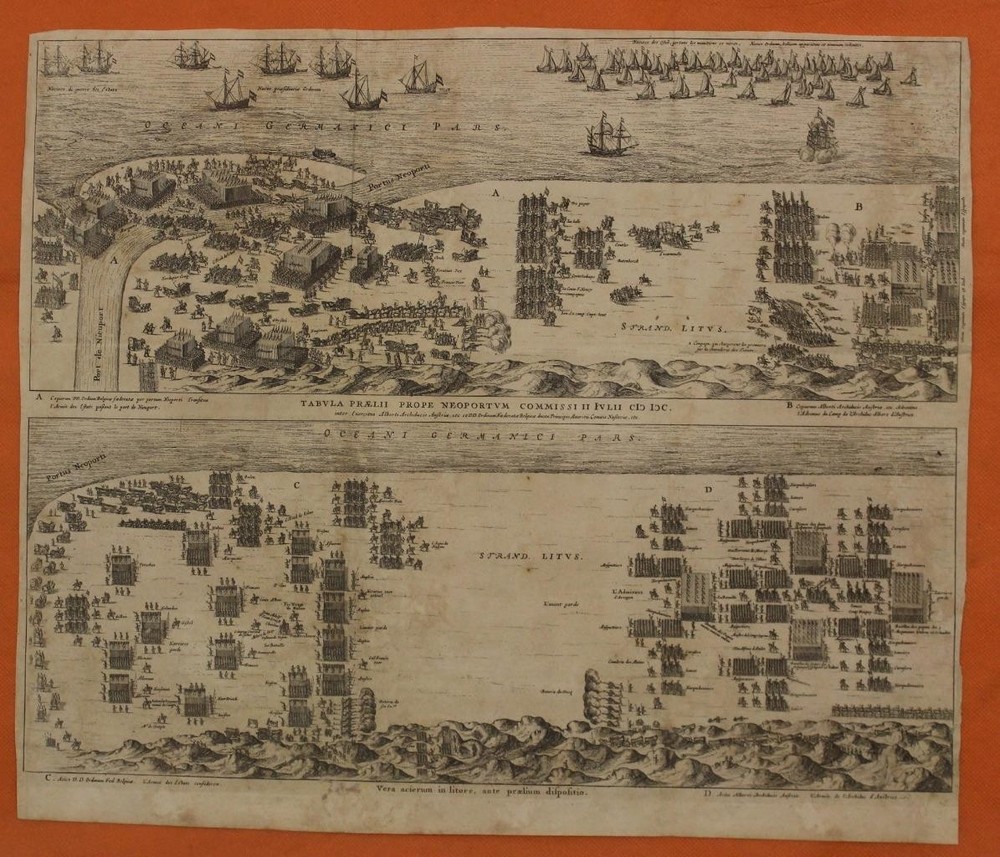
Battle Of Nieuwpoort Belgium 1690 Leti Unusual Antique Copper Engraved City MapANTIQUE COPPER ENGRAVED MAP OF BATTLE OF NIEUWPOORT
$ 10.56
Description
BATTLE OF NIEUWPOORT BELGIUM 1690 LETI UNUSUAL ANTIQUE COPPER ENGRAVED CITY MAP. Striking and highly detailed fine unusual 1690 Gregorio Leti's copper engraved map of the battle of Nieuwpoort, Belgium, in t wo images above each other. Above, the Dutch army crossing the port of Nieuwpoort. BATTLE OF NIEUWPOORT BELGIUM 1690 LETI UNUSUAL ANTIQUE COPPER ENGRAVED CITY MAP BATTLE OF NIEUWPOORT BELGIUM 1690 LETI UNUSUAL ANTIQUE COPPER ENGRAVED CITY MAP Description Tabvla Prælii prope Neoportvm commissi II Ivlii MDC interExercitus Alberti Archiducatus Austriæ, etc. et DD. Ordinum Fœderatæ Belgicæ ductu Principis Mauritii Comitis Mestriæ. etc. Description: Striking and highly detailed fine unusual 1690 Gregorio Leti's copper engraved map of the battle of Nieuwpoort, Belgium, in t wo images above each other. Above, the Dutch army crossing the port of Nieuwpoort. Below, the two armies opposite each other. Left the Dutch army under Maurice of Nassau and right the Spanish army under Albert of Austria, clearly showing the formation of the battalions. The Battle of Nieuwpoort (also known as the Battle of the Dunes) was fought on 2 July 1600 during the Eighty Years War and the Anglo-Spanish war in the dunes near Nieuwpoort. A Dutch army met a Spanish force head-on which, although their left flank nearly broke, were able to assail them with both infantry and cavalry. The Spanish gradually scattered in all directions and left their guns on the field . Source: Gregorio Leti. Teatro Belgico, o vero Ritratti historici, cronologici, politici e geografici, delle sette Provincie Unite. Amsterdam: Willem de Jonge, 1690. Date: 1690 ( undated ) Dimension: Paper size approx.: cm 51,4 x 43,7 Condition: Very strong and dark impression on good paper. Paper with chains and wiremarks. Map uncolored. Sheet browned. Small holes repaired on the verso. Map folded. Conditions are as you can see in the images. Mapmaker: Gregorio Leti (29 May 1630 – 9 June 1701) was an Italian historian and satirist from Milan, who sometimes published under the pseudonym Abbe Gualdi, L'abbé Gualdi, or Gualdus known for his works about the Catholic Church, especially the papacy. All of his publications were listed on the Index Librorum Prohibitorum. Certain information about the family stops with the paternal grandfather, Marco, who was in the service of Cardinal Ippolito Aldobrandini for two years, then a judge in Ancona; married to Laura Pizzi, he had two children, Agostino Francesco Nicola and Girolamo. The second son undertook a military career employed by the Medici and, in 1628, was sent by the Grand Duke of Tuscany, as infantry captain, to Milan to help the Spanish; here he met and married the noble Isabella. From the union was born a daughter, Caterina (married to Cesare Reina, secretary of the Senate of Milan and died early) and a son, Leti. In 1632 L. followed his parents to Calabria, to Amantea, where Girolamo had assumed the role of garrison commander. In 1639, following the death of his father, who in the meantime had moved to Salerno for another job, L. was entrusted by his mother to the Jesuits of the college of Cosenza, where he remained forcibly until 1644, when he decided to accept the invitation of uncle Agostino, joining him in Rome. The latter attempted in vain to direct him to legal studies and then to priestly life, subjecting the young man's intolerant soul to such pressure as to induce him to leave to reunite with his mother in Milan, where he remained until her death, which occurred at the end of 1646. Orphaned, he was forced to return to his uncle, now vicar in Orvieto, and to accept his guardianship, adapting to the severe discipline imparted to him by the tutor Don Agostino Cauli, in charge of his education. The stay, endured reluctantly, lasted until 1654, although interrupted by numerous moves: to Naples in 1647, to Milan, with his maternal relatives, from 1650 to 1652, and to Rome, where he established contacts with the Academy of Humorists. In 1654 it was finally Agostino himself, seeing his plans failing, who decided to hand over the administration of his assets to his nephew, leaving him free to travel. He was in all probability back in Rome in December 1655 if, as he himself claimed in The Cardinalism of the Holy Church (Amsterdam 1668), he witnessed the solemn entry of Queen Christina of Sweden into the city; but soon, probably due to financial difficulties, he returned to his uncle in Acquapendente, where he had become bishop on 14 June 1655. Here he formed a relationship with a girl, Antonia Ferretti, so much so that he expressed his intention to marry her to his uncle; having received a clear refusal, he dropped the intention and walked away definitively. There are various hypotheses on the activities carried out by L. in Italy; in 1670 Antonio Magliabechi reported to Cardinal Leopoldo de' Medici the belief that he had been an embroiderer and the more consolidated opinion that he was a friar, a hypothesis that had found some credence even outside Italy, if in 1697 a satirical writing by André Picquart was published entitled L'horoscope de m. G. L., moine défroqué (Amsterdam 1697) where he was accused of being an evicted Capuchin; L. denied the accusation in the preface to his Recueil de quellques lettres (s.l. [but ibid.] 1697). The date of his departure from his uncle is uncertain; in all probability it should be the autumn of 1656 and not September 1658, as appears from a letter from his uncle Agostino published by Leti. The first hypothesis is supported by the presence of L. in Alessandria, from 17 July to 19 August. 1657, and from his stay in various Italian cities before his definitive removal from the peninsula; furthermore, the numerous chronological inaccuracies present in Leti's publications do not allow the epistolary reference to be accredited. However, with certainty, after his departure L. had to travel a lot: he was in Venice, where he came into contact with the members of the Accademia degli Incogniti, in particular with Girolamo Brusoni, and stayed for a long time in Bologna. In these years, between 1653 and 1657, the first literary exercises began. It must have been, as he later recalled in the preface to The massacre of the reformed innocents (Geneva 1661), "some love story and something of poetry at the request of our Academy in Italy"; furthermore in Oliviero Cromvele's Advertimento della Vita (Amsterdam 1692) he states that he has composed operettas in Latin verse dedicated to Bolognese characters and some epithalami in Italian. Letiana's testimony alone attests to the elaboration of a scene from the comedy La favola d'Ovidio acecato by Giacinto Andrea Cicognini and the drafting of an untraceable literary divertissement, La R bandita, a speech presented at the Academy of Humorists and published in Bologna in 1653. In Bologna his youthful desire to go to Paris "to seek his fortune" was consolidated: for this purpose he obtained, thanks to his brother-in-law Cesare Reina, a letter of recommendation from Cardinal Gian Girolamo Lomellini for the Marquis François-Auguste de Valavoir, general of the French infantry in Italy and governor of Valenza Po, which L. managed to reach only after a stop forced to Alexandria, besieged by the French. Having obtained the support of the marquis, L. would have resumed his journey towards France, in the company of Mr. Saint-Lyon, a Swiss Huguenot officer in the service of Valavoir, up to Genoa, and then of the nobleman Nicola Santini from Lucca. After a short stay in Turin, the two continued their journey to Geneva, where L. decided to stop for four months, guest of Mario Miroglio, former canon of Casale Monferrato. During a brief visit to Lausanne he met the esteemed Calvinist doctor Jean-Antoine Guérin, who welcomed him into his home for three months, then married his daughter Maria, not yet eighteen, into his marriage in 1659. It was in this period that L. definitively abandoned the Catholic religion for the Calvinist one. Different hypotheses have been put forward regarding the timing and motivations of the abjuration: sometimes attributing it to mere opportunism, sometimes accepting the opinion of Jean Le Clerc, that the abandonment of Catholicism must have been anticipated at the time of adolescent readings of the works of Ferrante Pallavicino. It is probable that L. developed a certain intolerance for Catholic institutions from his youth, favored by the pedagogical rigor of his uncle Agostino and his heretical readings, but it was then his knowledge of Saint-Lyon and above all of Guérin that brought him closer to religion reformed, which he would finally definitively embrace, as F. Barcia observed, also to conclude his marriage with Maria Guérin. On the other hand, L.'s entire existence remained protected by a sort of religious indifference in the name of a freedom of thought for which "all religions are good in what concerns the foundation; but however [... they are] for all the corruptions, shortcomings and defects". In 1660 the two spouses settled in Geneva, where L., to support himself and his family, had five children, a son, who died at a young age, and four daughters, of whom the eldest married the theologian Jean in 1691. Le Clerc - took up the professions of teacher and writer. He gave paid language and history lessons to the city's nobles, winning the favor of prestigious students; at the same time, having abandoned the pleasant literature of his youth, he began to dedicate himself to the most profitable historical and eulogy publications, calibrating his compositions to the taste and favor of readers. Literary activity soon became his main occupation, so much so that in the years of his stay in Geneva (1660-79) the character L. was born and quickly established himself throughout Europe, a feared and revered author, willing to reveal, in a simple and accessible way, the background of the political and religious life of the courts . All of the maps we sell are ORIGINALS. We guarantee all of our maps to be authentic. We do our best to describe the condition of our maps as accurately as possible. Due to the age and type of paper, some imperfections are to be expected. Please examine the images provided carefully, and if you have any questions please ask and we will be happy to help. A Certification of Authenticity ( COA ) can be issued on request I will send you all your item by FedEx/DHL with covering Insurance If you buy more than one item you have to pay just one only shipping cost Any map purchased from us may be returend for any reason for a full refund. All goods destined for the United States are exempt from any taxation. About: Old Times Rare Antiquarian Books & Maps Sellers Our Firm was founded in 1983 and we are specialized on antiquarian works on paper concerning Antique Rare Maps, Atlases and Travel Books of all the World. Our Firm adheres to the Codes of Ethics outlined by the Italian Antiquarian Booksellers Association ( ALAI ) and International League of Antiquarian Booksellers ( ILAB ). All items sold by OLD TIMES are genuine and a Certificate of Authenticity (COA) will be happily supplied on request. Many Thanks View My Feedback View My Other Items For Sale View My About Me page Visit My eBay Store Add me to your Favorite Sellers Click images to enlarge Get images that make Supersized seem small. Showcase your items with Auctiva's Listing Templates! THE simple solution for eBay sellers. Track Page Views With Auctiva's Counter